



 Chat with AI
Exam 26: International Trade

Exam 1: Limits, Alternatives, and Choices107 Questions
Exam 2: The Market System and the Circular Flow287 Questions
Exam 3: Demand, Supply, and Market Equilibrium151 Questions
Exam 4: Market Failures Caused by Externalities Asymmetric Information229 Questions
Exam 5: Public Goods, Public Choice, and Government Failure268 Questions
Exam 6: Elasticity399 Questions
Exam 7: Utility Maximization358 Questions
Exam 8: Behavioral Economics311 Questions
Exam 9: Businesses and the Costs of Production445 Questions
Exam 10: Pure Competition in the Short Run342 Questions
Exam 11: Pure Competition in the Long Run250 Questions
Exam 12: Pure Monopoly407 Questions
Exam 13: Monopolistic Competition279 Questions
Exam 14: Oligopoly and Strategic Behavior362 Questions
Exam 15: Technology, RD, and Efficiency309 Questions
Exam 16: The Demand for Resources359 Questions
Exam 17: Wage Determination168 Questions
Exam 18: Rent, Interest, and Profit305 Questions
Exam 19: Natural Resource and Energy Economics337 Questions
Exam 20: Public Finance: Expenditures and Taxes336 Questions
Exam 21: Antitrust Policy and Regulation264 Questions
Exam 22: Agriculture: Economics and Policy265 Questions
Exam 23: Income Inequality, Poverty, and Discrimination324 Questions
Exam 24: Health Care280 Questions
Exam 25: Immigration259 Questions
Exam 26: International Trade347 Questions
Exam 27: The Balance of Payments, Exchange Rates, and Trade Deficits318 Questions
Exam 28: The Economics of Developing Countries277 Questions
Select questions type


When tariffs on imported products are removed by a nation, it will result in
(Multiple Choice)
4.9/5  (82)
(82) Which of the following is a valid counterargument to the call for higher tariffs to save U.S. jobs?
(Multiple Choice)
4.8/5 (79)
(79) What other economic process needs to accompany international trade, for nations to benefit from such trade?
(Multiple Choice)
4.8/5 (88)
(88) 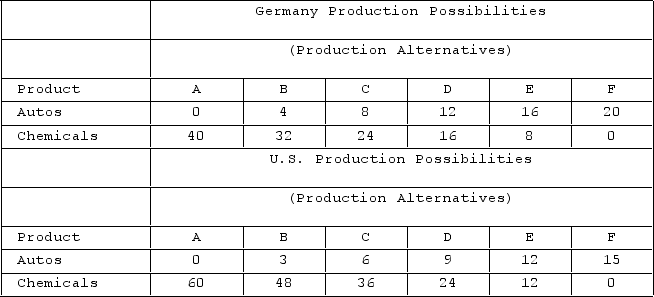 Refer to the accompanying production possibilities tables. Data are in millions of units. If Germany and the United States engage in trade, the mutually beneficial terms of trade will be between
 (Multiple Choice)
4.8/5 (78)
(78) If a nation imposes a tariff on an imported product, then the nation will experience a(n)
(Multiple Choice)
4.9/5 (73)
(73) 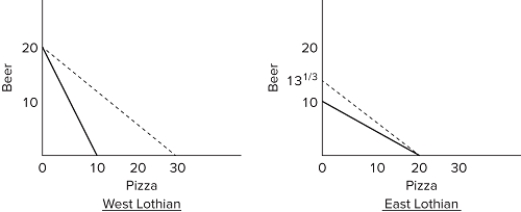 In the accompanying diagrams, solid lines are production possibilities curves, and the dashed lines are trading possibilities curves. The data suggest that
 (Multiple Choice)
4.8/5 (86)
(86) A side benefit of international trade is that it links national interests and increases the opportunity costs of war.
(True/False)
4.8/5 (77)
(77) 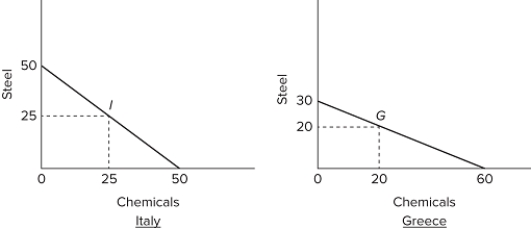 Suppose the world economy is composed of just two countries: Italy and Greece. Each can produce steel or chemicals, but at different levels of economic efficiency. The production possibilities curves for the two countries are shown in the graphs. It can be deduced that
 (Multiple Choice)
4.9/5 (83)
(83) Assume that by devoting all its resources to the production of X, nation Alpha can produce 40 units of X. By devoting all its resources to Y, Alpha can produce 60Y. Comparable figures for nation Beta are 60X and 40Y. Therefore, Alpha should specialize in Y and Beta in X.
(True/False)
4.8/5 (82)
(82) The Trade Adjustment Assistance Act of 2002 focused mainly on assisting
(Multiple Choice)
4.8/5 (77)
(77) In the theory of comparative advantage, a good should be produced in that nation where
(Multiple Choice)
4.9/5 (77)
(77) Tariffs and import quotas would benefit the following groups, except
(Multiple Choice)
4.9/5 (90)
(90) The accompanying table gives domestic supply and demand schedules for a product. Suppose that the world price of the product is $1. 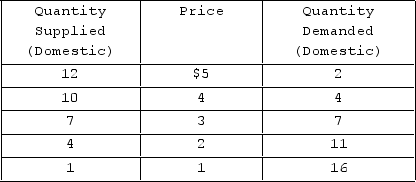 The total amount of revenue collected from a $1-per-unit tariff on this product will be
 (Multiple Choice)
4.7/5 (96)
(96) How will the difference between the world price and the domestic price of a good encourage exports and imports?
(Essay)
4.8/5 (81)
(81) 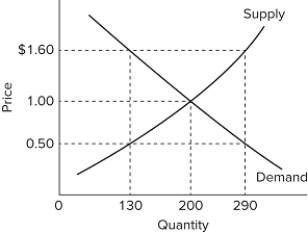 Refer to the diagram, which shows the domestic demand and supply curves for a specific standardized product in a particular nation. If the world price for this product is $0.50, this nation will experience a domestic
 (Multiple Choice)
4.8/5 (86)
(86) 
Filters
- Essay(0)
- Multiple Choice(0)
- Short Answer(0)
- True False(0)
- Matching(0)