



 Chat with AI
Exam 3: Demand, Supply, and Market Equilibrium

Exam 1: Limits, Alternatives, and Choices107 Questions
Exam 2: The Market System and the Circular Flow287 Questions
Exam 3: Demand, Supply, and Market Equilibrium151 Questions
Exam 4: Market Failures Caused by Externalities Asymmetric Information229 Questions
Exam 5: Public Goods, Public Choice, and Government Failure268 Questions
Exam 6: Elasticity399 Questions
Exam 7: Utility Maximization358 Questions
Exam 8: Behavioral Economics311 Questions
Exam 9: Businesses and the Costs of Production445 Questions
Exam 10: Pure Competition in the Short Run342 Questions
Exam 11: Pure Competition in the Long Run250 Questions
Exam 12: Pure Monopoly407 Questions
Exam 13: Monopolistic Competition279 Questions
Exam 14: Oligopoly and Strategic Behavior362 Questions
Exam 15: Technology, RD, and Efficiency309 Questions
Exam 16: The Demand for Resources359 Questions
Exam 17: Wage Determination168 Questions
Exam 18: Rent, Interest, and Profit305 Questions
Exam 19: Natural Resource and Energy Economics337 Questions
Exam 20: Public Finance: Expenditures and Taxes336 Questions
Exam 21: Antitrust Policy and Regulation264 Questions
Exam 22: Agriculture: Economics and Policy265 Questions
Exam 23: Income Inequality, Poverty, and Discrimination324 Questions
Exam 24: Health Care280 Questions
Exam 25: Immigration259 Questions
Exam 26: International Trade347 Questions
Exam 27: The Balance of Payments, Exchange Rates, and Trade Deficits318 Questions
Exam 28: The Economics of Developing Countries277 Questions
Select questions type


In the following question you are asked to determine, other things equal, the effects of a given change in a determinant of demand or supply for product X upon (1)the demand (D)for, or supply (S)of, X; (2)the equilibrium price (P)of X; and (3)the equilibrium quantity (Q)of X.A decrease in the price of a product that is a complement to X will
(Multiple Choice)
4.9/5  (68)
(68) When the price of a product increases, a consumer is able to buy less of it with a given money income. This describes the
(Multiple Choice)
4.9/5 (77)
(77) Adam Smith's "invisible hand" is now regarded as emergent equilibria as people's uncoordinated interactions are magically guided toward socially beneficial outcomes.
(True/False)
4.9/5 (81)
(81) An effective price ceiling will lower the equilibrium price and cause a surplus.
(True/False)
4.8/5 (83)
(83) If the demand for steak (a normal good)shifts to the left, the most likely reason is that
(Multiple Choice)
5.0/5 (91)
(91) Which of the following is consistent with the law of demand?
(Multiple Choice)
4.8/5 (76)
(76) Producing a good in the least costly way is known as allocative efficiency.
(True/False)
4.9/5 (81)
(81) Suppose that corn prices rise significantly. If farmers expect the price of corn to continue rising relative to other crops, then we would expect
(Multiple Choice)
4.8/5 (54)
(54) If the price of product L increases, the demand curve for close-substitute product J will
(Multiple Choice)
4.8/5 (71)
(71) If demand increases and supply simultaneously decreases, equilibrium price will rise.
(True/False)
4.8/5 (76)
(76) (Advanced analysis)The equation for the supply curve in the diagram shown is approximately 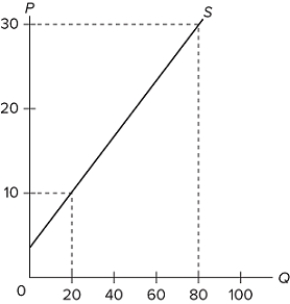
(Multiple Choice)
4.9/5 (68)
(68) Suppose product X is an input in the production of product Y. Product Y in turn is a substitute for product Z. A decrease in the price of X can be expected to
(Multiple Choice)
5.0/5 (92)
(92) If we observe the price of a good in a competitive market rising, then we can conclude that there had been a shortage in the market.
(True/False)
4.8/5 (97)
(97) In response to the general public's complaints about "price gouging" by sellers, the government could impose a price floor.
(True/False)
4.8/5 (79)
(79) Markets, viewed from the perspective of the supply and demand model,
(Multiple Choice)
4.8/5 (93)
(93) 
Filters
- Essay(0)
- Multiple Choice(0)
- Short Answer(0)
- True False(0)
- Matching(0)