



 Chat with AI
Exam 3: Demand, Supply, and Market Equilibrium

Exam 1: Limits, Alternatives, and Choices107 Questions
Exam 2: The Market System and the Circular Flow287 Questions
Exam 3: Demand, Supply, and Market Equilibrium151 Questions
Exam 4: Market Failures Caused by Externalities Asymmetric Information229 Questions
Exam 5: Public Goods, Public Choice, and Government Failure268 Questions
Exam 6: Elasticity399 Questions
Exam 7: Utility Maximization358 Questions
Exam 8: Behavioral Economics311 Questions
Exam 9: Businesses and the Costs of Production445 Questions
Exam 10: Pure Competition in the Short Run342 Questions
Exam 11: Pure Competition in the Long Run250 Questions
Exam 12: Pure Monopoly407 Questions
Exam 13: Monopolistic Competition279 Questions
Exam 14: Oligopoly and Strategic Behavior362 Questions
Exam 15: Technology, RD, and Efficiency309 Questions
Exam 16: The Demand for Resources359 Questions
Exam 17: Wage Determination168 Questions
Exam 18: Rent, Interest, and Profit305 Questions
Exam 19: Natural Resource and Energy Economics337 Questions
Exam 20: Public Finance: Expenditures and Taxes336 Questions
Exam 21: Antitrust Policy and Regulation264 Questions
Exam 22: Agriculture: Economics and Policy265 Questions
Exam 23: Income Inequality, Poverty, and Discrimination324 Questions
Exam 24: Health Care280 Questions
Exam 25: Immigration259 Questions
Exam 26: International Trade347 Questions
Exam 27: The Balance of Payments, Exchange Rates, and Trade Deficits318 Questions
Exam 28: The Economics of Developing Countries277 Questions
Select questions type


An economist for a bicycle company predicts that, other things equal, a rise in consumer incomes will increase the demand for bicycles. This prediction assumes that
(Multiple Choice)
4.8/5  (79)
(79) The law of demand states that if price increases, other things being equal, the demand for the product will decrease.
(True/False)
5.0/5 (76)
(76) What is the difference between a change in demand and a change in quantity demanded?
(Essay)
4.9/5 (86)
(86) A surplus indicates that the quantity demanded is greater than the quantity supplied at that price.
(True/False)
4.8/5 (86)
(86) When an economist says that the demand for a product has increased, this means that
(Multiple Choice)
4.7/5 (78)
(78) If the demand and supply curves for product X are stable, a government-mandated increase in the price of X will
(Multiple Choice)
4.8/5 (63)
(63) Given a downsloping demand curve and an upsloping supply curve for a product, an increase in the price of a substitute good (from the buyer's perspective)will
(Multiple Choice)
4.8/5 (64)
(64) Which of the following statements is true about price ceilings?
(Multiple Choice)
4.9/5 (80)
(80) What is productive efficiency, and how does a market achieve allocative efficiency?
(Essay)
4.7/5 (76)
(76) If the organizers of a major sports event set the ticket price above the equilibrium level, then scalping will develop in a secondary market for tickets.
(True/False)
4.7/5 (79)
(79) Answer the question based on the given supply and demand data for wheat. 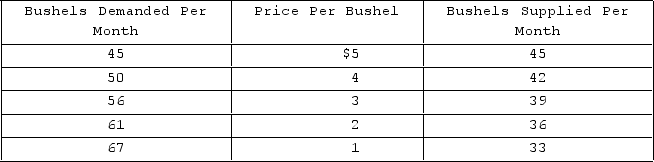 Equilibrium price in this market is
 (Multiple Choice)
4.9/5 (75)
(75) Buyers and sellers do not have to deal face-to-face with one another in markets.
(True/False)
5.0/5 (79)
(79) An increase in quantity supplied might be caused by an increase in resource costs.
(True/False)
4.7/5 (88)
(88) A price floor in a competitive market will result in persistent shortages of a product.
(True/False)
4.8/5 (90)
(90) 
Filters
- Essay(0)
- Multiple Choice(0)
- Short Answer(0)
- True False(0)
- Matching(0)