



 Chat with AI
Exam 3: Demand, Supply, and Market Equilibrium

Exam 1: Limits, Alternatives, and Choices107 Questions
Exam 2: The Market System and the Circular Flow287 Questions
Exam 3: Demand, Supply, and Market Equilibrium151 Questions
Exam 4: Market Failures Caused by Externalities Asymmetric Information229 Questions
Exam 5: Public Goods, Public Choice, and Government Failure268 Questions
Exam 6: Elasticity399 Questions
Exam 7: Utility Maximization358 Questions
Exam 8: Behavioral Economics311 Questions
Exam 9: Businesses and the Costs of Production445 Questions
Exam 10: Pure Competition in the Short Run342 Questions
Exam 11: Pure Competition in the Long Run250 Questions
Exam 12: Pure Monopoly407 Questions
Exam 13: Monopolistic Competition279 Questions
Exam 14: Oligopoly and Strategic Behavior362 Questions
Exam 15: Technology, RD, and Efficiency309 Questions
Exam 16: The Demand for Resources359 Questions
Exam 17: Wage Determination168 Questions
Exam 18: Rent, Interest, and Profit305 Questions
Exam 19: Natural Resource and Energy Economics337 Questions
Exam 20: Public Finance: Expenditures and Taxes336 Questions
Exam 21: Antitrust Policy and Regulation264 Questions
Exam 22: Agriculture: Economics and Policy265 Questions
Exam 23: Income Inequality, Poverty, and Discrimination324 Questions
Exam 24: Health Care280 Questions
Exam 25: Immigration259 Questions
Exam 26: International Trade347 Questions
Exam 27: The Balance of Payments, Exchange Rates, and Trade Deficits318 Questions
Exam 28: The Economics of Developing Countries277 Questions
Select questions type


A leftward shift of a product supply curve might be caused by
(Multiple Choice)
4.9/5  (84)
(84) 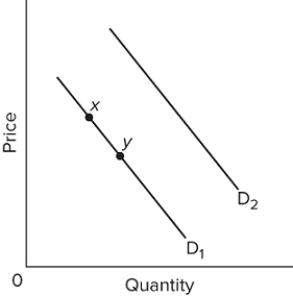 Refer to the diagram. A decrease in quantity demanded is depicted by a
 (Multiple Choice)
4.8/5 (87)
(87) (Advanced analysis)The demand for commodity X is represented by the equation P = 10 - 0.2 Q and supply by the equation P = 2 + 0.2 Q. The equilibrium price for X is
(Multiple Choice)
4.9/5 (64)
(64) If the government subsidizes the car makers in the production of cars, then the supply of steel increases.
(True/False)
4.9/5 (88)
(88) State the law of demand, and explain why the other-things-equal assumption is critical to it.
(Essay)
4.9/5 (76)
(76) "Price" in the statement of the Law of Demand refers to the same concept as the cost of producing the product.
(True/False)
4.8/5 (92)
(92) Which of the following would not shift the demand curve for beef?
(Multiple Choice)
4.9/5 (91)
(91) In the market for gasoline, if the change in demand due to the start of the summer driving season is greater than the change in supply due to disruptions in the refinery operations in the Gulf, then the equilibrium quantity will increase.
(True/False)
4.7/5 (82)
(82) A ceiling price in a competitive market will result in persistent surpluses of a product.
(True/False)
4.7/5 (78)
(78)  Refer to the above table. A shortage of 500 units will occur when the price is
 (Multiple Choice)
4.8/5 (79)
(79) What is the difference between a change in supply and a change in quantity supplied?
(Essay)
4.9/5 (78)
(78) In the following question you are asked to determine, other things equal, the effects of a given change in a determinant of demand or supply for product X upon (1)the demand (D)for, or supply (S)of, X; (2)the equilibrium price (P)of X; and (3)the equilibrium quantity (Q)of X.Removing the subsidy placed on product X years ago will
(Multiple Choice)
4.8/5 (78)
(78) The following are explanations of the Law of Demand, except
(Multiple Choice)
4.8/5 (77)
(77) An increase in both supply and demand will lead to an increase in the equilibrium price and an indeterminate change in the equilibrium quantity.
(True/False)
4.7/5 (95)
(95) 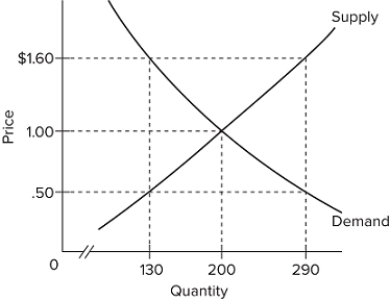 Refer to the diagram. A shortage of 160 units would be encountered if price was
 (Multiple Choice)
4.8/5 (77)
(77) Two goods are considered to be related goods by many buyers: if the price of one increases, buyers buy more of the other. This indicates that the two goods are complements.
(True/False)
5.0/5 (81)
(81) 
Filters
- Essay(0)
- Multiple Choice(0)
- Short Answer(0)
- True False(0)
- Matching(0)