



 Chat with AI
Exam 24: The Innate and Adaptive Immune Systems

Exam 1: Cells and Genomes34 Questions
Exam 2: Cell Chemistry and Bioenergetics54 Questions
Exam 3: Proteins52 Questions
Exam 4: DNA, Chromosomes, and Genomes57 Questions
Exam 5: DNA Replication, Repair, and Recombination51 Questions
Exam 6: How Cells Read the Genome: From DNA to Protein58 Questions
Exam 7: Control of Gene Expression62 Questions
Exam 8: Analyzing Cells, Molecules, and Systems95 Questions
Exam 9: Visualizing Cells29 Questions
Exam 10: Membrane Structure26 Questions
Exam 11: Membrane Transport of Small Molecules and the Electrical Properties of Membranes46 Questions
Exam 12: Intracellular Compartments and Protein Sorting46 Questions
Exam 13: Intracellular Membrane Traffic54 Questions
Exam 14: Energy Conversion: Mitochondria and Chloroplasts49 Questions
Exam 15: Cell Signaling63 Questions
Exam 16: The Cytoskeleton75 Questions
Exam 17: The Cell Cycle57 Questions
Exam 18: Cell Death12 Questions
Exam 19: Cell Junctions and the Extracellular Matrix56 Questions
Exam 20: Cancer50 Questions
Exam 21: Development of Multicellular Organisms61 Questions
Exam 22: Stem Cells and Tissue Renewal45 Questions
Exam 23: Pathogens and Infection32 Questions
Exam 24: The Innate and Adaptive Immune Systems47 Questions
Select questions type


Antigens and antibodies can form large, insoluble, cross-linked aggregates that precipitate from solution. The maximal amount of precipitant is observed at a certain antigen/antibody ratio; adding either excess antigen or excess antibody can prevent (or even reverse) the precipitation. Consider an antigen with multiple identical antigenic determinants that can be recognized by either bivalent or decavalent (i.e. pentameric) antibodies with binding sites that recognize the determinants. The amount of precipitation in the presence of a constant antigen concentration is plotted as a function of antibody concentration in the following qualitative graph. Which curve (1 or 2) in the graph do you think corresponds to the bivalent antibody? Would you expect to see such a bell-shaped curve if the antibodies were monovalent? 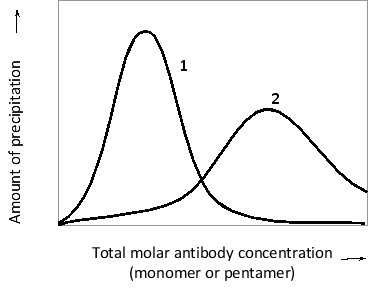
(Multiple Choice)
4.9/5  (73)
(73) Mice whose immune systems had previously rejected a tissue transplant from a certain strain of donor mouse received another transplant shortly afterward, either from the same donor strain or a new one. All of the recipient mice eventually rejected the transplant. However, one group did so more quickly than the other group. Do you think this group received the graft from the original mouse strain (O) or the new strain (N)? Write down O or N as your answer.
(Short Answer)
4.9/5 (74)
(74) Blood-group compatibility is an important consideration in red blood cell transfusions that are administered in millions of liters worldwide every year. In the ABO blood-group system, individuals with AB blood type are the universal recipient (can accept blood from any donor), while those with O type are universal donors. If an incompatible transfusion is made between an A-type (donor) and a B-type (recipient) individual, for example, the anti-A antibodies present in the recipient's plasma would rapidly destroy the transfused blood cells with the help of the complement system, with potentially serious consequences. But why do we produce antibodies against other blood-group antigens even without having been exposed to those foreign blood cells before? It has been suggested that these antibodies are generated in response to minor infections (in early life) with microbes of the normal flora of our bodies, and that, in addition to binding to the microbial antigens, these antibodies can cross-react with the similar A- and B-type carbohydrate antigens of the ABO blood-group system. If this is indeed the case, blood plasma from a "germ-free" individual would react with …
(Multiple Choice)
4.8/5 (79)
(79) In the following schematic diagram, which curve (A to D) do you think better shows the qualitative relationship between the affinity of a developing T cell's TCR for self-peptide-MHC complexes in the thymus and the survival chance of the cell? 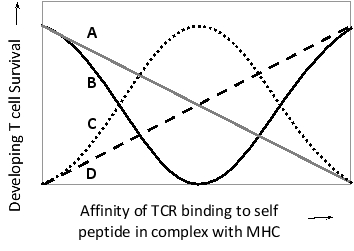
(Short Answer)
4.9/5 (80)
(80) Indicate whether each of the following descriptions better applies to class I (1) or class II (2) MHC proteins of vertebrates. Your answer would be a four-digit number composed of digits 1 and 2 only, e.g. 2221.
( ) They mainly present intracellular peptide fragments.
( ) They are found on most nucleated cells.
( ) They present antigens mainly to helper or regulatory T cells.
( ) They are recognized by CD4 co-receptors on helper and regulatory T cells.
(Short Answer)
4.8/5 (82)
(82) Indicate whether each of the following descriptions better applies to an adaptive (A) or innate (I) immune response. Your answer would be a four-letter string composed of letters A and I only, e.g. AAAA.
( ) It is found in invertebrate and vertebrate animals as well as in plants.
( ) It has a long-lasting memory.
( ) It is highly specific to the particular invading pathogen.
( ) It employs natural killer (NK) cells to induce apoptosis in infected host cells.
(Short Answer)
4.9/5 (77)
(77) How are natural killer (NK) cells different from cytotoxic T (TC) cells?
(Multiple Choice)
4.8/5 (85)
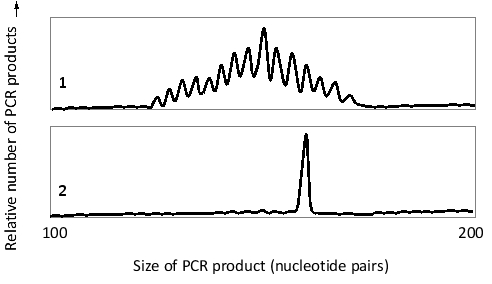
(85) A patient with persisting larger-than-normal lymph nodes is suspected to have a T cell lymphoma, a cancer of T lymphocytes. Abnormally enlarged lymph nodes are also found in local infections, when lymphocytes are activated to proliferate there. In order to distinguish between cancer and infection, you take tissue samples from the patient, as well as from a healthy individual, and perform a so-called clonality test. You extract DNA from the tissues and amplify a small chromosomal region that includes the T-cell-receptor ? chain D-J junctions. Amplification is done by PCR, using primers that hybridize to specific DNA sequences flanking the junctions. You then analyze the size distributions of the PCR products by capillary electrophoresis, which makes it possible to distinguish between DNA molecules with small differences in size. Based on the results, presented in the following schematic graphs, you conclude that, unfortunately, it is likely that the patient has developed a T cell lymphoma. Which graph (1 or 2) represents the patient's test results? Write down 1 or 2 as your answer.
(Short Answer)
4.9/5 (94)
(94) Indicate whether each of the following normally occurs before (B) or after (A) antigen stimulation of B cells. Your answer would be a four-letter string composed of letters A and B only, e.g. AAAA.
( ) V(D)J recombination
( ) Class switch recombination
( ) Somatic hypermutation
( ) Junctional diversification
(Short Answer)
4.9/5 (70)
(70) Consider two solution chambers of equal volume divided by a dialysis membrane that is impermeable to antibody molecules but permeable to small antigens. Starting with an antigen concentration of 4.8 nM in both chambers, you add its specific IgG antibody to one of the chambers at 1 nM concentration. You then measure the concentration of the antigen in the other chamber after equilibrium is reached, which turns out to be about 4 nM. What is the association constant (Ka) for the binding of the antigen to each antigen-binding site of IgG? Assume independent antigen-binding sites in each antibody molecule. Write down your answer in liters per mole, in scientific notation with one decimal place, e.g. 5.0 × 10² liters/mole).
(Short Answer)
4.7/5 (81)
(81) Indicate whether each of the following descriptions better applies to the clonal anergy (A), clonal deletion (D), receptor editing (E), or clonal suppression (S) mechanism of immunological self-tolerance. Your answer would be a five-letter string composed of letters A, D, E, and S only, e.g. SADSS.
( ) It involves apoptosis of self-reactive cells.
( ) It is mostly limited to B cells.
( ) It involves regulatory T (T??g) cells.
( ) It involves DNA recombination.
( ) It is limited to central tolerance processes.
(Short Answer)
4.7/5 (77)
(77) In antigen presentation to helper T cells (TH cells), both the TCR and co-receptor proteins…
(Multiple Choice)
4.8/5 (76)
(76) Indicate whether each of the following descriptions better applies to B cell receptors (B) or T cell receptors (T). Your answer would be a four-letter string composed of letters B and T only, e.g. BTTT.
( ) They can also be produced as secreted antibodies with the same antigen specificity.
( ) They diversify by class switching and somatic hypermutation.
( ) They often exist as heterodimers.
( ) They have a relatively low antigen-binding affinity.
(Short Answer)
4.9/5 (69)
(69) In contrast to a primary immune response, a secondary immune response generally …
(Multiple Choice)
5.0/5 (73)
(73) Indicate whether each of the following descriptions is shared (S) or not shared (N) between macrophages and neutrophils in destroying invading pathogens in vertebrates. Your answer would be a four-letter string composed of letters S and N only, e.g. SSSS.
( ) They use a respiratory burst and create toxic reactive oxygen species to kill engulfed pathogens.
( ) They are normally found in most tissues even before pathogen invasion.
( ) They are long-lived and normally survive long after activation.
( ) They secrete pro-inflammatory cytokines upon encountering invading pathogens.
(Short Answer)
4.9/5 (79)
(79) Sort the following events to reflect the order in which they occur in the presentation of viral peptides to cytotoxic T cells by a virus-infected cell. Your answer would be a four-letter string composed of letters A to D only, e.g. BDCA.
(A) Peptide transport into the ER lumen
(B) Partial proteasomal degradation of the viral protein into peptide fragments
(C) Peptide binding to class I MHC protein in the ER lumen
(D) The appearance of viral protein in the cytosol
(Short Answer)
4.8/5 (75)
(75) You have prepared glass beads coated with rabbit anti-Ig antibodies that were isolated from rabbits that were immunized with mouse immunoglobulin (Ig). If you incubate a sample of mononucleated cells from mouse spleen with these beads, which of the following cell types do you think would stick to the beads?
(Multiple Choice)
4.8/5 (71)
(71) Mammals produce five major classes of immunoglobulins. Indicate whether each of the following descriptions better applies to the immunoglobulin A, D, E, G, or M class. Your answer would be a five-letter string composed of letters A, D, E, G, and M only, e.g. GMADE.
( ) It binds to cells that secrete histamine.
( ) It is the major antibody in secretions such as saliva.
( ) It is the major antibody circulating in the blood.
( ) It is found on the surface of naïve B cells along with IgM.
( ) It forms wheel-like pentamers involved in the primary immune response.
(Short Answer)
4.8/5 (84)
(84) Indicate true (T) and false (F) statements below regarding lymphocytes in the adaptive immune system. Your answer would be a four-letter string composed of letters T and F only, e.g. TTFF.
( ) To induce an adaptive immune response, an invading pathogen must invade a peripheral lymphoid organ.
( ) Lymphocytes continuously circulate between central and peripheral lymphoid organs.
( ) Upon encountering its specific antigen in a peripheral lymphoid organ, a lymphocyte remains there to proliferate and differentiate into effector and memory cells.
( ) Memory B and T cells do not recirculate, but rather remain in the peripheral lymphoid organ in which they develop.
(Short Answer)
4.9/5 (68)
(68) 
Filters
- Essay(0)
- Multiple Choice(0)
- Short Answer(0)
- True False(0)
- Matching(0)