



 Chat with AI
Exam 6: How Cells Read the Genome: From DNA to Protein

Exam 1: Cells and Genomes34 Questions
Exam 2: Cell Chemistry and Bioenergetics54 Questions
Exam 3: Proteins52 Questions
Exam 4: DNA, Chromosomes, and Genomes57 Questions
Exam 5: DNA Replication, Repair, and Recombination51 Questions
Exam 6: How Cells Read the Genome: From DNA to Protein58 Questions
Exam 7: Control of Gene Expression62 Questions
Exam 8: Analyzing Cells, Molecules, and Systems95 Questions
Exam 9: Visualizing Cells29 Questions
Exam 10: Membrane Structure26 Questions
Exam 11: Membrane Transport of Small Molecules and the Electrical Properties of Membranes46 Questions
Exam 12: Intracellular Compartments and Protein Sorting46 Questions
Exam 13: Intracellular Membrane Traffic54 Questions
Exam 14: Energy Conversion: Mitochondria and Chloroplasts49 Questions
Exam 15: Cell Signaling63 Questions
Exam 16: The Cytoskeleton75 Questions
Exam 17: The Cell Cycle57 Questions
Exam 18: Cell Death12 Questions
Exam 19: Cell Junctions and the Extracellular Matrix56 Questions
Exam 20: Cancer50 Questions
Exam 21: Development of Multicellular Organisms61 Questions
Exam 22: Stem Cells and Tissue Renewal45 Questions
Exam 23: Pathogens and Infection32 Questions
Exam 24: The Innate and Adaptive Immune Systems47 Questions
Select questions type


How fast does a bacterial ribosome move on an mRNA?

Free
(Multiple Choice)
4.9/5  (84)
(84) Correct Answer: Verified
E
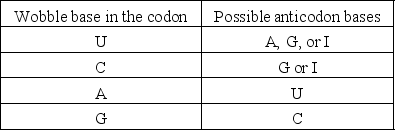
The anticodon sequence of a phenylalanine-specific tRNA is 5'-GAA-3'. Given the wobble base-pairing rules presented in the following table, how many different codons can be "read" by this tRNA? Write down your answer in digits, e.g. 12.
Free
(Short Answer)
4.8/5 (78)
(78) Correct Answer:Verified
Verified2
How does a eukaryotic cell deal with the superhelical tension in its genomic DNA resulting from the activity of RNA polymerases?
Free
(Multiple Choice)
4.9/5 (84)
(84) Correct Answer:Verified
VerifiedC
This general transcription factor recognizes the TATA box in RNA polymerase II promoters. It is...
(Multiple Choice)
4.8/5 (78)
(78) Indicate true (T) and false (F) statements below regarding the folding of proteins upon their synthesis. Your answer would be a five-letter string composed of letters T and F only, e.g. TFFFF.
( ) A globular protein can fold to its native form while still within the ribosome.
( ) A protein can begin to fold and to bind to other proteins while still being synthesized on the ribosome.
( ) A protein may undergo several cycles of hsp70 binding and release while still being synthesized on the ribosome.
( ) A molten globule can form only after the synthesis of the protein is complete.
( ) A protein typically undergoes hsp60-assisted folding while still being synthesized.
(Short Answer)
4.8/5 (72)
(72) Activation of an amino acid by an aminoacyl-tRNA synthetase involves the covalent linkage of...
(Multiple Choice)
4.8/5 (78)
(78) Indicate whether each of the following is located (or takes place) in the large (L) or the small (S) ribosomal subunit. Your answer would be a four-letter string composed of letters L and S only, e.g. LLLS.
( ) Peptide bond formation
( ) Codon-anticodon interaction
( ) The path of the mRNA
( ) The polypeptide exit tunnel
(Short Answer)
4.8/5 (95)
(95) Fill in the blank. These RNA molecules can catalyze a wide variety of biochemical reactions, including peptide bond formation and RNA splicing. They can be found in nature or selected in vitro for a desired function. Such a molecule is called a(n) ...
(Short Answer)
4.8/5 (73)
(73) 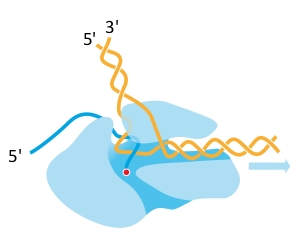
The enzyme poly-A polymerase is responsible for adding 3' poly-A tails to eukaryotic mRNAs. This enzyme...
(Multiple Choice)
4.9/5 (76)
(76) Three consecutive nucleotides in RNA (such as AUC or GUA) constitute a triplet called a ..., which can specify an amino acid or a stop signal for translation.
(Short Answer)
4.9/5 (64)
(64) This complex uses ATP and forms an "isolation chamber" for its misfolded protein substrates, allowing them to fold to their native conformation. It is called...
(Multiple Choice)
4.8/5 (68)
(68) In humans, nearly 80% of proteins are acetylated on their N-terminal residue, a modification known to be recognized by a specific E3 enzyme, which directs the ubiquitylation of the protein for rapid degradation. Does this mean that all of these proteins are actively degraded at any given time?
(Multiple Choice)
4.8/5 (74)
(74) In a gene that normally contains three exons, which of the following changes probably will NOT activate the nonsense-mediated mRNA decay pathway? The sizes of exons 1 to 3 are 100, 150, and 200 nucleotide pairs, respectively.
(Multiple Choice)
4.9/5 (76)
(76) The nucleolus is a dynamic subcompartment within the nucleus and its size varies depending on the circumstances. In which of the following cells would you NOT expect to see the nucleoli?
(Multiple Choice)
4.7/5 (74)
(74) The modified nucleotide shown below is normally found in mature... 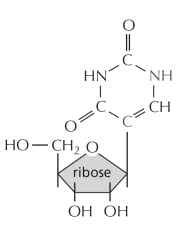
(Multiple Choice)
4.9/5 (70)
(70) Indicate true (T) and false (F) statements below regarding mRNA splicing in human cells. Your answer would be a four-letter string composed of letters T and F only, e.g. TFFF.
( ) Introns must be removed in the order in which they occur along the pre-mRNA.
( ) Nucleosomes tend to be positioned over exons (on average, about one nucleosome per exon).
( ) Exon size tends to be much more variable than intron size.
( ) The exon junction complexes mark the sites on the mRNA where splicing has not been successful.
(Short Answer)
4.8/5 (79)
(79) Comparing mRNA molecules from human and Escherichia coli cells, which of the following is typically NOT true?
(Multiple Choice)
4.8/5 (72)
(72) 
Filters
- Essay(0)
- Multiple Choice(0)
- Short Answer(0)
- True False(0)
- Matching(0)