



 Chat with AI
Exam 6: How Cells Read the Genome: From DNA to Protein

Exam 1: Cells and Genomes34 Questions
Exam 2: Cell Chemistry and Bioenergetics54 Questions
Exam 3: Proteins52 Questions
Exam 4: DNA, Chromosomes, and Genomes57 Questions
Exam 5: DNA Replication, Repair, and Recombination51 Questions
Exam 6: How Cells Read the Genome: From DNA to Protein58 Questions
Exam 7: Control of Gene Expression62 Questions
Exam 8: Analyzing Cells, Molecules, and Systems95 Questions
Exam 9: Visualizing Cells29 Questions
Exam 10: Membrane Structure26 Questions
Exam 11: Membrane Transport of Small Molecules and the Electrical Properties of Membranes46 Questions
Exam 12: Intracellular Compartments and Protein Sorting46 Questions
Exam 13: Intracellular Membrane Traffic54 Questions
Exam 14: Energy Conversion: Mitochondria and Chloroplasts49 Questions
Exam 15: Cell Signaling63 Questions
Exam 16: The Cytoskeleton75 Questions
Exam 17: The Cell Cycle57 Questions
Exam 18: Cell Death12 Questions
Exam 19: Cell Junctions and the Extracellular Matrix56 Questions
Exam 20: Cancer50 Questions
Exam 21: Development of Multicellular Organisms61 Questions
Exam 22: Stem Cells and Tissue Renewal45 Questions
Exam 23: Pathogens and Infection32 Questions
Exam 24: The Innate and Adaptive Immune Systems47 Questions
Select questions type


In the following schematic drawing, a transcribing RNA polymerase is moving toward the right on the DNA template as indicated. If the polymerase is allowed to rotate freely while the DNA is kept from doing so, would the enzyme rotate in a right-handed (R) or left-handed (L) fashion around the template? Write down R or L as your answer.
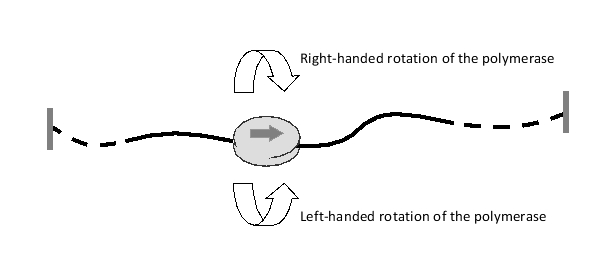
(Short Answer)
4.8/5  (84)
(84) You have identified an RNA-binding protein that can bind directly (with varying affinities) to mRNA molecules that bear the following sequences near the 3' splice sites of their exons. Based on these results, what is the five-nucleotide consensus sequence for the binding site of this protein? Your answer would be a five-letter string composed of letters A, U, C, or G only; e.g. UUUAG.
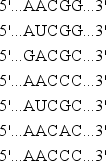
(Short Answer)
4.9/5 (83)
(83) The structural formulas for a few antibiotics that target the ribosome are shown below. Which one do you think is that of puromycin? Hint: puromycin mimics the structure of an amino acid linked to a tRNA molecule. 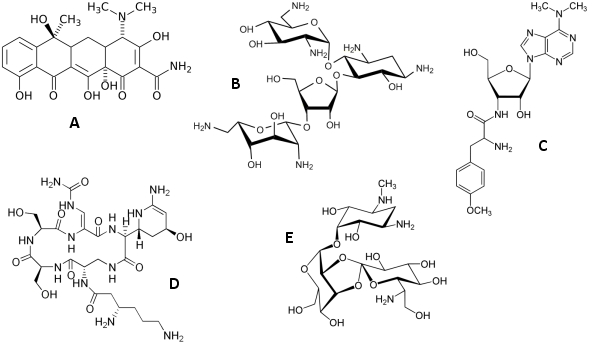
(Short Answer)
4.9/5 (79)
(79) On the ribosome, the mRNA is read from ..., and the polypeptide chain is synthesized from...
(Multiple Choice)
4.7/5 (84)
(84) This large and complex general transcription factor has a DNA helicase activity that exposes the template for RNA polymerase II transcription. It also has a kinase activity that phosphorylates the C-terminal domain of the polymerase on Ser5 leading to promoter clearance. It is...
(Multiple Choice)
4.9/5 (82)
(82) Several mechanisms contribute to the diversity of the mRNAs and proteins encoded by a single gene in our genome. Which of the following is normally NOT one of them?
(Multiple Choice)
5.0/5 (87)
(87) Which of the following is true about the molecule shown in the following drawing? 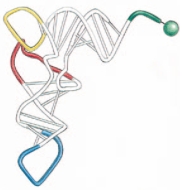
(Multiple Choice)
4.9/5 (79)
(79) DNA and RNA polymerase differ in all of the following EXCEPT...
(Multiple Choice)
4.8/5 (89)
(89) The transcript for which of the following noncoding RNA in our cells is expected to undergo 5' cap addition after transcription?
(Multiple Choice)
4.9/5 (79)
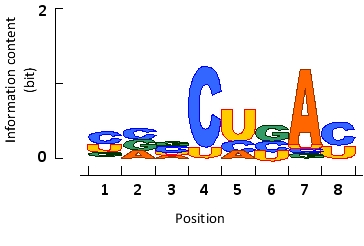
(79) Your friend who is studying the sequence conservation around the branch-point site on a subset of pre-mRNAs in Macaca mulatto (rhesus macaque) has sent you the following sequence logo of the region of interest, but has forgotten to indicate the position of the branch-point nucleotide itself within this region. Where do you think it is? Write down the position number (1 to 8) as your answer.
(Short Answer)
4.9/5 (103)
(103) No matter where translation begins, only one polypeptide sequence pattern can be obtained from the translation of an mRNA chain with the sequence (AC)n; that is, an mRNA with the sequence 5'...ACACACACAC...3'. In contrast, an mRNA chain with the sequence (ACG)n can be translated to polypeptide sequences of three distinct patterns, depending on the choice of the reading frame. Using similar judgment, how many different polypeptide sequence patterns can be obtained from an mRNA chain with the sequence (ACGU)n? Write down your answer in digits, e.g. 12.
(Short Answer)
4.7/5 (79)
(79) How is tRNA splicing different from mRNA splicing in eukaryotic cells?
(Multiple Choice)
4.9/5 (91)
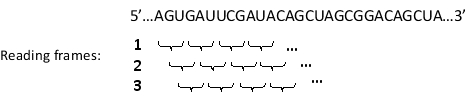
(91) The following mRNA sequence is taken from the middle of exon 3 in a mature mRNA that has 12 exons. Knowing that this mRNA does not undergo nonsense-mediated decay, which of the reading frames shown is the correct one for this mRNA? Write down 1, 2, or 3 as your answer.
(Short Answer)
4.7/5 (71)
(71) Of the following proteins or protein complexes, which one does NOT typically interact with an elongating RNA polymerase II?
(Multiple Choice)
4.9/5 (80)
(80) Which of the following features is common between the bacterial and eukaryotic ribosomes in translation initiation?
(Multiple Choice)
4.8/5 (93)
(93) The specific transfer RNA used for the incorporation of selenocysteine in proteins recognizes the UGA codon, which is normally a translation stop codon. What prevents this tRNA from reading through all the other "legitimate" UGA stop codons in the cells and causing a massive, disastrous recoding?
(Multiple Choice)
4.8/5 (77)
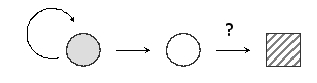
(77) In the following diagram showing the overall flow of genetic information in all living cells, what is the name of the process indicated with a question mark?
(Short Answer)
4.8/5 (83)
(83) 
Filters
- Essay(0)
- Multiple Choice(0)
- Short Answer(0)
- True False(0)
- Matching(0)