



 Chat with AI
Exam 6: How Cells Read the Genome: From DNA to Protein

Exam 1: Cells and Genomes34 Questions
Exam 2: Cell Chemistry and Bioenergetics54 Questions
Exam 3: Proteins52 Questions
Exam 4: DNA, Chromosomes, and Genomes57 Questions
Exam 5: DNA Replication, Repair, and Recombination51 Questions
Exam 6: How Cells Read the Genome: From DNA to Protein58 Questions
Exam 7: Control of Gene Expression62 Questions
Exam 8: Analyzing Cells, Molecules, and Systems95 Questions
Exam 9: Visualizing Cells29 Questions
Exam 10: Membrane Structure26 Questions
Exam 11: Membrane Transport of Small Molecules and the Electrical Properties of Membranes46 Questions
Exam 12: Intracellular Compartments and Protein Sorting46 Questions
Exam 13: Intracellular Membrane Traffic54 Questions
Exam 14: Energy Conversion: Mitochondria and Chloroplasts49 Questions
Exam 15: Cell Signaling63 Questions
Exam 16: The Cytoskeleton75 Questions
Exam 17: The Cell Cycle57 Questions
Exam 18: Cell Death12 Questions
Exam 19: Cell Junctions and the Extracellular Matrix56 Questions
Exam 20: Cancer50 Questions
Exam 21: Development of Multicellular Organisms61 Questions
Exam 22: Stem Cells and Tissue Renewal45 Questions
Exam 23: Pathogens and Infection32 Questions
Exam 24: The Innate and Adaptive Immune Systems47 Questions
Select questions type


An elongating ribosome is bound to appropriate tRNAs in both the A and the P sites and is ready for peptidyl transfer. What happens next?
(Multiple Choice)
4.7/5  (80)
(80) Which of the following processes takes place in the nucleoli within the eukaryotic nucleus?
(Multiple Choice)
4.8/5 (89)
(89) Which of the following nucleotides is hydrolyzed in both transcription and in translation elongation?
(Multiple Choice)
4.8/5 (78)
(78) In the following representation of a single-stranded RNA molecule, the nucleotide residues are drawn as gray circles, while base-pairing interactions between them are indicated by dashed lines. The structure of this RNA molecule has... 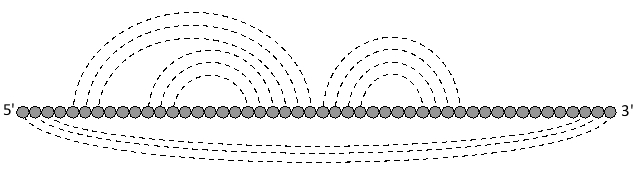
(Multiple Choice)
4.9/5 (89)
(89) Sort the following events in the order that they occur during transcription initiation in Escherichia coli. Your answer would be a four-letter string composed of letters A to D only; e.g. DCAB.
(A) Abortive initiation trials
(B) ? Factor release from the RNA polymerase holoenzyme
(C) Binding of the holoenzyme to the promoter in the "closed" complex
(D) Formation of the transcription bubble
(Short Answer)
4.9/5 (83)
(83) For the bacterial transcription machinery, which of the following mRNA sequences would you expect to constitute a potent transcriptional termination signal? Note that the two underlined regions in each sequence are complementary to each other.
(Multiple Choice)
4.8/5 (94)
(94) Which of the following types of noncoding RNA chiefly functions in the processing and chemical modification of ribosomal RNAs (rRNAs)?
(Multiple Choice)
4.7/5 (88)
(88) The sequence of a region of DNA around the 5? end of a gene in Escherichia coli is shown below. The -10 hexamer and the transcription start site are highlighted. What would be the sequence of the first 10 nucleotides of the mRNA transcribed from this gene? Write down the sequence from 5? to 3?, e.g. CGGAUAAACT.
5?…GCGCTTGGTATAATCGCTGGGGGTCAAAGAT…3?
(Short Answer)
4.8/5 (88)
(88) What is the function of the 19S cap in the proteasome complex?
(Multiple Choice)
4.8/5 (85)
(85) As an mRNA molecule is processed in the nucleus, it loses some proteins and binds to new ones, some of which are used in mRNA surveillance pathways. The presence of which of the following molecules on an mRNA is a signal that the mRNA is still NOT ready for nuclear export?
(Multiple Choice)
4.9/5 (72)
(72) Which of the following better describes a typical, actively translated mRNA in its journey from the nucleus to the cytosol?
(Multiple Choice)
4.8/5 (68)
(68) Eukaryotic pre-mRNAs undergo a number of modifications such as capping at the 5' end. A 5' cap...
(Multiple Choice)
4.9/5 (79)
(79) After the first and before the second chemical step of RNA splicing, the intron of the pre-mRNA...
(Multiple Choice)
4.9/5 (88)
(88) Indicate true (T) and false (F) statements below regarding the RNA world hypothesis. Your answer would be a four-letter string composed of letters T and F only, e.g. TFFF.
( ) According to this hypothesis, RNA in primitive cells was responsible for storing genetic information, while proteins were responsible for the catalysis of chemical reactions.
( ) The existence of natural ribozymes supports this hypothesis.
( ) In support of this hypothesis, all peptides in present-day cells are made by the ribosome.
( ) All present-day cells use DNA as their hereditary material.
(Short Answer)
4.8/5 (72)
(72) A primary mRNA transcript with three exons is depicted below. Which of the following mature mRNA products of this transcript is a result of exon skipping? 
(Multiple Choice)
4.8/5 (67)
(67) Due to their high transcription rate, active ribosomal RNA (rRNA) genes can be easily distinguished in electron micrographs of chromatin spreads. They have a characteristic "Christmas tree" appearance, where the DNA template is the "trunk" of the tree and the nascent RNA transcripts form closely packed "branches." At the base of each branch is an RNA polymerase extending that branch, while RNA processing complexes at the tip of the branch form terminal "ornaments." The top of the tree represents the ... of the rRNA gene, and the "ornaments" are at the ... end of the nascent rRNA molecules.
(Multiple Choice)
4.8/5 (83)
(83) Each aminoacyl-tRNA synthetase activates a certain amino acid by attaching it to its corresponding tRNA(s) through a high-energy linkage...
(Multiple Choice)
4.8/5 (80)
(80) How many ATP molecules must be hydrolyzed by the proteasome for the digestion of a protein that has been tagged for degradation with a polyubiquitin chain?
(Multiple Choice)
4.8/5 (88)
(88) Indicate true (T) and false (F) statements below regarding the accuracy of translation by the ribosome. Your answer would be a four-letter string composed of letters T and F only, e.g. TFFF.
( ) The difference in the binding affinity of a codon to a correct versus incorrect anticodon CANNOT by itself account for the high accuracy of translation.
( ) GTP hydrolysis by EF-Tu both speeds up translation and increases its accuracy.
( ) The ribosome can detect correct Watson-Crick base-pairing between the codon and anticodon in the A site, and consequently trigger GTP hydrolysis by EF-Tu.
( ) Even after GTP hydrolysis by EF-Tu, the ribosome can prevent wrong amino acid incorporation by kinetic proofreading.
(Short Answer)
4.8/5 (81)
(81) In the following qualitative histogram, which two curves better correspond to human exon and intron length distributions, respectively? 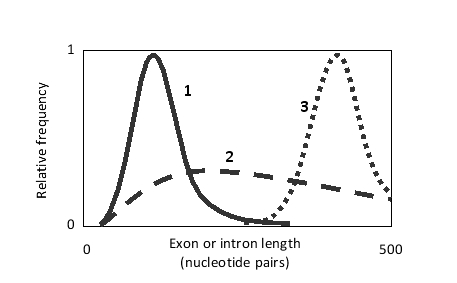
(Multiple Choice)
4.8/5 (78)
(78) 
Filters
- Essay(0)
- Multiple Choice(0)
- Short Answer(0)
- True False(0)
- Matching(0)