



 Chat with AI
Exam 20: Cancer

Exam 1: Cells and Genomes34 Questions
Exam 2: Cell Chemistry and Bioenergetics54 Questions
Exam 3: Proteins52 Questions
Exam 4: DNA, Chromosomes, and Genomes57 Questions
Exam 5: DNA Replication, Repair, and Recombination51 Questions
Exam 6: How Cells Read the Genome: From DNA to Protein58 Questions
Exam 7: Control of Gene Expression62 Questions
Exam 8: Analyzing Cells, Molecules, and Systems95 Questions
Exam 9: Visualizing Cells29 Questions
Exam 10: Membrane Structure26 Questions
Exam 11: Membrane Transport of Small Molecules and the Electrical Properties of Membranes46 Questions
Exam 12: Intracellular Compartments and Protein Sorting46 Questions
Exam 13: Intracellular Membrane Traffic54 Questions
Exam 14: Energy Conversion: Mitochondria and Chloroplasts49 Questions
Exam 15: Cell Signaling63 Questions
Exam 16: The Cytoskeleton75 Questions
Exam 17: The Cell Cycle57 Questions
Exam 18: Cell Death12 Questions
Exam 19: Cell Junctions and the Extracellular Matrix56 Questions
Exam 20: Cancer50 Questions
Exam 21: Development of Multicellular Organisms61 Questions
Exam 22: Stem Cells and Tissue Renewal45 Questions
Exam 23: Pathogens and Infection32 Questions
Exam 24: The Innate and Adaptive Immune Systems47 Questions
Select questions type


From an immortalized human HeLa cell line with wild-type p53 genes, you have derived a line that lacks both copies of the gene. You then treat the original and derived cells with the anticancer drug doxorubicin, which can activate the p53 pathway in the cell by stalling DNA replication forks and inducing double-strand breaks in DNA. You measure cell proliferation in the presence of different doses of the drug in each of the two cell lines, and plot the results as shown in the graph below. Which cell line (A or B) do you expect to be the original HeLa line? Write down A or B as your answer. 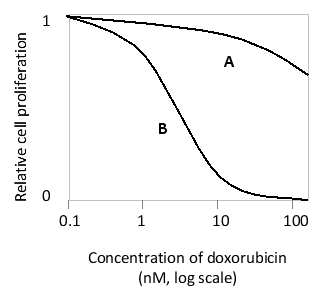
(Short Answer)
5.0/5  (78)
(78) The requirement for accumulation of multiple mutations in cancer progression is manifested in the normalized percentage of new cases of cancer diagnosed in different age groups. Which of the curves A to E in the following graph better represents the incidence of human cancers as a function of age? 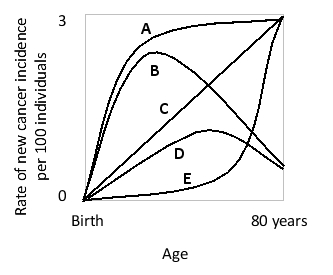
(Short Answer)
4.9/5 (81)
(81) Mutation in which of the following genes is most prevalent in human colorectal cancer cells?
(Multiple Choice)
4.7/5 (70)
(70) Indicate true (T) and false (F) statements below regarding cancer incidence and cancer prevention. Your answer would be a four-letter string composed of letters T and F only, e.g. TFFF.
( ) Over half of all cancers are preventable by lifestyle changes.
( ) The age-adjusted cancer death rates have increased steadily since 1900, mostly due to the industrial way of life.
( ) Currently, more than half of all cancer patients survive at least five years post-diagnosis.
( ) About half of all cancers are thought to arise by infection with viruses, bacteria, or parasites.
(Short Answer)
4.8/5 (86)
(86) Which of the following can lead to p53 stabilization and activation?
(Multiple Choice)
4.8/5 (91)
(91) The Ames test is used to test the mutagenicity of a compound suspected to be a carcinogen. In a simple form of the test, the carcinogen is first mixed with a rat liver extract. A disc of filter paper is soaked with this mixture and placed on a culture of a strain of Salmonella typhimurium that is defective in a gene involved in the synthesis of histidine, an amino acid that is essential for cell growth and proliferation. The strain is thus normally unable to grow into visible colonies when the histidine in the culture medium is depleted. In the presence of a mutagen, however, mutations (often "reverse mutations" in the same gene) can enable the bacteria to produce histidine on their own, and therefore grow into colonies. The results of the Ames test for three compounds A, B, and C-each used at the same concentration-are shown in the schematic diagram below. Colonies are indicated with black dots, and the disc is indicated with a white circle at the center of each plate. Which compound (A to C) appears to be a stronger mutagen in this assay? Write down A, B, or C as your answer.
(Multiple Choice)
4.8/5 (79)
(79) Among the following cancers, one is currently leading to the most number of deaths in the United States and in the rest of the world. In the United States, it contributes to cancer mortality more than the next three killing cancers combined. Worldwide, it claims more than 1.5 million lives every year. Which cancer is this?
(Multiple Choice)
4.8/5 (88)
(88) PARP inhibitors can efficiently kill many breast cancer cells that lack functional Brca1 or Brca2 genes. How do these drugs accomplish this?
(Multiple Choice)
4.8/5 (80)
(80) Consider a healthy adult animal in which 10¹⁵ cell divisions have taken place since birth. Spontaneous mutations can occur at a rate of approximately one nucleotide out of about ten billion nucleotides every time DNA is replicated. The animal has a diploid genome size of about 2 billion nucleotide pairs. Assuming that only about 5% of mutations occur within genes or gene regulatory sequences, and further assuming that about 0.1% of those may cause cancer, how many potential cancer-causing mutations has the animal been able to successfully suppress (i.e. has been able to survive) during its lifetime?
(Multiple Choice)
4.9/5 (88)
(88) Indicate whether each of the following descriptions better applies to proto-oncogenes (P) or tumor suppressor genes (T). Your answer would be a four-letter string composed of letters P and T only, e.g. PPPT.
( ) Cancer mutations in these genes are usually recessive.
( ) Cancer mutations in these genes include gene duplications.
( ) Cancer mutations in these genes are responsible for most hereditary cancers.
( ) Cancer mutations in these genes are commonly in the form of nonsense (truncating) mutations that abort protein synthesis.
(Short Answer)
5.0/5 (76)
(76) 
Filters
- Essay(0)
- Multiple Choice(0)
- Short Answer(0)
- True False(0)
- Matching(0)