



 Chat with AI
Exam 20: Cancer

Exam 1: Cells and Genomes34 Questions
Exam 2: Cell Chemistry and Bioenergetics54 Questions
Exam 3: Proteins52 Questions
Exam 4: DNA, Chromosomes, and Genomes57 Questions
Exam 5: DNA Replication, Repair, and Recombination51 Questions
Exam 6: How Cells Read the Genome: From DNA to Protein58 Questions
Exam 7: Control of Gene Expression62 Questions
Exam 8: Analyzing Cells, Molecules, and Systems95 Questions
Exam 9: Visualizing Cells29 Questions
Exam 10: Membrane Structure26 Questions
Exam 11: Membrane Transport of Small Molecules and the Electrical Properties of Membranes46 Questions
Exam 12: Intracellular Compartments and Protein Sorting46 Questions
Exam 13: Intracellular Membrane Traffic54 Questions
Exam 14: Energy Conversion: Mitochondria and Chloroplasts49 Questions
Exam 15: Cell Signaling63 Questions
Exam 16: The Cytoskeleton75 Questions
Exam 17: The Cell Cycle57 Questions
Exam 18: Cell Death12 Questions
Exam 19: Cell Junctions and the Extracellular Matrix56 Questions
Exam 20: Cancer50 Questions
Exam 21: Development of Multicellular Organisms61 Questions
Exam 22: Stem Cells and Tissue Renewal45 Questions
Exam 23: Pathogens and Infection32 Questions
Exam 24: The Innate and Adaptive Immune Systems47 Questions
Select questions type


The immortalized non-malignant mouse cell line NIH-3T3 was derived from normal mouse fibroblasts in the early 1960s. These cells are able to readily take up exogenous DNA and are prone to transformation by cancer-causing agents, including some retroviruses. DNA extracted from a human bladder carcinoma line is able to transform these cells, as judged by a significant increase in the number of foci (cell clumps) in the cell-culture plates when the DNA is added. The malignant cells contain human DNA, and the DNA can be shown by sequence analysis to contain a single mutant gene that is present in the original bladder carcinoma cell line. The gene codes for a monomeric G protein and was one of the first cancer-critical genes to be identified in this way. The protein encoded by this gene is …
(Multiple Choice)
4.8/5  (77)
(77) Indicate whether each of the following cancers can be best classified as a carcinoma (C), sarcoma (S), or neither of the two (N). Your answer would be a four-letter string composed of letters C, S, and N only, e.g. SSNC.
( ) Breast cancer
( ) Lung cancer
( ) Colorectal cancer
( ) Myeloma
(Short Answer)
4.9/5 (83)
(83) For each of the following genes involved in regulation of cell growth through the mTOR pathway, indicate whether the gene is activated (A) or inactivated (I) in cancer cells compared to normal healthy cells. Your answer would be a four-letter string composed of letters A and I only, e.g. AAAA.
( ) mTOR
( ) Akt
( ) PTEN
( ) PI3K
(Short Answer)
4.9/5 (94)
(94) Indicate whether each of the following descriptions better applies to trastuzumab (T) which targets Her2, imatinib (I) which targets Bcr-Abl, or ipilimumab (P) which targets the CTLA4 protein. Your answer would be a three-letter string composed of letters T, I, and P only, e.g. TTP.
( ) It is NOT an antibody.
( ) It counters the immunosuppressive microenvironment of tumors.
( ) It does not bind to a cancer cell component.
(Short Answer)
4.9/5 (85)
(85) The following simplified diagram shows the typical sequence of genetic changes in a developing colorectal carcinoma. Indicate which event (A to C) corresponds to the following changes. Your answer would be a three-letter string composed of letters A to C only, e.g. CAB.
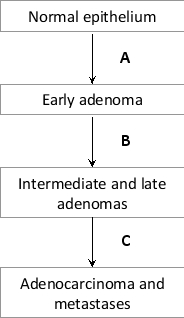 ( ) Activation of K-Ras
( ) Loss of p53
( ) Loss of Apc
( ) Activation of K-Ras
( ) Loss of p53
( ) Loss of Apc
(Short Answer)
4.9/5 (74)
(74) Indicate true (T) and false (F) statements below regarding the mutational landscape of cancer cells. Your answer would be a four-letter string composed of letters T and F only, e.g. TFFF.
( ) In each cancer, usually there is one driver mutation and a large number of passenger mutations.
( ) It is estimated that about 20% of our genes are cancer-critical.
( ) Cancer-critical genes can encode metabolic enzymes or components of the RNA splicing machinery.
( ) The karyotype is often severely disordered in cancer cells.
(Short Answer)
4.9/5 (91)
(91) In medical oncology, PET (positron emission tomography) is used to selectively image tumors in the body and to monitor cancer progression and response to treatment. Before performing a PET scan, the patient should fast for at least several hours for blood glucose to be sufficiently low. At the time of the scan, the positron-emitting glucose analog fluorodeoxyglucose (FDG) is injected into the bloodstream and the patient is asked to wait for up to an hour while avoiding physical activity. Finally, the scanner moves slowly over the body to reveal the location of possible tumors. Why do you think the patient should avoid physical activity before the scan?
(Multiple Choice)
4.9/5 (73)
(73) Which of the following proteins is NOT encoded by a proto-oncogene?
(Multiple Choice)
4.9/5 (71)
(71) The Rb gene in retinoblastomas is similar to the Apc gene in polyposis colon carcinomas in that both genes …
(Multiple Choice)
4.8/5 (88)
(88) The genotypes of 400 colorectal cancer tumors are tabulated below, where the number of tumors with or without mutations in each of the two cancer-critical genes, β-catenin and Apc, are indicated. Which row (a or b) corresponds to those with a mutant Apc gene? Which column (1 or 2) corresponds to those with a mutant β-catenin gene? 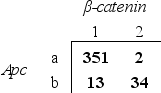
(Multiple Choice)
4.9/5 (93)
(93) Genetically knocking out both copies of the p53 gene in rats …
(Multiple Choice)
4.9/5 (88)
(88) Suppose you are studying tumor heterogeneity in a certain type of melanoma. You have used fluorescence-activated cell sorting (FACS) to specifically isolate those melanoma tumor cells that either do (first category) or do not (second category) express a specific marker present in normal stem cells in the tissue of origin (i.e. the melanocyte stem cells). You implant the same number of cells from each of these categories into severely immunodeficient mice and compare the tumor-formation efficiencies after several weeks, which turn out to be significantly higher for the first category. You then analyze the new tumors using FACS, and find out that the majority of the cells in the tumors that originated from the first category of cells harbor the stem-cell marker, whereas the majority of the cells in the tumors that originated from the second cell category lack the marker, just like their respective founder cells. Do these observations support the existence of cancer stem cells? Write down Yes or No as your answer.
(Short Answer)
4.9/5 (76)
(76) You have analyzed a large set of human cancer-critical genes for a selected group of carcinomas, classifying each of the genes based on whether they are known to undergo somatic or germ-line mutations, as well as based on whether they are dominant or recessive. You then group them and plot the statistics in the following histograms. Which group (a or b) do you think represents somatic, as compared to germ-line, mutations? Which group (1 or 2) do you think represents dominant, as compared to recessive, mutations? (Note that the sum of percentages of somatic and germ-line mutations is more than 100%, since some genes are mutated in both somatic and germ cells). 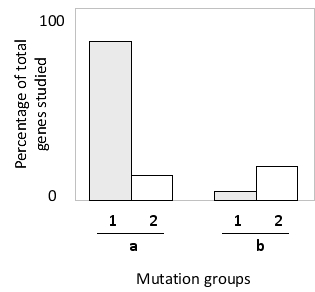
(Multiple Choice)
4.8/5 (88)
(88) Compared to cells of a normal tissue, which of the following occurs less frequently in cells within a solid tumor?
(Multiple Choice)
4.9/5 (74)
(74) You have karyotyped cells from two colorectal tumor samples, one from a hereditary nonpolyposis colorectal cancer (HNPCC) patient, and the other from a familial adenomatous polyposis coli (FAP) patient. One group of the karyotypes shows gross chromosomal abnormalities with extra or deleted chromosomes and several translocations and deletions. The other group, however, is almost normal, and comparable to noncancerous samples. Which group would you expect to have loss-of-function mutations in the DNA mismatch repair system genes MSH2 and MLH1 as their primary driver mutations?
(Multiple Choice)
4.9/5 (81)
(81) Mutations in two important cancer-critical genes, encoding p53 and Rb, respectively, are commonly found in cancers. What type of mutations are these expected to be?
(Multiple Choice)
4.8/5 (69)
(69) Retinoblastoma is an early-onset cancer of the retina with a rapid progression, and is mostly diagnosed in children. In its hereditary form, multiple eye tumors usually arise in both eyes, while the nonhereditary form usually causes fewer tumors in only one eye. Treatment may involve a combination of chemotherapy, radiotherapy, and other therapies and the majority of patients can be cured if given the right treatment. However, survivors of one form of retinoblastoma (and not the other form) have a markedly increased frequency of subsequent neoplasms that can lead to other cancers later in life, especially soft-tissue sarcomas. These patients should therefore be closely monitored throughout their lives. Which gene is affected by the primary driver mutation in this cancer as well as the later sarcomas? Which form of retinoblastoma do you think is associated with a higher risk of subsequent neoplasms?
(Multiple Choice)
4.8/5 (70)
(70) Indicate true (T) and false (F) statements below regarding cancer. Your answer would be a four-letter string composed of letters T and F only, e.g. TFFF.
( ) Cancer can be induced by infectious agents such as viruses.
( ) The earlier a cancer is diagnosed, the better the chances are for a cure.
( ) Most cancers originate from a single aberrant cell.
( ) A single mutation is NOT enough to turn a normal cell into a cancer cell.
(Short Answer)
4.9/5 (81)
(81) Indicate true (T) and false (F) statements below regarding cell proliferation in human somatic cancer cells. Your answer would be a four-letter string composed of letters T and F only, e.g. TFFF.
( ) Cancer cells show replicative cell senescence.
( ) Cancer cells maintain their telomeres by inhibiting the enzyme telomerase.
( ) Some cancer cells do not rely on telomerase for telomere lengthening.
( ) Most cancer cells lack telomeres.
(Short Answer)
4.8/5 (89)
(89) Which of the molecules (A or B) in the following drawing is a more potent mutagen? Write down A or B as your answer. 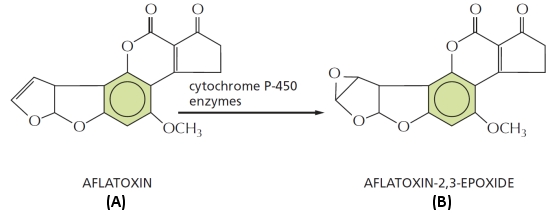
(Short Answer)
4.8/5 (88)
(88) 
Filters
- Essay(0)
- Multiple Choice(0)
- Short Answer(0)
- True False(0)
- Matching(0)