



 Chat with AI
Exam 4: DNA, Chromosomes, and Genomes

Exam 1: Cells and Genomes34 Questions
Exam 2: Cell Chemistry and Bioenergetics54 Questions
Exam 3: Proteins52 Questions
Exam 4: DNA, Chromosomes, and Genomes57 Questions
Exam 5: DNA Replication, Repair, and Recombination51 Questions
Exam 6: How Cells Read the Genome: From DNA to Protein58 Questions
Exam 7: Control of Gene Expression62 Questions
Exam 8: Analyzing Cells, Molecules, and Systems95 Questions
Exam 9: Visualizing Cells29 Questions
Exam 10: Membrane Structure26 Questions
Exam 11: Membrane Transport of Small Molecules and the Electrical Properties of Membranes46 Questions
Exam 12: Intracellular Compartments and Protein Sorting46 Questions
Exam 13: Intracellular Membrane Traffic54 Questions
Exam 14: Energy Conversion: Mitochondria and Chloroplasts49 Questions
Exam 15: Cell Signaling63 Questions
Exam 16: The Cytoskeleton75 Questions
Exam 17: The Cell Cycle57 Questions
Exam 18: Cell Death12 Questions
Exam 19: Cell Junctions and the Extracellular Matrix56 Questions
Exam 20: Cancer50 Questions
Exam 21: Development of Multicellular Organisms61 Questions
Exam 22: Stem Cells and Tissue Renewal45 Questions
Exam 23: Pathogens and Infection32 Questions
Exam 24: The Innate and Adaptive Immune Systems47 Questions
Select questions type


The centromeric regions in the fission yeast Schizosaccharomyces pombe are wrapped by nucleosomes containing the CENP-A histone H3 variant, and are flanked by clusters of tRNA genes that separate them from the surrounding pericentric heterochromatin. If the tRNA clusters are removed from this region, the HP1-bound heterochromatin spreads further to cover the centromeric regions. The tRNA genes are transcribed by strong RNA polymerase III promoters, which can associate with transcription factors and recruit chromatin-modifying enzymes.
Based on these observations, indicate which blanks (A to E) in the paragraph below correspond to each of the following phrases. Your answer would be a five-letter string composed of letters A to E only, e.g. BCDEA.
"The …(A) are not sufficient to prevent heterochromatin expansion to the centromeric regions. Instead, the …(B) are acting as …(C) in S. pombe, similar to the role of the …(D) in the ?-globin locus in chickens and humans. Likely candidates for the histone-modifying enzymes recruited by the RNA polymerase III complexes are …(E)."
( ) HS4 element
( ) chromatin boundaries
( ) histone acetyl transferases
( ) tRNA genes
( ) CENP-A-containing histones
(Short Answer)
4.8/5  (87)
(87) The eukaryotic chromosomes are organized inside the nucleus with a huge compaction ratio of several-thousand-fold. What is responsible for such a tight packaging?
(Multiple Choice)
4.8/5 (77)
(77) Indicate whether each of the following histone modifications is generally associated with active genes (A) or silenced genes (S). Your answer would be a four-letter string composed of letters A and S only, e.g. SSAS.
( ) H3 lysine 9 acetylation
( ) H3 serine 10 phosphorylation
( ) H3 lysine 4 trimethylation
( ) H3 lysine 9 trimethylation
(Short Answer)
4.8/5 (79)
(79) In assembling a nucleosome, normally the …(1) histone dimers first combine to form a tetramer, which then further combines with two … (2) histone dimers to form the octamer.
(Multiple Choice)
4.8/5 (73)
(73) Indicate true (T) and false (F) statements below regarding histones. Your answer would be a six-letter string composed of letters T and F only, e.g. TTFFFF.
( ) The histones are highly acidic proteins.
( ) The histone fold consists of three ? helices.
( ) The core histones are much more conserved than the H1 histone.
( ) The N-terminal tails of the core histones undergo a variety of reversible post-translational modifications.
( ) Every nucleosome core is made up of three polypeptide chains.
( ) The H1 histone is absent in the 30-nm fibers.
(Short Answer)
4.7/5 (69)
(69) The copy number of some human genes, such as the salivary amylase gene AMY1, varies greatly between different individuals. The salivary amylase breaks down some of the dietary starch into smaller sugars. In the case of AMY1, a positive correlation has been observed between the copy number and the amount of amylase in the saliva. Gene copy number per diploid genome can be estimated by performing a quantitative polymerase chain reaction (PCR) using primers specific to the gene of interest. You have performed such PCR experiments on samples from two human populations that have traditional diets with low and high starch levels, respectively, and have plotted the data in the histogram below. Which population (A or B) in the histogram is likely to be the one with traditionally higher dietary starch? Write down A or B as your answer. 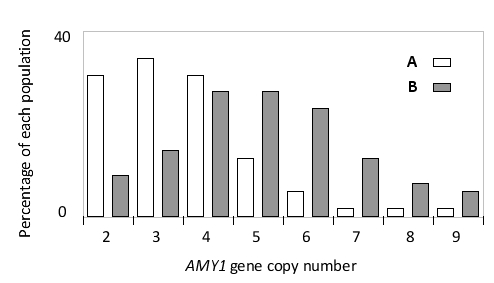
(Short Answer)
4.8/5 (83)
(83) Fill in the blanks in the following paragraph regarding genome evolution. In your answer, separate the two missing phrases with a comma, e.g. protein, plasma membrane. Do not use abbreviations.
"Conservation of genomic sequences between humans and chickens is mainly due to … selection, whereas the conservation observed between humans and chimpanzees is mostly due to the short time available for mutations to accumulate. Even the DNA sequences at the … position of synonymous codons are nearly identical between humans and chimpanzees."
(Short Answer)
4.8/5 (87)
(87) Fill in the blank in the following paragraph regarding chromatin organization. Do not use abbreviations.
"Our ~6.4-giganucleotide nuclear DNA is organized into 46 chromosomes, each occupying a territory inside the interphase nucleus. In each chromosome, the chromatin is thought to be composed of 'open' and 'closed' chromatin compartments. At the meganucleotide scale, each compartment is organized into knot-free arrangements called … that allow tight packing and simultaneously avoid entanglement."
(Short Answer)
5.0/5 (79)
(79) Imagine a human protein containing 33 repeats of a simple domain arranged in tandem. In contrast, a homolog found in bacteria contains only one domain. What is the minimum number of duplication events that can account for the evolution of this protein since our divergence from bacteria? Write down the number as your answer, e.g. 200.
(Short Answer)
4.8/5 (78)
(78) Compared to the human genome, the genome of yeast typically has …
(Multiple Choice)
4.9/5 (80)
(80) To discover genes that have undergone accelerated evolution in the human lineage, you compared the amino acid sequences of dozens of proteins from orthologous protein-coding genes in humans, chimpanzees, and mice. For each gene, you build an unrooted phylogenetic tree in which the branch lengths (a, b, or c) correspond to the number of amino acid substitutions in that branch, as depicted below. Primates and rodents diverged ~90 million years ago, and humans and chimpanzees diverged ~5.5 million years ago. For each individual gene shared by the three species, you therefore define the "normalized substitution rate" parameters h and k as h = (a/5.5)/[c/([2 × 90] - 5.5)], and k = (b/5.5)/[c/([2 × 90] - 5.5)]. Based on these definitions, which genes are more likely to be responsible for "uniquely human" traits? 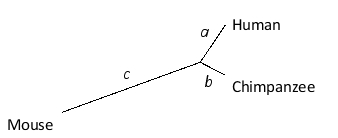
(Multiple Choice)
5.0/5 (80)
(80) Which of the following is NOT true about the nuclear subcompartments?
(Multiple Choice)
4.9/5 (85)
(85) Indicate whether each of the following descriptions better applies to a centromere (C), a telomere (T), or an origin of replication (O). Your answer would be a seven-letter string composed of letters C, T, and O only, e.g. TTTCCTO.
( ) It contains repeated sequences at the ends of the chromosomes.
( ) It is NOT generally longer in higher organisms compared to yeast.
( ) Each eukaryotic chromosome has many such sequences.
( ) There are normally two such sequences in each eukaryotic chromosomal DNA molecule.
( ) There is normally one such sequence per eukaryotic chromosomal DNA molecule.
( ) It is where DNA duplication starts in S phase.
( ) It attaches the chromosome to the mitotic spindle via the kinetochore structure.
(Short Answer)
4.8/5 (88)
(88) A DNA nucleotide pair has an average mass of approximately 660 daltons. Knowing the number of nucleotides in the human genome, how many picograms of DNA are there in a diploid human nucleus? Avogadro's number is 6 × 10²³. Write down the picogram amount without decimals (round the number to the closest integer), e.g. 23 pg.
(Short Answer)
4.8/5 (77)
(77) It has been shown that inhibition of a key chromatin remodeling complex known as NuRD, by deleting one of its subunits, can result in a significant increase in the efficiency of reprogramming of somatic cells into pluripotent stem cells. The reprogramming is normally done by the induced expression of a battery of transcription factors in the somatic cells, but is typically not very efficient. Such an observation suggests that the NuRD complex is normally involved in …
(Multiple Choice)
4.8/5 (82)
(82) 
Filters
- Essay(0)
- Multiple Choice(0)
- Short Answer(0)
- True False(0)
- Matching(0)