



 Chat with AI
Exam 4: DNA, Chromosomes, and Genomes

Exam 1: Cells and Genomes34 Questions
Exam 2: Cell Chemistry and Bioenergetics54 Questions
Exam 3: Proteins52 Questions
Exam 4: DNA, Chromosomes, and Genomes57 Questions
Exam 5: DNA Replication, Repair, and Recombination51 Questions
Exam 6: How Cells Read the Genome: From DNA to Protein58 Questions
Exam 7: Control of Gene Expression62 Questions
Exam 8: Analyzing Cells, Molecules, and Systems95 Questions
Exam 9: Visualizing Cells29 Questions
Exam 10: Membrane Structure26 Questions
Exam 11: Membrane Transport of Small Molecules and the Electrical Properties of Membranes46 Questions
Exam 12: Intracellular Compartments and Protein Sorting46 Questions
Exam 13: Intracellular Membrane Traffic54 Questions
Exam 14: Energy Conversion: Mitochondria and Chloroplasts49 Questions
Exam 15: Cell Signaling63 Questions
Exam 16: The Cytoskeleton75 Questions
Exam 17: The Cell Cycle57 Questions
Exam 18: Cell Death12 Questions
Exam 19: Cell Junctions and the Extracellular Matrix56 Questions
Exam 20: Cancer50 Questions
Exam 21: Development of Multicellular Organisms61 Questions
Exam 22: Stem Cells and Tissue Renewal45 Questions
Exam 23: Pathogens and Infection32 Questions
Exam 24: The Innate and Adaptive Immune Systems47 Questions
Select questions type


Which of the following features of DNA underlies its simple replication procedure?
(Multiple Choice)
4.7/5  (70)
(70) What features do Cajal bodies, interchromatin granule clusters, and nucleoli have in common?
(Multiple Choice)
4.9/5 (86)
(86) For each of the following classifications, indicate whether you would expect to find an actively transcribed gene in the first category (1) or the second (2). Your answer would be a six-digit number composed of digits 1 and 2 only, e.g. 222121.
( ) 1: Heterochromatin, or 2: euchromatin
( ) 1: Chromosome puffs, or 2: condensed chromosome bands
( ) 1: Nuclear periphery, or 2: the center of the nucleus
( ) 1: Within the chromosome territory, or 2: extended out of the territory
( ) 1: Apart from, or 2: close to actively transcribed genes within the nucleus
( ) 1: 11-nm "beads-on-a-string" fibers, or 2: 30-nm fibers
(Short Answer)
4.9/5 (80)
(80) Indicate true (T) and false (F) statements below about the human genome. Your answer would be a six-letter string composed of letters T and F only, e.g. FTFFFT.
( ) Only about 1.5% of the human genome is highly conserved.
( ) Almost half of our genome is composed of repetitive sequences.
( ) Genes occupy almost a quarter of the genome.
( ) There are roughly as many pseudogenes in the human genome as functional genes.
( ) Transposable elements occupy almost 10% of our genome.
( ) On average, exons comprise 1.5% of our genes.
(Short Answer)
4.9/5 (78)
(78) In a double-stranded DNA molecule, one of the chains has the sequence CCCATTCTA when read from the 5? to the 3? end. Indicate true (T) and false (F) statements below regarding this chain. Your answer would be a four-letter string composed of letters T and F only, e.g. TTFT.
( ) The other chain is heavier, i.e. it has a greater mass.
( ) There are no C residues in the other chain.
( ) The 5?-terminal residue of the other chain is G.
( ) The other chain is pyrimidine-rich.
(Short Answer)
4.9/5 (83)
(83) Which of the following would most reliably suggest that a genomic sequence is functionally important?
(Multiple Choice)
4.9/5 (60)
(60) Most fish genomes are at least 1 billion nucleotide pairs long. However, the genome of the puffer fish Fugu rubripes is quite small at only about 0.4 billion nucleotide pairs, even though the number of Fugu genes is estimated to be comparable to that of its relatives which have larger genomes. What do you think mainly accounts for the Fugu genome being this small?
(Multiple Choice)
4.9/5 (73)
(73) As each cell in our body prepares for mitosis, its chromosomes start to look different. What are the changes in chromosome appearance that accompany the entry into M phase? Indicate true (T) and false (F) descriptions below. Your answer would be a five-letter string composed of letters T and F only, e.g. TTFFT.
( ) The chromosomes become readily visible by the naked eye.
( ) The chromosomes coil up further to become about 10 times shorter.
( ) Each chromosome is condensed and then replicated to form two sister chromatids.
( ) The typical diameter of a mitotic chromosome arm is about 70 nm.
( ) The two sister chromatids are disentangled from each other by the time chromosome condensation is complete.
(Short Answer)
4.8/5 (57)
(57) Polytene chromosomes are useful for studying chromatin because they …
(Multiple Choice)
4.9/5 (67)
(67) Imagine a chromosome translocation event that brings a gene encoding a histone acetyl transferase enzyme from its original chromosomal location to a new one near heterochromatin. Which of the following scenarios is definitely NOT going to happen?
(Multiple Choice)
4.8/5 (86)
(86) Phylogenetic trees based on nucleotide or amino acid sequences can be constructed using various algorithms. One simple algorithm is based on a matrix of pairwise genetic distances (divergences) calculated after multiple alignment of the sequences. Imagine you have aligned a particular gene from different hominids (humans and the great apes), and have estimated the normalized number of nucleotide substitutions that have occurred in this gene in each pair of organisms since their divergence from their last common ancestor. You have obtained the following distance matrix.
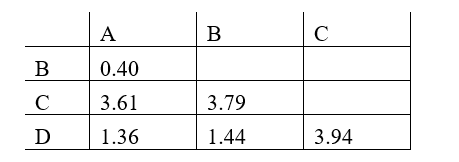 Answer the following question(s) based on this matrix.
-If species A in the distance matrix represents human, indicate which of the other species (B to D) represents chimpanzee, gorilla, and orangutan, respectively. Your answer would be a three-letter string composed of letters B, C, and D only, e.g. DCB.
Answer the following question(s) based on this matrix.
-If species A in the distance matrix represents human, indicate which of the other species (B to D) represents chimpanzee, gorilla, and orangutan, respectively. Your answer would be a three-letter string composed of letters B, C, and D only, e.g. DCB.
(Short Answer)
4.8/5 (82)
(82) Which of the following is true regarding heterochromatin in a typical mammalian cell?
(Multiple Choice)
4.7/5 (93)
(93) Five major types of chromatin were identified in studies performed on Drosophila melanogaster cells, although much more remains to be learned about chromatin diversity and dynamics. Which of the following is correct regarding these findings in Drosophila?
(Multiple Choice)
4.8/5 (92)
(92) The genetic information carried by a cell is passed on, generation after generation, with astonishing fidelity. However, genomes are still altered over evolutionary time scales, and even their overall size can change significantly. Which of the following genome-altering events has increased the size of the mammalian genome the most?
(Multiple Choice)
4.8/5 (85)
(85) The chromatin remodeling complexes play an important role in chromatin regulation in the nucleus. They …
(Multiple Choice)
4.8/5 (96)
(96) The globin gene family in mammals, birds, and reptiles is organized into ?- and ?-globin gene clusters that are located on two different chromosomes. In most fish and amphibians, however, the globin genes are close to each other on one chromosome. At which point (A to E) in the following simplified phylogenetic tree is a chromosomal translocation likely to have happened that placed the ?- and ?-globin genes on two separate chromosomes? 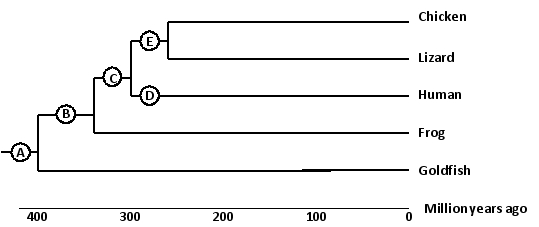
(Short Answer)
5.0/5 (78)
(78) Which of the following correlates the best with biological complexity in eukaryotes?
(Multiple Choice)
4.9/5 (81)
(81) The position effect variegation (PEV) phenotype described in this chapter can be used to identify new genes that regulate heterochromatin formation. For instance, strains of Drosophila melanogaster with the White variegation phenotype have been subjected to mutagenesis to screen for dominant mutations (in other genes) that either enhance or suppress PEV, meaning the mutations result in either lower or higher red pigment production, respectively. Which of the following mutations is expected to be an enhancer of variegation?
(Multiple Choice)
4.7/5 (80)
(80) Indicate true (T) and false (F) statements below regarding human genetic variations. Your answer would be a four-letter string composed of letters T and F only, e.g. TFTF.
( ) The genomes of two randomly chosen humans are expected to be identical with respect to at least 99.99% of the nucleotides.
( ) Copy number variations can contain genes.
( ) If the frequency of a point mutation in a population is only 0.1%, with no mutation at this site in the rest of the population, then the variation is NOT considered to constitute a single-nucleotide polymorphism.
( ) Most of the common genetic variants in the current human population could have been present in a human ancestral population of only about 10,000 individuals.
(Short Answer)
4.9/5 (76)
(76) 
Filters
- Essay(0)
- Multiple Choice(0)
- Short Answer(0)
- True False(0)
- Matching(0)