



 Chat with AI
Exam 2: Cell Chemistry and Bioenergetics

Exam 1: Cells and Genomes34 Questions
Exam 2: Cell Chemistry and Bioenergetics54 Questions
Exam 3: Proteins52 Questions
Exam 4: DNA, Chromosomes, and Genomes57 Questions
Exam 5: DNA Replication, Repair, and Recombination51 Questions
Exam 6: How Cells Read the Genome: From DNA to Protein58 Questions
Exam 7: Control of Gene Expression62 Questions
Exam 8: Analyzing Cells, Molecules, and Systems95 Questions
Exam 9: Visualizing Cells29 Questions
Exam 10: Membrane Structure26 Questions
Exam 11: Membrane Transport of Small Molecules and the Electrical Properties of Membranes46 Questions
Exam 12: Intracellular Compartments and Protein Sorting46 Questions
Exam 13: Intracellular Membrane Traffic54 Questions
Exam 14: Energy Conversion: Mitochondria and Chloroplasts49 Questions
Exam 15: Cell Signaling63 Questions
Exam 16: The Cytoskeleton75 Questions
Exam 17: The Cell Cycle57 Questions
Exam 18: Cell Death12 Questions
Exam 19: Cell Junctions and the Extracellular Matrix56 Questions
Exam 20: Cancer50 Questions
Exam 21: Development of Multicellular Organisms61 Questions
Exam 22: Stem Cells and Tissue Renewal45 Questions
Exam 23: Pathogens and Infection32 Questions
Exam 24: The Innate and Adaptive Immune Systems47 Questions
Select questions type


Steps 6 and 7 of glycolysis are catalyzed by the enzymes glyceraldehyde 3-phosphate dehydrogenase and phosphoglycerate kinase, respectively. Together, they ...
(Multiple Choice)
4.8/5  (83)
(83) The enzyme phosphoglucose isomerase converts glucose 6-phosphate to its isomer fructose 6-phosphate in the second step of glycolysis. The equilibrium constant for the reaction is 0.36. Evaluating the ΔG° of the reaction (ΔG° = -5.9 × log Kₑq), decide which of the following conclusions is true.
(Multiple Choice)
4.8/5 (84)
(84) Sort the following molecules based on the amount of energy that is released when their phosphate bond is hydrolyzed as indicated. Your answer would be a four-letter string composed of letters A to D only, e.g. ADCB. Put the molecule with the highest amount of hydrolysis energy on the left.
(A) ATP when hydrolyzed to ADP
(B) Glucose 6-phosphate when hydrolyzed to glucose
(C) 1,3-bisphosphoglycerate when hydrolyzed to 3-phosphoglycerate
(D) Phosphoenolpyruvate when hydrolyzed to pyruvate
(Short Answer)
4.9/5 (65)
(65) What is the end product of glycolysis in the cytoplasm of eukaryotic cells? How many carbon atoms does the molecule have?
(Multiple Choice)
4.9/5 (89)
(89) The electron carriers NADH and FADH₂ donate their electrons to the electron-transport chain in the inner mitochondrial membrane, leading to ATP synthesis powered by an H⁺ gradient across the membrane. If, on average, the oxidation of each NADH or FADH₂ molecule in this pathway results in the production of 2.5 and 1.5 molecules of ATP, respectively, how many ATP (and GTP) molecules are produced on average as a result of the complete oxidation of one molecule of acetyl CoA in the mitochondrion? Consider only the citric acid cycle and oxidative phosphorylation.
(Multiple Choice)
4.9/5 (76)
(76) For each of the following pairs, indicate whether they interact via hydrogen bonds (H) or ionic bonds (I), or do not favorably interact (N). Your answer would be a four-letter string composed of letters H, I, and N only, e.g. HNNI.
( ) ATP and Mg²?
( ) Urea and water
( ) Glucose and the enzyme hexokinase (which uses glucose as a substrate)
( ) A phospholipid tail and inorganic phosphate
(Short Answer)
4.9/5 (77)
(77) The bond energies associated with noncovalent attractions in the cell are too weak to resist disruption by thermal motion. However, cellular macromolecules can interact specifically AND strongly with each other (or fold by themselves) merely via such interactions. How is this possible?
(Multiple Choice)
4.9/5 (66)
(66) The citric acid cycle is summarized in the following figure. Answer the following question(s) about this cycle.
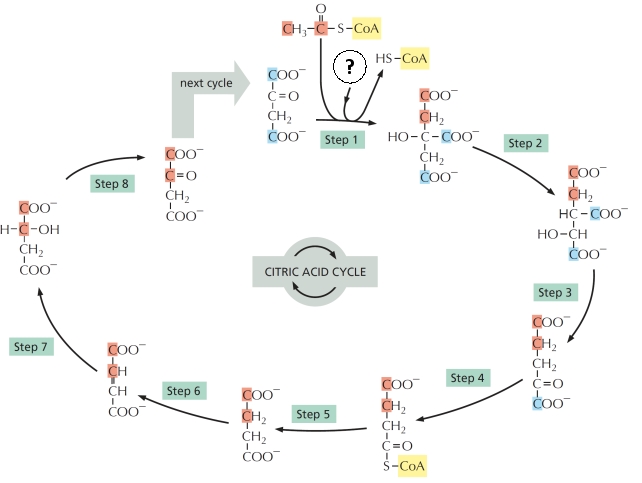 -In the citric acid cycle shown above, which steps produce either NADH or FADH?? List all such steps by their number, from the smallest number to the largest. Your answer would be a number composed of digits 1 to 8 only, e.g. 258.
(Short Answer)
4.9/5 (76)
(76) Enzymes are the cell's catalyst crew. They make the life of the cell possible by carrying out various reactions with astounding performance. Which of the following is NOT true regarding cellular enzymes?
(Multiple Choice)
4.7/5 (81)
(81) Which of the following elements is not normally found in cells?
(Multiple Choice)
4.7/5 (87)
(87) Which of the following is true regarding energy production and storage in plants and animals?
(Multiple Choice)
4.8/5 (92)
(92) Which of the following chemicals do you NOT expect to be readily dissolved in water?
(Multiple Choice)
4.7/5 (86)
(86) Indicate whether each of the following molecules is an intermediate in glycolysis (G) or in the tricarboxylic acid cycle (T). Your answer would be a four-letter string composed of letters G and T only, e.g. GGTT.
( ) Fumarate
( ) Malate
( ) Phosphoenolpyruvate
( ) Succinate
(Short Answer)
4.9/5 (73)
(73) The equilibrium constant for the reaction that breaks down each molecule of substrate A to one molecule of B and one molecule of C is equal to 0.5. Starting with a mixture containing only molecules A at 1 M concentration, what will be the concentration of molecule A after reaching equilibrium under these conditions?
(Multiple Choice)
4.9/5 (90)
(90) 
Filters
- Essay(0)
- Multiple Choice(0)
- Short Answer(0)
- True False(0)
- Matching(0)