



 Chat with AI
Exam 2: Cell Chemistry and Bioenergetics

Exam 1: Cells and Genomes34 Questions
Exam 2: Cell Chemistry and Bioenergetics54 Questions
Exam 3: Proteins52 Questions
Exam 4: DNA, Chromosomes, and Genomes57 Questions
Exam 5: DNA Replication, Repair, and Recombination51 Questions
Exam 6: How Cells Read the Genome: From DNA to Protein58 Questions
Exam 7: Control of Gene Expression62 Questions
Exam 8: Analyzing Cells, Molecules, and Systems95 Questions
Exam 9: Visualizing Cells29 Questions
Exam 10: Membrane Structure26 Questions
Exam 11: Membrane Transport of Small Molecules and the Electrical Properties of Membranes46 Questions
Exam 12: Intracellular Compartments and Protein Sorting46 Questions
Exam 13: Intracellular Membrane Traffic54 Questions
Exam 14: Energy Conversion: Mitochondria and Chloroplasts49 Questions
Exam 15: Cell Signaling63 Questions
Exam 16: The Cytoskeleton75 Questions
Exam 17: The Cell Cycle57 Questions
Exam 18: Cell Death12 Questions
Exam 19: Cell Junctions and the Extracellular Matrix56 Questions
Exam 20: Cancer50 Questions
Exam 21: Development of Multicellular Organisms61 Questions
Exam 22: Stem Cells and Tissue Renewal45 Questions
Exam 23: Pathogens and Infection32 Questions
Exam 24: The Innate and Adaptive Immune Systems47 Questions
Select questions type


The cell can change the pH of its internal compartments using membrane transport proteins that pump protons into or out of a compartment. How many protons should be pumped into an endocytic vesicle that is 10-¹⁵ liters in volume and has a neutral pH in order to change the pH to 5? Avogadro's number is 6 × 10²³. Omit complications such as the membrane potential, buffers, and other cellular components.
(Multiple Choice)
4.9/5  (89)
(89) Which of the following represents an "activated" carrier molecule?
(Multiple Choice)
4.9/5 (84)
(84) Indicate true (T) and false (F) statements below regarding glycolysis. Your answer would be a four-letter string composed of letters T and F only, e.g. TTTT.
( ) Molecular oxygen is used in glycolysis to oxidize glucose.
( ) Along the glycolytic pathway, ATP is both consumed and generated.
( ) In the course of glycolysis, one molecule of NADH is formed per molecule of glucose.
( ) Following the production of one molecule of fructose 1,6-bisphosphate, the rest of the glycolytic pathway generates four molecules of ATP.
(Short Answer)
4.9/5 (94)
(94) Indicate if each of the following descriptions matches lipids (1), nucleic acids (2), polysaccharides (3), or proteins (4). Your answer would be a four-digit number composed of digits 1 to 4 only, e.g. 1332.
( ) Their monomers contain phosphorus and nitrogen.
( ) They constitute almost half of the cell's dry mass.
( ) They are the main constituent of all cellular membranes.
( ) They are largely hydrophobic and can store energy.
(Short Answer)
4.9/5 (74)
(74) What is the pH of a 10-⁸ M solution of hydrochloric acid? Round the pH value to the nearest integer, e.g. 10.
(Multiple Choice)
4.9/5 (75)
(75) Macromolecules in the cell can be made from their monomers using one of two polymerization schemes. One is called head polymerization, in which the reactive bond required for polymerization is carried on the end of the growing polymer. In contrast, in tail polymerization, the reactive bond is carried by each monomer for its own incorporation. In the figure, indicate the polymerization scheme and the type of macromolecule. 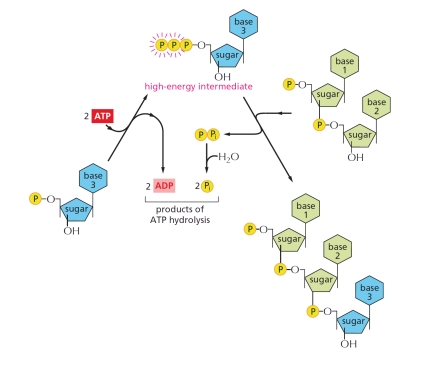
(Multiple Choice)
4.9/5 (77)
(77) In the following diagram showing the distribution of thermal energy in a population of substrate molecules, the energy thresholds indicated by numbers represent ... 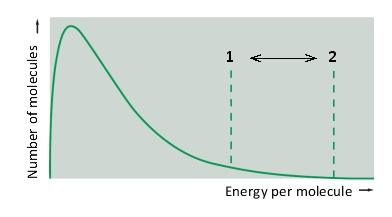
(Multiple Choice)
4.9/5 (78)
(78) In an enzymatic reaction involving NADH or NADPH, reduction of a substrate accompanies the oxidation of these carrier molecules to NAD⁺ or NADP⁺, respectively. What else typically happens in such a reaction?
(Multiple Choice)
4.8/5 (82)
(82) Indicate whether each of the following descriptions matches glycolysis (G) or the Krebs cycle (K). Your answer would be a four-letter string composed of letters G and K only, e.g. GGGK.
( ) It oxidizes acetyl CoA to CO?.
( ) In eukaryotic cells, it is carried out in the cytosol.
( ) It produces FADH?.
( ) ?-Ketoglutarate, one of its intermediates, is used to synthesize the amino acid glutamic acid.
(Short Answer)
4.9/5 (70)
(70) The folding of proteins can be considered a simple conversion from the unfolded to the natively folded state. At about 27°C (or 300 K), the free-energy change of folding for a particular protein is measured to be -40 kJ/mole. If the enthalpy change (?H) of folding is -640 kJ/mole, what is the entropy change (?S) of folding for this protein? Write down your answer with the appropriate sign (+ or -) and in kJ/mole/K, e.g. -1000 kJ/mole/K.
(Short Answer)
4.8/5 (83)
(83) The citric acid cycle is summarized in the following figure. Answer the following question(s) about this cycle.
 -In the citric acid cycle shown above, which steps produce CO? as a by-product? List all such steps by their number, from the smallest number to the largest. Your answer would be a number composed of digits 1 to 8 only, e.g. 258.
(Short Answer)
4.8/5 (83)
(83) Despite their overall similarity, NADH and NADPH are not used indiscriminately by the cell. What are the distinctive features of these two carrier molecules?
(Multiple Choice)
4.9/5 (77)
(77) In the following diagram showing the reaction pathway for a simple single-substrate enzymatic reaction, which of the quantities corresponds to the activation energy of the forward reaction? 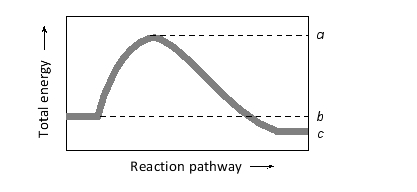
(Multiple Choice)
4.8/5 (83)
(83) The molecules inside the cell constantly collide with other molecules and diffuse through the cytoplasm in a random walk. The average net distance traveled by such a molecule after a certain time period t is proportional to the square root of t, i.e. (t)⁰.⁵, as well as to its diffusion coefficient. If, on average, it takes a molecule 100 milliseconds to travel a net distance of 0.5 µm from its starting point, how long would it normally take for the same molecule to travel a net distance of 5 µm from the same starting point?
(Multiple Choice)
4.9/5 (72)
(72) Fill in the blank in the following paragraph.
"During intense 'anaerobic' physical exercise, the high energy demand in the muscle cells leads to an accumulation of lactic acid in these cells and their surrounding tissues. Similarly, the yeast Saccharomyces cerevisiae can produce ethanol when grown anaerobically. The lactate or ethanol production takes place in a process called ..."
(Short Answer)
4.8/5 (85)
(85) A cellular enzyme catalyzes the catabolic reaction shown below. Its coenzyme is shown in the box. Which of the following is correct regarding this reaction? 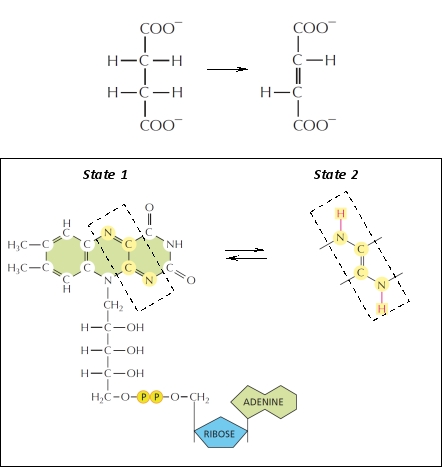
(Multiple Choice)
4.9/5 (76)
(76) Which of the following correctly summarizes the overall process of photosynthesis?
(Multiple Choice)
5.0/5 (85)
(85) Which of the following statements is true regarding reactions involving oxidation and reduction?
(Multiple Choice)
4.8/5 (85)
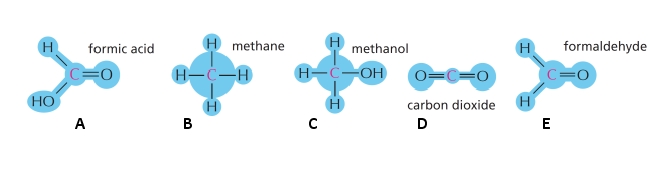
(85) Sort the following molecules (A to E) based on the oxidation of the carbon atom, from higher to lower oxidation states. Your answer would be a five-letter string composed of letters A to E only, e.g. ADCBE. Put the letter corresponding to the highest oxidation level on the left.
(Short Answer)
4.8/5 (79)
(79) 
Filters
- Essay(0)
- Multiple Choice(0)
- Short Answer(0)
- True False(0)
- Matching(0)