



 Chat with AI
Exam 2: Choice, Opportunity Costs, and Specialization

Exam 1: Economics: the World Around You90 Questions
Exam 2: Choice, Opportunity Costs, and Specialization98 Questions
Exam 3: Markets, Demand and Supply, and the Price System99 Questions
Exam 4: The Market System and the Private and Public Sector100 Questions
Exam 5: National Income Accounting104 Questions
Exam 6: An Introduction to the Foreign Exchange Market and the Balance of Payments90 Questions
Exam 7: Unemployment and Inflation130 Questions
Exam 8: Macroeconomic Equilibrium: Aggregate Demand and Supply123 Questions
Exam 9: Aggregate Expenditures120 Questions
Exam 10: Income and Expenditures Equilibrium135 Questions
Exam 11: Fiscal Policy94 Questions
Exam 12: Money and Banking125 Questions
Exam 13: Monetary Policy138 Questions
Exam 14: Macroeconomic Policy: Tradeoffs, Expectations, Credibility, and Sources of Business Cycles117 Questions
Exam 15: Macroeconomic Viewpoints: New Keynesian, Monetarist, and New Classical103 Questions
Exam 16: Economic Growth99 Questions
Exam 17: Development Economics105 Questions
Exam 18: Globalization85 Questions
Exam 19: World Trade Equilibrium112 Questions
Exam 20: International Trade Restrictions109 Questions
Exam 21: Exchange Rates and Financial Links Between Countries132 Questions
Select questions type


If the resources within a nation are not being fully or efficiently utilized, it means:
(Multiple Choice)
4.8/5  (78)
(78) Which economic concept is the closest parallel to the saying "There's no free lunch"?
(Multiple Choice)
5.0/5 (88)
(88) Which of the following conditions will be true for a nation operating at a point lying inside its production possibilities curve?
(Multiple Choice)
4.8/5 (69)
(69) The table given below represents butter and ham production by two countries Norway and Sweden.
Table 2.5
Tirne Spent Making Eutter Namay Sweden 100\% Butter 5 100 0\% Ham 10 100
-Refer to Table 2.5 and identify the correct statement.
(Multiple Choice)
4.9/5 (85)
(85) It has been generally observed that most trade in the world occurs between a developed and a less-developed nation rather than between industrial or developed nations.
(True/False)
4.9/5 (68)
(68) Which of the following will result in an outward shift of the production possibilities curve [PPC]?
(Multiple Choice)
4.7/5 (66)
(66) If you have a choice of consuming either two apples, three oranges, or one candy bar, the opportunity cost of the candy bar is:
(Multiple Choice)
4.8/5 (73)
(73) Which of the following statements is true about comparative advantage?
(Multiple Choice)
4.8/5 (77)
(77) If a nation specializes in activities in which opportunity costs are the lowest and then trades with other nations, it is most likely to:
(Multiple Choice)
5.0/5 (76)
(76) Which of the following is related to the concept of trade-off used in economics?
(Multiple Choice)
4.7/5 (89)
(89) If using the same resources, the U.S. workers can produce more of any good than Mexican workers, then the United States should produce every good.
(True/False)
4.8/5 (82)
(82) The figure given below represents an economy producing corn and planes under different economic situations.
Figure 2.2
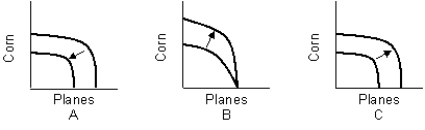 -Refer to Figure 2.2. If there is an increase in the education level of the population, graph(s) _____ best illustrate(s) what will happen to the production possibilities curve [PPC].
 (Multiple Choice)
4.8/5 (74)
(74) When constructing a production possibility curve for an economy, which of the following is assumed to be constant?
(Multiple Choice)
4.8/5 (89)
(89) Given a production possibilities curve for defense goods and nondefense goods, which of the following is not true?
(Multiple Choice)
4.7/5 (84)
(84) Which of the following will bring about an inward shift of a production possibilities curve [PPC]?
(Multiple Choice)
4.9/5 (75)
(75) Which of the following exemplifies a private property right?
(Multiple Choice)
4.8/5 (81)
(81) The city of Austin can buy roads or light rail. If 10 miles of roads cost $1 million and 2 miles of light rail cost $10 million, what is the city's opportunity cost of 1000 miles of roads?
(Multiple Choice)
4.8/5 (101)
(101) The figure given below represents the PPC in two nations - Germany and Korea, producing only two goods cars and food.
Figure 2.4
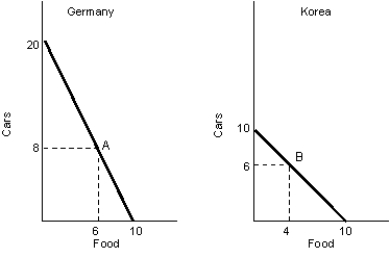 -Refer to Figure 2.4 and identify the correct statement.
 (Multiple Choice)
5.0/5 (76)
(76) 
Filters
- Essay(0)
- Multiple Choice(0)
- Short Answer(0)
- True False(0)
- Matching(0)