



 Chat with AI
Exam 2: Choice, Opportunity Costs, and Specialization

Exam 1: Economics: the World Around You90 Questions
Exam 2: Choice, Opportunity Costs, and Specialization98 Questions
Exam 3: Markets, Demand and Supply, and the Price System99 Questions
Exam 4: The Market System and the Private and Public Sector100 Questions
Exam 5: National Income Accounting104 Questions
Exam 6: An Introduction to the Foreign Exchange Market and the Balance of Payments90 Questions
Exam 7: Unemployment and Inflation130 Questions
Exam 8: Macroeconomic Equilibrium: Aggregate Demand and Supply123 Questions
Exam 9: Aggregate Expenditures120 Questions
Exam 10: Income and Expenditures Equilibrium135 Questions
Exam 11: Fiscal Policy94 Questions
Exam 12: Money and Banking125 Questions
Exam 13: Monetary Policy138 Questions
Exam 14: Macroeconomic Policy: Tradeoffs, Expectations, Credibility, and Sources of Business Cycles117 Questions
Exam 15: Macroeconomic Viewpoints: New Keynesian, Monetarist, and New Classical103 Questions
Exam 16: Economic Growth99 Questions
Exam 17: Development Economics105 Questions
Exam 18: Globalization85 Questions
Exam 19: World Trade Equilibrium112 Questions
Exam 20: International Trade Restrictions109 Questions
Exam 21: Exchange Rates and Financial Links Between Countries132 Questions
Select questions type


Given below is the production possibilities schedule for capital goods and consumer goods.
Table 2.3
Production Possibilities Schedule Combination Capital Goods Consumer Goods A 4 0 B 3 4 C 2 7 D 1 9 E 0 10
-If the nation depicted in Figure 2.3 is producing at combination E, the opportunity cost of producing the tenth unit of consumer good is:
(Multiple Choice)
4.9/5  (68)
(68) The table given below represents the output per hour of cookies and chilies in Ohio and Iowa.
Table 2.4
Output per Hour Iowa Cookies Chilies Ohid 6 24 Iowa 12 96
-Refer to Table 2.4. Identify the correct statement.
(Multiple Choice)
4.8/5 (71)
(71) A bowed-out production possibilities curve [PPC] implies that the marginal opportunity cost of producing more of one good is:
(Multiple Choice)
4.8/5 (71)
(71) The figure given below represents the production possibilities curve for goods and services in an economy.
Figure 2.3
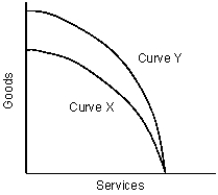 -Refer to Figure 2.3. The movement from Curve X to Curve Y indicates:
 (Multiple Choice)
4.9/5 (83)
(83) Shirley can choose between peanut butter pretzels and caramel coated popcorns for her evening snack. According to economists, her _____ cost of consuming caramel coated popcorns would be the forgone peanut butter pretzels.
(Multiple Choice)
4.8/5 (80)
(80) If an individual can produce a good or service with a lower opportunity cost than another individual, then he or she is said to have the comparative advantage.
(True/False)
4.9/5 (85)
(85) The table given below represents the output per hour of cookies and chilies in Ohio and Iowa.
Table 2.4
Output per Hour Iowa Cookies Chilies Ohid 6 24 Iowa 12 96
-Refer to Table 2.4. The opportunity cost of a chili in Ohio is:
(Multiple Choice)
4.9/5 (87)
(87) Consider the production possibilities curve [PPC] for a country producing only two commodities; wheat and wine. Ceteris paribus, the _____ cost of producing wine increases with each successive increase in wine production.
(Multiple Choice)
4.9/5 (78)
(78) The table given below represents the output per hour of cookies and chilies in Ohio and Iowa.
Table 2.4
Output per Hour Iowa Cookies Chilies Ohid 6 24 Iowa 12 96
-Refer to Table 2.4. Calculate the opportunity cost of a cookie in Iowa.
(Multiple Choice)
4.8/5 (74)
(74) Individuals, firms, and nations should specialize in those activities which have the highest marginal cost.
(True/False)
4.8/5 (77)
(77) Which of the following would not cause any kind of an outward shift of a nation's production possibilities curve [PPC]?
(Multiple Choice)
4.8/5 (73)
(73) While constructing a production possibilities frontier [PPF], we assume:
(Multiple Choice)
4.7/5 (71)
(71) The figure given below represents the PPC in two nations - Germany and Korea, producing only two goods cars and food.
Figure 2.4
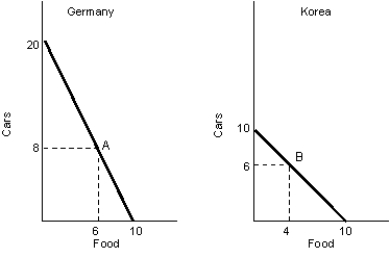 -Refer to Figure 2.4. What would be the marginal opportunity cost of producing one unit of food in Korea assuming the economy is at point B?
 (Multiple Choice)
4.9/5 (82)
(82) Economic growth can be illustrated by an outward shift of the PPC.
(True/False)
4.9/5 (92)
(92) The marginal cost of producing a commodity increases because of specialization.
(True/False)
4.9/5 (78)
(78) The giving up of a good or activity in order to obtain some other good or activity is called:
(Multiple Choice)
4.9/5 (69)
(69) 
Filters
- Essay(0)
- Multiple Choice(0)
- Short Answer(0)
- True False(0)
- Matching(0)