



 Chat with AI
Exam 10: Income and Expenditures Equilibrium

Exam 1: Economics: the World Around You90 Questions
Exam 2: Choice, Opportunity Costs, and Specialization98 Questions
Exam 3: Markets, Demand and Supply, and the Price System99 Questions
Exam 4: The Market System and the Private and Public Sector100 Questions
Exam 5: National Income Accounting104 Questions
Exam 6: An Introduction to the Foreign Exchange Market and the Balance of Payments90 Questions
Exam 7: Unemployment and Inflation130 Questions
Exam 8: Macroeconomic Equilibrium: Aggregate Demand and Supply123 Questions
Exam 9: Aggregate Expenditures120 Questions
Exam 10: Income and Expenditures Equilibrium135 Questions
Exam 11: Fiscal Policy94 Questions
Exam 12: Money and Banking125 Questions
Exam 13: Monetary Policy138 Questions
Exam 14: Macroeconomic Policy: Tradeoffs, Expectations, Credibility, and Sources of Business Cycles117 Questions
Exam 15: Macroeconomic Viewpoints: New Keynesian, Monetarist, and New Classical103 Questions
Exam 16: Economic Growth99 Questions
Exam 17: Development Economics105 Questions
Exam 18: Globalization85 Questions
Exam 19: World Trade Equilibrium112 Questions
Exam 20: International Trade Restrictions109 Questions
Exam 21: Exchange Rates and Financial Links Between Countries132 Questions
Select questions type


If the spending multiplier equals 6 and equilibrium real GDP is $32 billion below potential real GDP, then total planned expenditures need to decrease by approximately $5.33 billion to close the recessionary gap.
(True/False)
4.9/5  (87)
(87) Leakages are greater than injections when total planned expenditures exceed real GDP.
(True/False)
4.8/5 (84)
(84) A marginal propensity to consume of 0.75 and a marginal propensity to import of 0.05 are associated with an open-economy spending multiplier of 3.33.
(True/False)
4.8/5 (82)
(82) The interest rate effect states that an increase in the price level will cause:
(Multiple Choice)
4.7/5 (93)
(93) The table given below reports the value of real GDP and its components consumption (C), investment (I), exports, and imports for two consecutive years.
Table 10.3
Equilibrium Real GDP C I Exports Imports Year 1 \ 9,350 \ 7,500 \ 1,350 \ 1,800 - Year 2 \ 11,450 \ 8,900 - \ 2,350 \ 1,600 Assume that government spending is zero for this economy.
-Consider Table 10.3 to calculate the value of the MPC.
(Multiple Choice)
4.8/5 (81)
(81) In general, autonomous spending increases have a lower multiplier effect on real GDP when the economy is open to international trade.
(True/False)
4.7/5 (80)
(80) The figure given below represents the leakages and injections of an economy.
Figure 10.6
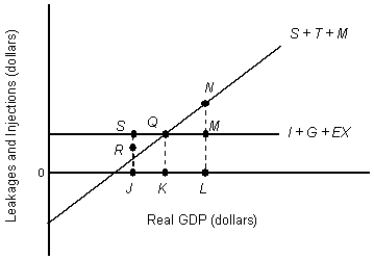 -In Figure 10.6, if 0L is the potential level of real GDP, then KL represents:
 (Multiple Choice)
4.9/5 (92)
(92) The table given below states the value of the GDP and the different components of aggregate expenditure for two years.
Table 10.1
GDP Export Import Year 1 - \ 750 \ 110 \ 60 \ 70 \ 50 Year 2 \ 1,150 \ 930 \ 90 \ 75 \ 125 -
-Refer to Table 10.1. What is the equilibrium level of imports in year 2?
(Multiple Choice)
4.8/5 (79)
(79) If a country's imports are very important in determining the volume of exports from its trading partners, then:
(Multiple Choice)
4.8/5 (67)
(67) If MPS is equal to 0.15 and MPI is equal to 0.10, an initial change in expenditures of $19,000 would result in a total change in income equal to _____.
(Multiple Choice)
4.9/5 (84)
(84) At each round of the multiplier process, increases in income:
(Multiple Choice)
4.9/5 (91)
(91) At the equilibrium level of income, which of the following is true?
(Multiple Choice)
4.8/5 (81)
(81) The figure given below shows the macroeconomic equilibrium of a country.
Figure 10.7
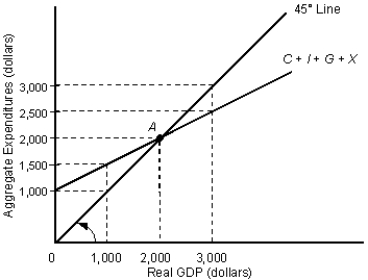 -In Figure 10.7, the spending multiplier equals _____.
 (Multiple Choice)
4.7/5 (88)
(88) Ceteris paribus, a decline in the general price level in the United States will make foreign-produced goods relatively more expensive to U.S. residents and increase the aggregate demand of domestic goods.
(True/False)
5.0/5 (93)
(93) If equilibrium income is $500 billion, MPC = 0.8, MPI = 0.2 and autonomous government spending increases by $20 billion, the new equilibrium income will be _____.
(Multiple Choice)
4.9/5 (73)
(73) If total planned expenditures exceed real GDP, the economy will contract, causing production of goods and services to decrease and unplanned inventories to rise.
(True/False)
4.9/5 (87)
(87) Assume we are at an income level where the C+I+G+X (consumption+investment+government spending+net exports) function lies above the 45-degree line. We can conclude that at this income level:
(Multiple Choice)
4.8/5 (84)
(84) Scenario 10.2
A hypothetical open economy has a marginal propensity to import (MPI) equal to 0.2 and a marginal propensity to consume equal to 0.7. Assume that the economy is initially in equilibrium.
-Refer to Scenario 10.2. What is the spending multiplier of this economy?
(Multiple Choice)
4.9/5 (77)
(77) The percentage of a change in income that is spent domestically is:
(Multiple Choice)
5.0/5 (97)
(97) 
Filters
- Essay(0)
- Multiple Choice(0)
- Short Answer(0)
- True False(0)
- Matching(0)