



 Chat with AI
Exam 10: Income and Expenditures Equilibrium

Exam 1: Economics: the World Around You90 Questions
Exam 2: Choice, Opportunity Costs, and Specialization98 Questions
Exam 3: Markets, Demand and Supply, and the Price System99 Questions
Exam 4: The Market System and the Private and Public Sector100 Questions
Exam 5: National Income Accounting104 Questions
Exam 6: An Introduction to the Foreign Exchange Market and the Balance of Payments90 Questions
Exam 7: Unemployment and Inflation130 Questions
Exam 8: Macroeconomic Equilibrium: Aggregate Demand and Supply123 Questions
Exam 9: Aggregate Expenditures120 Questions
Exam 10: Income and Expenditures Equilibrium135 Questions
Exam 11: Fiscal Policy94 Questions
Exam 12: Money and Banking125 Questions
Exam 13: Monetary Policy138 Questions
Exam 14: Macroeconomic Policy: Tradeoffs, Expectations, Credibility, and Sources of Business Cycles117 Questions
Exam 15: Macroeconomic Viewpoints: New Keynesian, Monetarist, and New Classical103 Questions
Exam 16: Economic Growth99 Questions
Exam 17: Development Economics105 Questions
Exam 18: Globalization85 Questions
Exam 19: World Trade Equilibrium112 Questions
Exam 20: International Trade Restrictions109 Questions
Exam 21: Exchange Rates and Financial Links Between Countries132 Questions
Select questions type


Savings are good for a family. If all families increase savings, the economy is better off. This fallacy of composition is called:
(Multiple Choice)
4.8/5  (85)
(85) Foreign repercussions of changes in domestic imports cause the true domestic spending multiplier to be less than 1/(MPS+MPI)
(True/False)
4.8/5 (69)
(69) A change in the price level in an economy will be depicted by a movement along the AE curve and not by a leftward or rightward movement of the curve.
(True/False)
4.9/5 (86)
(86) The table given below reports the value of real GDP and its components consumption (C), investment (I), exports, and imports for two consecutive years.
Table 10.3
Equilibrium Real GDP C I Exports Imports Year 1 \ 9,350 \ 7,500 \ 1,350 \ 1,800 - Year 2 \ 11,450 \ 8,900 - \ 2,350 \ 1,600 Assume that government spending is zero for this economy.
-Refer to Table 10.3. To increase equilibrium real GDP in an open economy to $12,000 in year 3, all else equal to that in year 2, investment would have to increase by:
(Multiple Choice)
4.7/5 (75)
(75) Assume that an increase of $300 in exports leads to an increase of $750 in equilibrium income. If the marginal propensity to import equals 1/10, the marginal propensity to save must be _____.
(Multiple Choice)
4.9/5 (89)
(89) Everything else constant, the international trade effect indicates that aggregate expenditures in the domestic economy fall when:
(Multiple Choice)
4.8/5 (85)
(85) The portion of the aggregate supply curve that is a positive function of the general price level represents excess capacity and unemployed resources.
(True/False)
4.8/5 (73)
(73) The figure given below represents the leakages and injections in an economy.
Figure 10.2
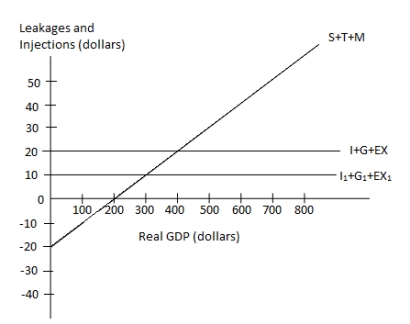 In the figure:
I, I1: Investment;
G: Government spending;
EX, EX1: Exports;
T: Taxes; and
M: Imports.
-According to Figure 10.2, real GDP of $200 indicates a point where:
In the figure:
I, I1: Investment;
G: Government spending;
EX, EX1: Exports;
T: Taxes; and
M: Imports.
-According to Figure 10.2, real GDP of $200 indicates a point where: (Multiple Choice)
4.9/5 (85)
(85) Assume that a GDP gap can be closed by a $200 initial change in planned spending. The MPS is 0.3 and the MPI equals 0.1. If the economy is currently in equilibrium with an income level of $600, potential GDP equals:
(Multiple Choice)
4.8/5 (90)
(90) The figure given below represents the leakages and injections in an economy.
Figure 10.3
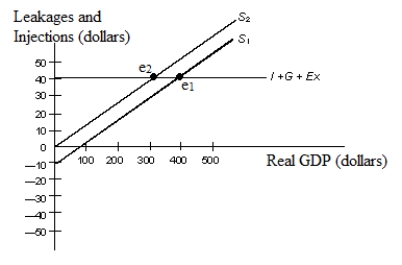 In the figure:
S1 and S2: Saving functions
I: Investment
G: Government spending
EX: Net exports
-Refer to Figure 10.3. The paradox of thrift might not be a problem if:
In the figure:
S1 and S2: Saving functions
I: Investment
G: Government spending
EX: Net exports
-Refer to Figure 10.3. The paradox of thrift might not be a problem if: (Multiple Choice)
4.7/5 (71)
(71) Ceteris paribus, a downward shift in the net exports function will cause:
(Multiple Choice)
4.9/5 (79)
(79) Calculate the marginal propensity to save for the economy from the information given in Table 10.4.
(Multiple Choice)
4.7/5 (72)
(72) Injections represent outflows of planned expenditures from the real GDP stream.
(True/False)
4.8/5 (81)
(81) The Keynesian region of the aggregate supply curve explains the situation experienced during the Great Depression. Therefore, we can conclude that the Great Depression was characterized by:
(Multiple Choice)
4.9/5 (81)
(81) Which of the following is associated with an increase in the average price level?
(Multiple Choice)
4.8/5 (81)
(81) Suppose for an economy, investment = $40; saving = $50, government spending + exports = 100; and taxes + imports = $110. Then for this economy, total leakages exceed total injections by $20, so there will be pressure for the economy to contract.
(True/False)
4.8/5 (86)
(86) Scenario 10.2
A hypothetical open economy has a marginal propensity to import (MPI) equal to 0.2 and a marginal propensity to consume equal to 0.7. Assume that the economy is initially in equilibrium.
-Refer to Scenario 10.2. If a tourist visits the country and spends $100 that she brought with her, then what will happen to the equilibrium real GDP?
(Multiple Choice)
4.7/5 (80)
(80) Scenario 10.1
Imagine an economy that does not have international trade and is originally in equilibrium. Then the government increases the level of spending by $350 million because it received a gift from abroad. In this economy, only 65 cents of every dollar is spent, and the rest is saved.
-Refer to Scenario 10.1. The new equilibrium level of GDP for the economy will be:
(Multiple Choice)
4.8/5 (89)
(89) The figure given below represents the leakages and injections of an economy.
Figure 10.6
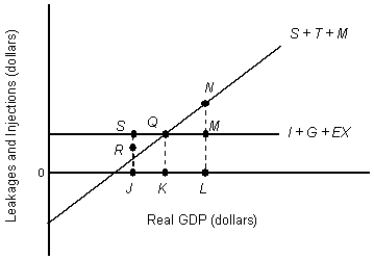 -Refer to Figure 10.6. If 0L represents potential GDP, the GDP gap can be closed by increasing autonomous expenditures by an amount equal to line segment _____.
 (Multiple Choice)
4.8/5 (92)
(92) 
Filters
- Essay(0)
- Multiple Choice(0)
- Short Answer(0)
- True False(0)
- Matching(0)