



 Chat with AI
Exam 4: Market Failures Caused by Externalities Asymmetric Information

Exam 2: The Market System and the Circular Flow274 Questions
Exam 3: Demand, Supply, and Market Equilibrium357 Questions
Exam 4: Market Failures Caused by Externalities Asymmetric Information222 Questions
Exam 5: Public Goods, Public Choice, and Government Failure242 Questions
Exam 6: An Introduction to Macroeconomics243 Questions
Exam 7: Measuring Domestic Output and National Income238 Questions
Exam 8: Economic Growth274 Questions
Exam 9: Business Cycles, Unemployment, and Inflation298 Questions
Exam 10: Basic Macroeconomic Relationships233 Questions
Exam 11: The Aggregate Expenditures Model126 Questions
Exam 12: Aggregate Demand and Aggregate Supply320 Questions
Exam 13: Fiscal Policy, Deficits, and Debt401 Questions
Exam 14: Money, Banking, and Financial Institutions265 Questions
Exam 15: Money Creation285 Questions
Exam 16: Interest Rates and Monetary Policy405 Questions
Exam 17: Financial Economics356 Questions
Exam 18: Extending the Analysis of Aggregate Supply268 Questions
Exam 19: Current Issues in Macro Theory and Policy279 Questions
Exam 20: International Trade339 Questions
Exam 21: The Balance of Payments, Exchange Rates, and Trade Deficits315 Questions
Exam 22: The Economics of Developing Countries269 Questions
Select questions type


Assume that there are four consumers A, B, C, and D, and the prices that each of them is willing to
pay for a glass of lemonade is, respectively, $1.50, $1.20, $1.00, and $0.90. If the actual price of
lemonade is $1.00 per glass, then consumer surplus in this market will be $0.70.
(True/False)
4.8/5  (93)
(93) 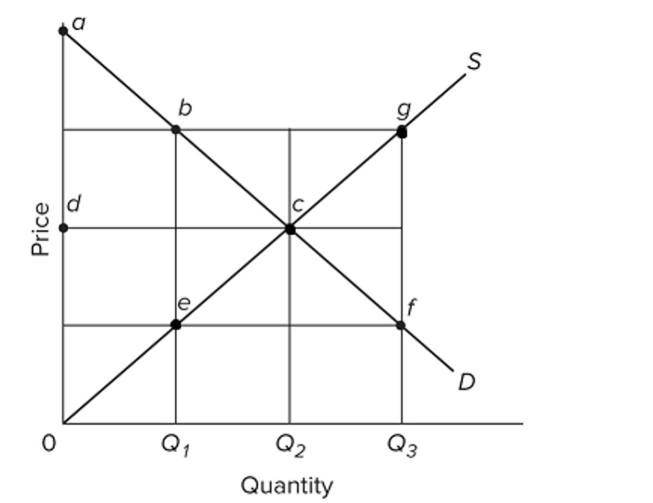 Refer to the provided graph of a competitive market. If the output level is Q2, then there will be
 (Multiple Choice)
4.7/5 (78)
(78) It is the custom for paper mills located alongside the Layzee River to discharge waste products into the river. As a result, operators of hydroelectric power-generating plants downstream along the river
find that they must clean up the river's water before it flows through their equipment.
In the situation described above, we would expect an
(Multiple Choice)
4.9/5 (73)
(73) Professional buyers of antiques often have more information about the value of antique objects than do the sellers. This illustrates
(Multiple Choice)
4.8/5 (78)
(78) Upon learning that his auto transmission is about to fail, Ray sells his car to an unsuspecting buyer. This circumstance illustrates the
(Multiple Choice)
4.8/5 (71)
(71) An effective antipollution policy from the economic perspective requires that all pollution be
eliminated and banned.
(True/False)
4.9/5 (82)
(82) The difference between the maximum price a consumer is willing to pay for a product and the actual price the consumer pays is called
(Multiple Choice)
5.0/5 (81)
(81) 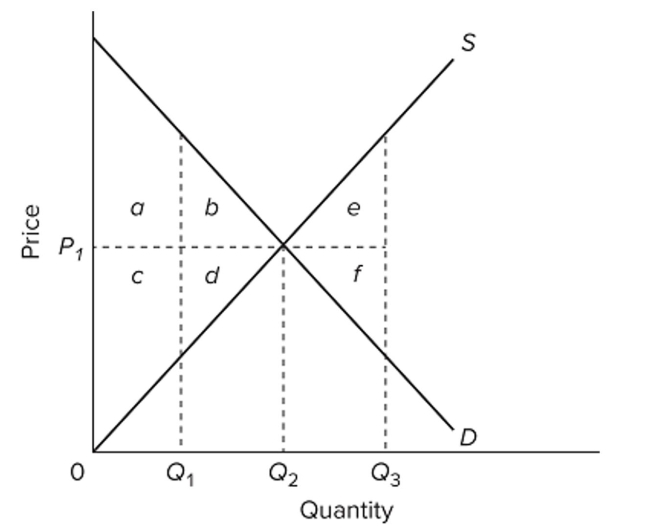 Refer to the diagram. Assuming equilibrium price P1, consumer surplus is represented by areas
 (Multiple Choice)
4.7/5 (67)
(67) Define negative externality, and explain how water pollution is an example.
(Essay)
5.0/5 (74)
(74) What are some ways the private sector has found to overcome information difficulties without
government intervention?
(Essay)
5.0/5 (81)
(81) Jennifer buys a piece of costume jewelry for $33, for which she was willing to pay $42. The minimum acceptable price to the seller, Nathan, was $30. Jennifer experiences a
(Multiple Choice)
4.9/5 (70)
(70) An example of an adverse selection problem is in insurance, where the people most likely to claim
insurance payouts are the people who will seek to buy the most generous policies.
(True/False)
4.9/5 (90)
(90) (Last Word) Since it's not possible for governments to know the costs of pollution abatement as well as the polluters know themselves, then there is a(n)
(Multiple Choice)
4.9/5 (88)
(88) Adverse selection is when someone with home insurance decides to take the chance that a dying
tree would fall on the garage, rather than spend the money to have the tree cut down.
(True/False)
4.8/5 (76)
(76) In a television advertisement for AFLAC supplemental health insurance, an ice skater says to his skating partner, "Do you want to try a triple jump?" She responds, "Why not, I have AFLAC." This
Response illustrates the
(Multiple Choice)
4.7/5 (85)
(85) In dealing with market failures, the government always bases its decisions on economic analysis of
marginal cost and marginal benefit.
(True/False)
4.9/5 (73)
(73) When the marginal benefits exceed the marginal costs of producing a product, then allocative
efficiency is not achieved in the market.
(True/False)
4.9/5 (73)
(73) A producer's minimum acceptable price for a particular unit of a good
(Multiple Choice)
4.7/5 (67)
(67) If a good that generates negative externalities were priced to take these negative externalities into account, then its
(Multiple Choice)
4.9/5 (85)
(85) 
Filters
- Essay(0)
- Multiple Choice(0)
- Short Answer(0)
- True False(0)
- Matching(0)