



 Chat with AI
Exam 4: Market Failures Caused by Externalities Asymmetric Information

Exam 2: The Market System and the Circular Flow274 Questions
Exam 3: Demand, Supply, and Market Equilibrium357 Questions
Exam 4: Market Failures Caused by Externalities Asymmetric Information222 Questions
Exam 5: Public Goods, Public Choice, and Government Failure242 Questions
Exam 6: An Introduction to Macroeconomics243 Questions
Exam 7: Measuring Domestic Output and National Income238 Questions
Exam 8: Economic Growth274 Questions
Exam 9: Business Cycles, Unemployment, and Inflation298 Questions
Exam 10: Basic Macroeconomic Relationships233 Questions
Exam 11: The Aggregate Expenditures Model126 Questions
Exam 12: Aggregate Demand and Aggregate Supply320 Questions
Exam 13: Fiscal Policy, Deficits, and Debt401 Questions
Exam 14: Money, Banking, and Financial Institutions265 Questions
Exam 15: Money Creation285 Questions
Exam 16: Interest Rates and Monetary Policy405 Questions
Exam 17: Financial Economics356 Questions
Exam 18: Extending the Analysis of Aggregate Supply268 Questions
Exam 19: Current Issues in Macro Theory and Policy279 Questions
Exam 20: International Trade339 Questions
Exam 21: The Balance of Payments, Exchange Rates, and Trade Deficits315 Questions
Exam 22: The Economics of Developing Countries269 Questions
Select questions type


In a free-market economy, a product which entails a positive externality will be
(Multiple Choice)
4.8/5  (80)
(80) If the consumer is willing to pay a price higher than the actual price of a product, then the consumer
will not buy the product because the consumer surplus will be negative.
(True/False)
4.8/5 (84)
(84) Credit bureaus provide credit histories to banks and insurance companies, in order to help deal with the problem of
(Multiple Choice)
4.8/5 (63)
(63) Other things equal, a fall in the market price caused by a change in supply will
(Multiple Choice)
4.8/5 (82)
(82) At equilibrium in a market for a product, the total revenues received by sellers equal the
(Multiple Choice)
4.7/5 (76)
(76) External benefits in consumption refer to benefits accruing to
(Multiple Choice)
4.8/5 (84)
(84) 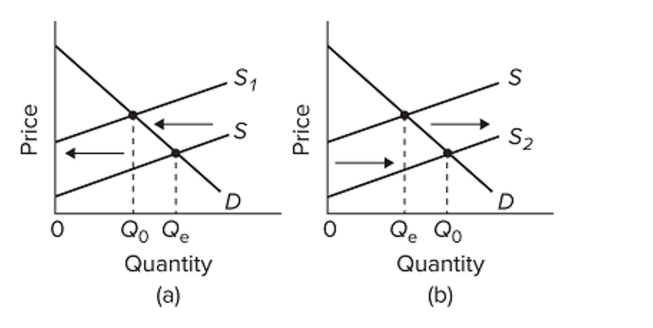 Refer to the diagrams for two separate product markets. Assume that society's optimal level of output in each market is Q0 and that government purposely shifts the market supply curve from S to
S1 in diagram (a) on the left and from S to S2 in diagram (b) on the right. The shift of the supply curve
From S to S1 in diagram (a) might be caused by a per-unit
Refer to the diagrams for two separate product markets. Assume that society's optimal level of output in each market is Q0 and that government purposely shifts the market supply curve from S to
S1 in diagram (a) on the left and from S to S2 in diagram (b) on the right. The shift of the supply curve
From S to S1 in diagram (a) might be caused by a per-unit (Multiple Choice)
4.9/5 (82)
(82) 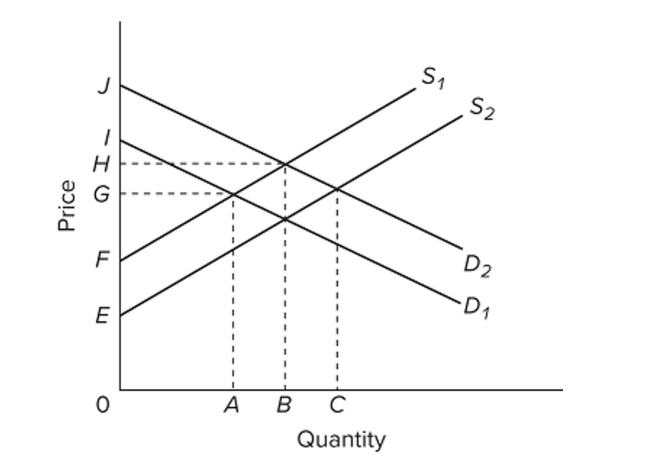 Refer to the provided supply and demand graph. S1 and D1 represent the current market supply and demand, respectively. S2 and D2 represent the socially optimal supply and demand. One way that
The government could shift demand to its socially optimal level is to
Refer to the provided supply and demand graph. S1 and D1 represent the current market supply and demand, respectively. S2 and D2 represent the socially optimal supply and demand. One way that
The government could shift demand to its socially optimal level is to (Multiple Choice)
4.9/5 (76)
(76) 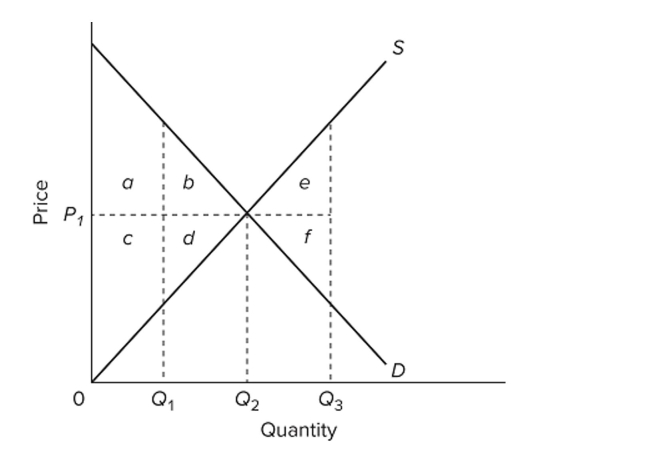 Refer to the diagram. The area that identifies the maximum sum of consumer surplus and producer surplus is
 (Multiple Choice)
4.9/5 (87)
(87) When there is allocative efficiency in a market, the buyers' maximum willingness to pay for the last
unit traded is equal to the sellers' minimum acceptable price for that unit.
(True/False)
4.8/5 (83)
(83) The socially optimal amount of pollution abatement occurs where society's marginal
(Multiple Choice)
4.8/5 (71)
(71) 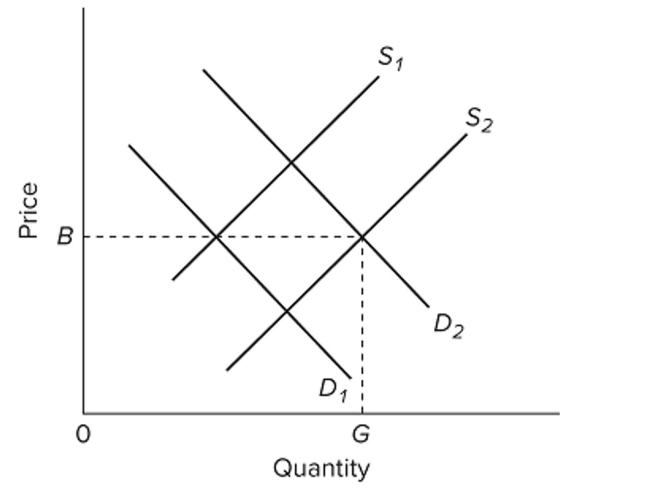 Refer to the competitive market diagram for product Z. Assume that the current market demand and supply curves for Z are D2 and S2. If there are substantial external costs associated with the
Production of Z, then
Refer to the competitive market diagram for product Z. Assume that the current market demand and supply curves for Z are D2 and S2. If there are substantial external costs associated with the
Production of Z, then (Multiple Choice)
4.9/5 (84)
(84) Production subsidies are a way of internalizing external costs among polluting firms.
(True/False)
4.9/5 (90)
(90) One consequence of the asymmetric-information problem in the used car market, if left unresolved, is the higher probability of
(Multiple Choice)
4.8/5 (90)
(90) (Consider This) The principle that private negotiation can resolve potential externalities without
resorting to government intervention is known as the Coase theorem.
(True/False)
4.9/5 (76)
(76) 
Filters
- Essay(0)
- Multiple Choice(0)
- Short Answer(0)
- True False(0)
- Matching(0)