Exam 14: Partial Derivatives

arrow
  • Select Tags
search iconSearch Question
  • Select Tags

 Determine where the function f(x,y,z)=xyzx2+y2+z2−2 is continuous. \text { Determine where the function } f ( x , y , z ) = \frac { x y z } { x ^ { 2 } + y ^ { 2 } + z ^ { 2 } - 2 } \text { is continuous. }

(Short Answer)
4.8/5
(65)

Let g(r,s,t)=res/tg ( r , s , t ) = r e ^ { s / t } . Find g(4,ln⁡3,12)g \left( 4 , \ln 3 , \frac { 1 } { 2 } \right) .

(Multiple Choice)
4.9/5
(88)

Find the equation of the normal line to the given surface at the specified point. z+2=xeycos⁡z,(4,0,0)z + 2 = x e ^ { y } \cos z , ( 4,0,0 )

(Short Answer)
4.9/5
(89)

Find the domain and range of the function h(x,y)=2x−9yh ( x , y ) = \sqrt { 2 x - 9 y } .

(Multiple Choice)
4.8/5
(63)

 Find the differential of the function z=e3xsin⁡5y, \text { Find the differential of the function } z = e ^ { 3 x } \sin 5 y \text {, }

(Short Answer)
5.0/5
(79)

 Find three positive numbers whose sum is 291 and whose product is a maximum. \text { Find three positive numbers whose sum is } 291 \text { and whose product is a maximum. }

(Multiple Choice)
4.9/5
(87)

Use the Chain Rule to find ∂z∂s\frac { \partial z } { \partial s } . z=eγcos⁡(θ),r=6st,θ=s2+t2z = e ^ { \gamma } \cos ( \theta ) , r = 6 s t , \theta = \sqrt { s ^ { 2 } + t ^ { 2 } }

(Multiple Choice)
4.9/5
(66)

Find all the second partial derivatives. f(x,y)=x4−4x2y3f ( x , y ) = x ^ { 4 } - 4 x ^ { 2 } y ^ { 3 }

(Short Answer)
4.9/5
(94)

Find the limit lim⁡(x,y)→(1,2)(3x2+4y2)\lim _ { ( x , y ) \rightarrow ( 1,2 ) } \left( 3 x ^ { 2 } + 4 y ^ { 2 } \right) .

(Multiple Choice)
4.7/5
(74)

Find the maximum rate of change of f(x,y)=xy2+yf ( x , y ) = x y ^ { 2 } + \sqrt { y } at the point (2,1)( 2,1 ) . In what direction does it occur?

(Multiple Choice)
4.7/5
(79)

 Find the gradient of f(x,y,z)=x4eyz at the point P(−2,0,−9). \text { Find the gradient of } f ( x , y , z ) = x ^ { 4 } e ^ { y z } \text { at the point } P ( - 2,0 , - 9 ) \text {. }

(Short Answer)
4.8/5
(86)

Find and classify the relative extrema and saddle points of the function f(x,y)=e−2xsin⁡4yf ( x , y ) = e ^ { - 2 x } \sin 4 y for x≥0x \geq 0 and 0≤y≤π2.0 \leq y \leq \frac { \pi } { 2 } .

(Multiple Choice)
4.8/5
(81)

Find the differential of the function. y=x9+2xy = x ^ { 9 } + 2 x

(Short Answer)
4.8/5
(88)

Find the local maximum, and minimum value and saddle points of the function. f(x,y)=x2−xy+y2−9x+6y+9f ( x , y ) = x ^ { 2 } - x y + y ^ { 2 } - 9 x + 6 y + 9

(Short Answer)
4.8/5
(84)

 Sketch the graph of the function g(x,y)=x2. \text { Sketch the graph of the function } g ( x , y ) = x ^ { 2 } \text {. }

(Essay)
4.9/5
(87)

Use implicit differentiation to find ∂z/∂x\partial z / \partial x . 8x2+8y2−4z2=2x(y+z)8 x ^ { 2 } + 8 y ^ { 2 } - 4 z ^ { 2 } = 2 x ( y + z )

(Short Answer)
5.0/5
(75)

Find the first partial derivatives of the function. c=ln⁡(a+a4+b4)c = \ln \left( a + \sqrt { a ^ { 4 } + b ^ { 4 } } \right)

(Short Answer)
4.8/5
(77)

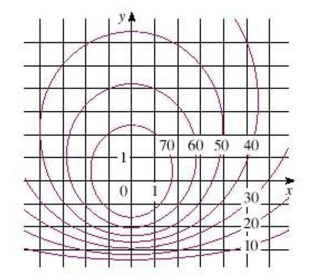
A contour map for a function ff is shown. Use it to estimate the value of f(−3,3)f ( - 3,3 ) .  A contour map for a function  f  is shown. Use it to estimate the value of  f ( - 3,3 ) .

(Multiple Choice)
4.8/5
(99)

Find the indicated partial derivative. f(x,y)=x2y4−3x4y,fmxf ( x , y ) = x ^ { 2 } y ^ { 4 } - 3 x ^ { 4 } y , f _ { m x }

(Multiple Choice)
4.7/5
(89)
Showing 21 - 39 of 39
close modal

Filters

  • Essay(0)
  • Multiple Choice(0)
  • Short Answer(0)
  • True False(0)
  • Matching(0)