



 Chat with AI
Exam 5: Integrals

Exam 1: Functions and Models112 Questions
Exam 2: Limits and Derivatives76 Questions
Exam 3: Differentiation Rules75 Questions
Exam 4: Applications of Differentiation77 Questions
Exam 5: Integrals60 Questions
Exam 6: Applications of Integration78 Questions
Exam 7: Techniques of Integration79 Questions
Exam 8: Further Applications of Integration59 Questions
Exam 9: Differential Equations60 Questions
Exam 10: Parametric Equations and Polar Coordinates60 Questions
Exam 11: Infinite Sequences and Series60 Questions
Exam 12: Vectors and the Geometry of Space54 Questions
Exam 13: Vector Functions58 Questions
Exam 14: Partial Derivatives39 Questions
Exam 15: Multiple Integrals60 Questions
Exam 16: Vector Calculus59 Questions
Exam 17: Second-Order Differential Equations60 Questions
Select questions type


Find the volume of the solid generated by revolving the region bounded by the graphs of the equations about the indicated line.Sketch the region and a representative rectangle. the line

Free
(Multiple Choice)
4.9/5  (78)
(78) Correct Answer: Verified
D
Use the method of cylindrical shells to find the volume of solid obtained by rotating the region
bounded by the given curves about the x-axis.
Free
(Short Answer)
4.8/5 (69)
(69) Correct Answer:Verified
VerifiedThe base of a solid is a circular disk with radius .Find the volume of the solid if parallel cross-sections perpendicular to the base are isosceles right triangles with hypotenuse lying along the
Base.
Free
(Multiple Choice)
4.8/5 (79)
(79) Correct Answer:Verified
VerifiedE
Use the method of cylindrical shells to find the volume of solid obtained by rotating the region bounded by the given curves about the specified axis. about
(Multiple Choice)
4.9/5 (92)
(92) Find the volume of the solid generated by revolving the region bounded by the graphs of the equations about the indicated line. the line
(Multiple Choice)
4.9/5 (83)
(83) Find the volume of the solid generated by revolving the region bounded by the graphs of the equations about the indicated axis.
(Short Answer)
4.9/5 (87)
(87) In a steam engine the pressure and volume of steam satisfy the equation , where is a constant. (This is true for adiabatic expansion, that is, expansion in which there is no heat transfer between the cylinder and its surroundings.) Calculate the work done by the engine (in ft-lb) during a cycle when the steam starts at a pressure of and a volume of and expands to a volume of . Use the fact that the work done by the gas when the volume expands from to volume is
(Short Answer)
4.9/5 (73)
(73) Find the volume of the solid generated by revolving the region bounded by the graphs of the equations about the indicated line.Sketch the region and a representative rectangle.
(Essay)
4.9/5 (92)
(92) Find the area of the region bounded by the graph of , the -axis, and the tangent line to the graph of at .
(Short Answer)
5.0/5 (81)
(81) A bucket weighs and a rope of negligible weight are used to draw water from a well that is 40 ft deep. The bucket starts with of water and is pulled up at a rate of , but water leaks out of a hole in the bucket at a rate of . Find the work done in pulling the bucket to the top of the well.
(Multiple Choice)
4.7/5 (74)
(74) Sketch the region bounded by the graphs of the given equations and find the area of that region.
(Essay)
4.8/5 (70)
(70) Find the volume of the solid generated by revolving the region bounded by the graphs of the equations about the indicated axis.
(Short Answer)
4.8/5 (77)
(77) Find the area of the region bounded by the given curves (a) using integration with respect to x and (b) using integration with respect to y.
(Short Answer)
4.8/5 (87)
(87) The base of is a circular region with boundary curve . Cross-sections perpendicular to the axis are isosceles right triangles with hypotenuse in the base. Find the volume of .
(Short Answer)
4.8/5 (79)
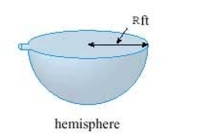
(79) The tank shown is full of water. Given that water weighs and , find the work (in -ft) required to pump the water out of the tank.
(Short Answer)
4.8/5 (83)
(83) Find the volume of the solid obtained by revolving the region under the graph of on about the -axis.
(Short Answer)
4.9/5 (80)
(80) The base of a solid is the region bounded by the graphs of and . The cross sections perpendicular to the -axis are equilateral triangles. Find the volume of the solid.
(Short Answer)
4.8/5 (92)
(92) A heavy rope, long, weighs and hangs over the edge of a building high. How much work is done in pulling the rope to the top of the building?
(Multiple Choice)
4.7/5 (77)
(77) Find the area of the region bounded by the parabola , the tangent line to this parabola at , and the axis.
(Multiple Choice)
4.8/5 (93)
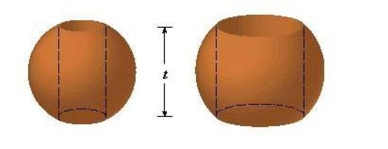
(93) Suppose you make napkin rings by drilling holes with different diameters through two wooden balls (which also have different diameters). You discover that both napkin rings have the same height as shown in the figure. Use cylindrical shells to compute the volume of a napkin ring created by drilling a hole with radius through the center of a sphere of radius and express the answer in terms of .
(Multiple Choice)
4.8/5 (68)
(68) 
Filters
- Essay(0)
- Multiple Choice(0)
- Short Answer(0)
- True False(0)
- Matching(0)