



 Chat with AI
Exam 3: Differentiation Rules

Exam 1: Functions and Models112 Questions
Exam 2: Limits and Derivatives76 Questions
Exam 3: Differentiation Rules75 Questions
Exam 4: Applications of Differentiation77 Questions
Exam 5: Integrals60 Questions
Exam 6: Applications of Integration78 Questions
Exam 7: Techniques of Integration79 Questions
Exam 8: Further Applications of Integration59 Questions
Exam 9: Differential Equations60 Questions
Exam 10: Parametric Equations and Polar Coordinates60 Questions
Exam 11: Infinite Sequences and Series60 Questions
Exam 12: Vectors and the Geometry of Space54 Questions
Exam 13: Vector Functions58 Questions
Exam 14: Partial Derivatives39 Questions
Exam 15: Multiple Integrals60 Questions
Exam 16: Vector Calculus59 Questions
Exam 17: Second-Order Differential Equations60 Questions
Select questions type


The size of the monthly repayment k that amortizes a loan of A dollars in N years at an interest rate of r per year, compounded monthly, on the unpaid balance is given by
The value of can be found by performing the iteration
A family secured a loan of from a bank to finance the purchase of a house. They have agreed to repay the loan in equal monthly installments of over 25 years. Find the interest rate on this loan. Round the rate to one decimal place.
(Multiple Choice)
4.9/5  (74)
(74) The quantity demanded per month of an item is related to the unit price by the demand equation
where is measured in dollars and is measured in units of a thousand. How many items must be sold by the manufacturer to maximize its revenue?
Hint: Recall that the revenue is given by .
(Short Answer)
4.8/5 (93)
(93) The function satisfies the hypotheses of Rolle's Theorem on the interval . Find all values of that satisfy the conclusion of the theorem.
(Multiple Choice)
4.9/5 (78)
(78) A fence tall runs parallel to a tall building at a distance of from the building. What is the length of the shortest ladder that will reach from the ground over the fence to the wall of the building? Round the result to the nearest hundredth.
(Short Answer)
4.9/5 (89)
(89) Use Newton's method to approximate the indicated root of in the interval , correct to six decimal places. Use as the initial approximation.
(Short Answer)
4.8/5 (71)
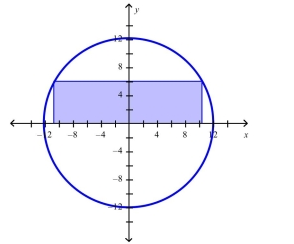
(71) Find the dimensions of the rectangle enclosed in the semicircle with the largest possible area.
(Multiple Choice)
4.9/5 (83)
(83) Consider the function . (a) Find the intervals on which is increasing or decreasing. (b) Find the relative maxima and relative minima of .
(Short Answer)
4.8/5 (75)
(75) Given .
(a) Find the intervals on which is increasing or decreasing.
(b) Find the relative maxima and relative minima of .
(Multiple Choice)
4.9/5 (77)
(77) Find the dimensions of a rectangle of area that has the smallest possible perimeter.
(Multiple Choice)
4.8/5 (84)
(84) Find the local and absolute extreme values of the function on the given interval.
(Short Answer)
5.0/5 (71)
(71) Estimate the extreme values of the function.Round the answers to the nearest hundredth.
(Short Answer)
4.8/5 (77)
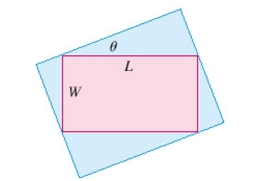
(77) Find the maximum area of a rectangle that can be circumscribed about a given rectangle with length and width .
(Short Answer)
4.8/5 (74)
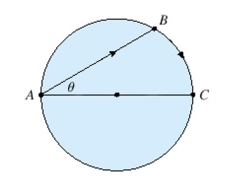
(74) A woman at a point on the shore of a circular lake with radius wants to arrive at the point diametrically opposite on the other side of the lake in the shortest possible time. She can walk at the rate of and row a boat at . How should she proceed? (Find ). Round the result, if necessary, to the nearest hundredth.
(Multiple Choice)
4.8/5 (83)
(83) 
Filters
- Essay(0)
- Multiple Choice(0)
- Short Answer(0)
- True False(0)
- Matching(0)