



 Chat with AI
Exam 1: Invitation to Biology

Exam 1: Invitation to Biology99 Questions
Exam 2: Molecules of Life98 Questions
Exam 3: Cell Structure101 Questions
Exam 4: Energy and Metabolism95 Questions
Exam 5: Photosynthesis93 Questions
Exam 6: Releasing Chemical Energy77 Questions
Exam 7: Dna Structure and Function99 Questions
Exam 8: Gene Expression and Control96 Questions
Exam 9: How Cells Reproduce99 Questions
Exam 10: Patterns of Inheritance88 Questions
Exam 11: Biotechnology100 Questions
Exam 12: Evidence of Evolution85 Questions
Exam 13: Processes of Evolution99 Questions
Exam 14: Prokaryotes, Protists, and Viruses95 Questions
Exam 15: Plants and Fungi100 Questions
Exam 16: Animal Evolution100 Questions
Exam 17: Population Ecology94 Questions
Exam 18: Communities and Ecosystems100 Questions
Exam 19: The Biosphere and Human Effects100 Questions
Exam 20: Animal Tissues and Organs97 Questions
Exam 21: How Animals Move100 Questions
Exam 22: Circulation and Respiration100 Questions
Exam 23: Immunity100 Questions
Exam 24: Digestion and Excretion100 Questions
Exam 25: Neural Control and the Senses100 Questions
Exam 26: Endocrine Control100 Questions
Exam 27: Animal Reproduction and Development101 Questions
Exam 28: Plant Form and Function100 Questions
Exam 29: Life Cycles of Flowering Plants100 Questions
Select questions type


In the Olestra experiment conducted by researchers at the Johns Hopkins University School of Medicine, the people who ate the Olestra potato chips were the ____.
(Multiple Choice)
4.7/5  (63)
(63) Classification. Answer the following questions in reference to life's diversity. Choose only the most correct answer.
-These prokaryotes are able to colonize extreme environments such as hydrothermal vents on the seafloor.
A)archaea
B)bacteria
C)Eukarya
D)Plantae
E)fungi
F)animals
G)protists
(Short Answer)
4.9/5 (66)
(66) Match the term with its definition. 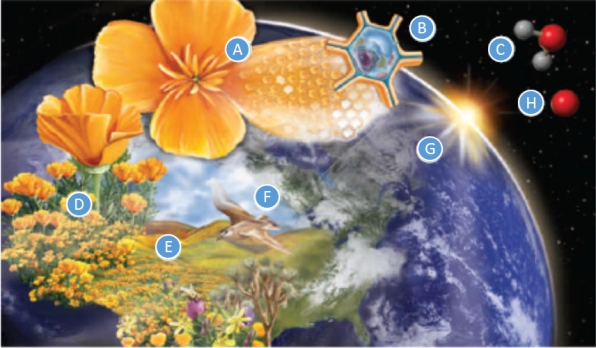 a.atom
b.organism
c.biosphere
d.molecule
e.population
f.ecosystem
g.cell
h.community
-a community interacting with its environment
a.atom
b.organism
c.biosphere
d.molecule
e.population
f.ecosystem
g.cell
h.community
-a community interacting with its environment (Short Answer)
4.7/5 (63)
(63) Which of the following represents an activity within a population?
(Multiple Choice)
4.9/5 (68)
(68) Who developed the two-part naming system scientists use today to classify newly found organisms?
(Multiple Choice)
4.9/5 (91)
(91) After rigorous statistical analyses have shown a very low likelihood (usually 5% or less) of a result having occurred by chance alone, the result is said to be ____.
(Multiple Choice)
4.8/5 (75)
(75) All organisms fit into one of two categories: ____ and ____.
(Multiple Choice)
4.8/5 (70)
(70) Lipids, proteins, DNA, RNA, and complex carbohydrates are all ____.
(Multiple Choice)
4.8/5 (86)
(86) Classification. Answer the following questions in reference to life's diversity. Choose only the most correct answer.
-Besides feeding themselves, these multicelled organisms serve as food for most other organisms.
A)archaea
B)bacteria
C)Eukarya
D)Plantae
E)fungi
F)animals
G)protists
(Short Answer)
4.8/5 (72)
(72) Match the term with its definition. a.atom
b.organism
c.biosphere
d.molecule
e.population
f.ecosystem
g.cell
h.community
-individual that consists of one or more cells
a.atom
b.organism
c.biosphere
d.molecule
e.population
f.ecosystem
g.cell
h.community
-individual that consists of one or more cells (Short Answer)
4.8/5 (82)
(82) The idea that Earth orbits the sun is referred to as ____ of the solar system, because of the scientist who first proposed it.
(Multiple Choice)
4.9/5 (77)
(77) Matching
Based on the Olestra potato chip experiment conducted by researchers at the Johns Hopkins University School of Medicine, match the following letters to the number with which they best correspond.
-Olestra
A)observation
B)hypothesis
C)prediction
D)experiment
E)control group
F)experimental group
G)the variable
H)results
I)conclusion
(Short Answer)
4.8/5 (87)
(87) What is the right sequence of events applied in the scientific method?
(Multiple Choice)
4.9/5 (76)
(76) In science, if a result is deemed statistically significant, that means ____.
(Multiple Choice)
4.7/5 (74)
(74) Matching
Based on the Olestra potato chip experiment conducted by researchers at the Johns Hopkins University School of Medicine, match the following letters to the number with which they best correspond.
-In the control group, 17.6 percent of people reported having cramps later, while in the experimental group, 15.8 percent of people had cramps later.
A)observation
B)hypothesis
C)prediction
D)experiment
E)control group
F)experimental group
G)the variable
H)results
I)conclusion
(Short Answer)
4.9/5 (73)
(73) Match the term with its definition. a.atom
b.organism
c.biosphere
d.molecule
e.population
f.ecosystem
g.cell
h.community
-all regions of Earth where organisms live
a.atom
b.organism
c.biosphere
d.molecule
e.population
f.ecosystem
g.cell
h.community
-all regions of Earth where organisms live (Short Answer)
4.9/5 (83)
(83) 
Filters
- Essay(0)
- Multiple Choice(0)
- Short Answer(0)
- True False(0)
- Matching(0)