



 Chat with AI
Exam 1: Invitation to Biology

Exam 1: Invitation to Biology99 Questions
Exam 2: Molecules of Life98 Questions
Exam 3: Cell Structure101 Questions
Exam 4: Energy and Metabolism95 Questions
Exam 5: Photosynthesis93 Questions
Exam 6: Releasing Chemical Energy77 Questions
Exam 7: Dna Structure and Function99 Questions
Exam 8: Gene Expression and Control96 Questions
Exam 9: How Cells Reproduce99 Questions
Exam 10: Patterns of Inheritance88 Questions
Exam 11: Biotechnology100 Questions
Exam 12: Evidence of Evolution85 Questions
Exam 13: Processes of Evolution99 Questions
Exam 14: Prokaryotes, Protists, and Viruses95 Questions
Exam 15: Plants and Fungi100 Questions
Exam 16: Animal Evolution100 Questions
Exam 17: Population Ecology94 Questions
Exam 18: Communities and Ecosystems100 Questions
Exam 19: The Biosphere and Human Effects100 Questions
Exam 20: Animal Tissues and Organs97 Questions
Exam 21: How Animals Move100 Questions
Exam 22: Circulation and Respiration100 Questions
Exam 23: Immunity100 Questions
Exam 24: Digestion and Excretion100 Questions
Exam 25: Neural Control and the Senses100 Questions
Exam 26: Endocrine Control100 Questions
Exam 27: Animal Reproduction and Development101 Questions
Exam 28: Plant Form and Function100 Questions
Exam 29: Life Cycles of Flowering Plants100 Questions
Select questions type


Classification. Answer the following questions in reference to life's diversity. Choose only the most correct answer.
-Members of this domain have a nucleus and numerous membrane-bound organelles.
A)archaea
B)bacteria
C)Eukarya
D)Plantae
E)fungi
F)animals
G)protists
(Short Answer)
4.8/5  (76)
(76) Which of the following represents the most correct order of the organization of life from the smallest unit to the largest?
(Multiple Choice)
5.0/5 (72)
(72) Match the term with its definition. 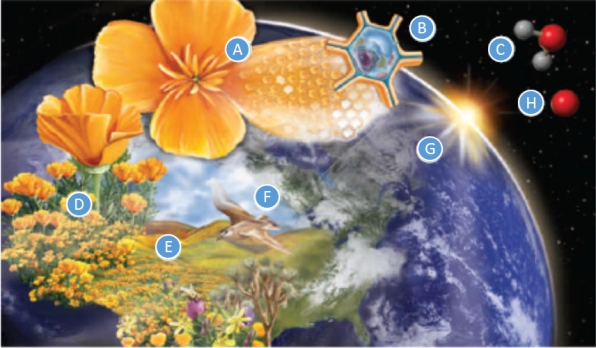 a.atom
b.organism
c.biosphere
d.molecule
e.population
f.ecosystem
g.cell
h.community
-two or more atoms bonded together
a.atom
b.organism
c.biosphere
d.molecule
e.population
f.ecosystem
g.cell
h.community
-two or more atoms bonded together (Short Answer)
4.8/5 (79)
(79) Classification. Answer the following questions in reference to life's diversity. Choose only the most correct answer.
-This single-celled or multicelled eukaryotic consumer breaks down material outside itself, then absorbs nutrients released from the breakdown.
A)archaea
B)bacteria
C)Eukarya
D)Plantae
E)fungi
F)animals
G)protists
(Short Answer)
4.8/5 (90)
(90) In the Olestra potato chip experiment, the report published in the Journal of the American Medical Association in January 1998 indicated that ____.
(Multiple Choice)
4.8/5 (80)
(80) Living organisms are members of all of the following levels. However, soil is a component of ___.
(Multiple Choice)
4.8/5 (91)
(91) If a hypothesis stands after years of repeated testing, is consistent with all data gathered, and helps make successful predictions about other phenomena, it is considered to be a ____.
(Multiple Choice)
4.8/5 (79)
(79) The species extinctions taking place today are being caused by ____ activities.
(Multiple Choice)
4.9/5 (88)
(88) Which of the following organisms is a multicelled producer?
(Multiple Choice)
4.8/5 (83)
(83) Why do scientists typically design experiments that will yield quantitative results?
(Multiple Choice)
4.8/5 (70)
(70) Why are the laws of thermodynamics considered laws of nature and not scientific theories?
(Multiple Choice)
4.7/5 (69)
(69) The scope of variation among living organisms is referred to as ____.
(Multiple Choice)
4.9/5 (78)
(78) Taxonomists today tend to group organisms into the same category based on similar ____.
(Multiple Choice)
4.8/5 (86)
(86) Classification. Answer the following questions in reference to life's diversity. Choose only the most correct answer.
-Multicelled consumers that actively move about during at least part of their lives.
A)archaea
B)bacteria
C)Eukarya
D)Plantae
E)fungi
F)animals
G)protists
(Short Answer)
4.9/5 (82)
(82) Matching
Based on the Olestra potato chip experiment conducted by researchers at the Johns Hopkins University School of Medicine, match the following letters to the number with which they best correspond.
-Some people complained of intestinal problems after eating chips containing Olestra.
A)observation
B)hypothesis
C)prediction
D)experiment
E)control group
F)experimental group
G)the variable
H)results
I)conclusion
(Short Answer)
4.9/5 (87)
(87) A substance that an organism needs for growth and survival but cannot make for itself is referred to as a(n) ____.
(Multiple Choice)
4.8/5 (71)
(71) 
Filters
- Essay(0)
- Multiple Choice(0)
- Short Answer(0)
- True False(0)
- Matching(0)