



 Chat with AI
Exam 22: Circulation and Respiration

Exam 1: Invitation to Biology99 Questions
Exam 2: Molecules of Life98 Questions
Exam 3: Cell Structure101 Questions
Exam 4: Energy and Metabolism95 Questions
Exam 5: Photosynthesis93 Questions
Exam 6: Releasing Chemical Energy77 Questions
Exam 7: Dna Structure and Function99 Questions
Exam 8: Gene Expression and Control96 Questions
Exam 9: How Cells Reproduce99 Questions
Exam 10: Patterns of Inheritance88 Questions
Exam 11: Biotechnology100 Questions
Exam 12: Evidence of Evolution85 Questions
Exam 13: Processes of Evolution99 Questions
Exam 14: Prokaryotes, Protists, and Viruses95 Questions
Exam 15: Plants and Fungi100 Questions
Exam 16: Animal Evolution100 Questions
Exam 17: Population Ecology94 Questions
Exam 18: Communities and Ecosystems100 Questions
Exam 19: The Biosphere and Human Effects100 Questions
Exam 20: Animal Tissues and Organs97 Questions
Exam 21: How Animals Move100 Questions
Exam 22: Circulation and Respiration100 Questions
Exam 23: Immunity100 Questions
Exam 24: Digestion and Excretion100 Questions
Exam 25: Neural Control and the Senses100 Questions
Exam 26: Endocrine Control100 Questions
Exam 27: Animal Reproduction and Development101 Questions
Exam 28: Plant Form and Function100 Questions
Exam 29: Life Cycles of Flowering Plants100 Questions
Select questions type


The following statements describe features of cardiovascular systems. Match the appropriate system from the list to each description. Some choices may be used more than once.
-circulatory pump in amphibians and lizards
A)direct gas exchange
B)open circulatory system
C)two-chambered heart
D)three-chambered heart
E)four-chambered heart
(Short Answer)
4.8/5  (75)
(75) The following statements describe features of cardiovascular systems. Match the appropriate system from the list to each description. Some choices may be used more than once.
-prevents oxygen-poor blood from flowing to tissues
A)direct gas exchange
B)open circulatory system
C)two-chambered heart
D)three-chambered heart
E)four-chambered heart
(Short Answer)
4.9/5 (80)
(80) 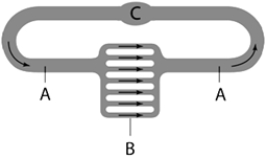 -In the above diagram, C represents ____.
Blood flow distribution can be adjusted by changing the diameter of the ____.
(Multiple Choice)
4.8/5 (72)
(72) Identify the labeled structures of the circulatory system in the figure below. 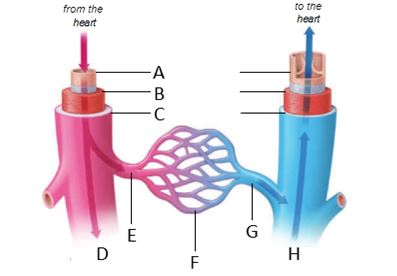 a. artery
b. endothelium
c. capillary
d. arteriole
e. venule
f. vein
g. smooth muscle
h. connective tissue
-structure labeled "G"
a. artery
b. endothelium
c. capillary
d. arteriole
e. venule
f. vein
g. smooth muscle
h. connective tissue
-structure labeled "G" (Short Answer)
4.9/5 (91)
(91) The following statements describe respiratory systems. Match the appropriate system from the list to each description. Some choices may be used more than once.
-utilizes a countercurrent exchange system
A)respiratory surface
B)gills
C)bird lungs
D)mammalian lungs
(Short Answer)
4.9/5 (97)
(97) Blood pressure is lowest when ventricles are _____; this is known as _____.
(Multiple Choice)
4.8/5 (71)
(71) 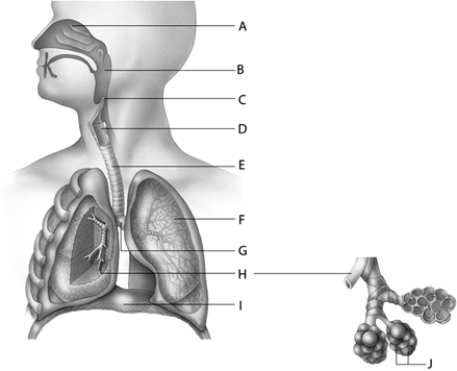 -In the above diagram, the _____ is/are labeled with the letter "E."
 (Multiple Choice)
4.9/5 (78)
(78) The purpose of performing CPR on a person who has experienced sudden cardiac arrest is to ____.
(Multiple Choice)
4.8/5 (81)
(81) The following statements describe features of cardiovascular systems. Match the appropriate system from the list to each description. Some choices may be used more than once.
-hemolymph is pumped into vessels
A)direct gas exchange
B)open circulatory system
C)two-chambered heart
D)three-chambered heart
E)four-chambered heart
(Short Answer)
4.8/5 (92)
(92) When the atria of the heart are full of blood, the ____ valves are closed.
(Multiple Choice)
4.9/5 (85)
(85) Extra fluid that leaks out of the capillary bed enters the ____.
(Multiple Choice)
4.9/5 (66)
(66) Identify the labeled structures of the circulatory system in the figure below. a. artery
b. endothelium
c. capillary
d. arteriole
e. venule
f. vein
g. smooth muscle
h. connective tissue
-structure labeled "B"
a. artery
b. endothelium
c. capillary
d. arteriole
e. venule
f. vein
g. smooth muscle
h. connective tissue
-structure labeled "B" (Short Answer)
4.9/5 (81)
(81) 
Filters
- Essay(0)
- Multiple Choice(0)
- Short Answer(0)
- True False(0)
- Matching(0)