
Exam 4: Polynomial and Rational Functions

arrow
  • Select Tags
search iconSearch Question
flashcardsStudy Flashcards
  • Select Tags

An arch has the shape of the parabola An arch has the shape of the parabola   A rectangle is fit under the arch by selecting a point   on the parabola (see the figure). If   the rectangle has base   and height   . Find the base of a second rectangle that has the same area.  A rectangle is fit under the arch by selecting a point An arch has the shape of the parabola   A rectangle is fit under the arch by selecting a point   on the parabola (see the figure). If   the rectangle has base   and height   . Find the base of a second rectangle that has the same area.  on the parabola (see the figure). If An arch has the shape of the parabola   A rectangle is fit under the arch by selecting a point   on the parabola (see the figure). If   the rectangle has base   and height   . Find the base of a second rectangle that has the same area.  the rectangle has base An arch has the shape of the parabola   A rectangle is fit under the arch by selecting a point   on the parabola (see the figure). If   the rectangle has base   and height   . Find the base of a second rectangle that has the same area.  and height An arch has the shape of the parabola   A rectangle is fit under the arch by selecting a point   on the parabola (see the figure). If   the rectangle has base   and height   . Find the base of a second rectangle that has the same area.  . Find the base of a second rectangle that has the same area. An arch has the shape of the parabola   A rectangle is fit under the arch by selecting a point   on the parabola (see the figure). If   the rectangle has base   and height   . Find the base of a second rectangle that has the same area.

(Multiple Choice)
4.8/5
(75)

Use the factor theorem to decide whether Use the factor theorem to decide whether   is a factor of the polynomial.   ;  is a factor of the polynomial. Use the factor theorem to decide whether   is a factor of the polynomial.   ;  ; Use the factor theorem to decide whether   is a factor of the polynomial.   ;

(Multiple Choice)
4.8/5
(72)

Sketch the graph of Sketch the graph of   .  . Sketch the graph of   .

(Multiple Choice)
4.8/5
(79)

Applying the first theorem on bounds for real zeros of polynomials, determine the smallest and largest integers that are upper and lower bounds, respectively, for the real solutions of the equation. With the aid of a graphing utility, discuss the validity of the bounds. Applying the first theorem on bounds for real zeros of polynomials, determine the smallest and largest integers that are upper and lower bounds, respectively, for the real solutions of the equation. With the aid of a graphing utility, discuss the validity of the bounds.

(Multiple Choice)
4.9/5
(74)

Find the fourth-degree polynomial function whose graph is shown in the figure. Find the fourth-degree polynomial function whose graph is shown in the figure.
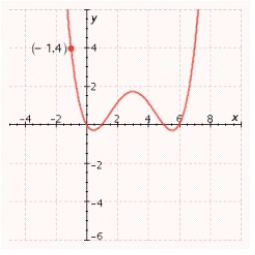
(Multiple Choice)
4.9/5
(84)

Find all values of Find all values of   such that    such that Find all values of   such that    Find all values of   such that

(Multiple Choice)
4.8/5
(84)

For the following function, find a number For the following function, find a number   such that the graph of   contains the point    such that the graph of For the following function, find a number   such that the graph of   contains the point    contains the point For the following function, find a number   such that the graph of   contains the point    For the following function, find a number   such that the graph of   contains the point

(Multiple Choice)
4.8/5
(87)

A flat metal plate is positioned in an xy-plane such that the temperature T (in A flat metal plate is positioned in an xy-plane such that the temperature T (in   C) at the point (x, y) is inversely proportional to the distance from the origin. If the temperature at the point P (3, 4) is 20   C, find the temperature at the point Q (6, 5). C) at the point (x, y) is inversely proportional to the distance from the origin. If the temperature at the point P (3, 4) is 20 A flat metal plate is positioned in an xy-plane such that the temperature T (in   C) at the point (x, y) is inversely proportional to the distance from the origin. If the temperature at the point P (3, 4) is 20   C, find the temperature at the point Q (6, 5). C, find the temperature at the point Q (6, 5).

(Multiple Choice)
5.0/5
(82)

Find the polynomial function of degree Find the polynomial function of degree   whose graph is shown in the figure.    whose graph is shown in the figure. Find the polynomial function of degree   whose graph is shown in the figure.    Find the polynomial function of degree   whose graph is shown in the figure.

(Multiple Choice)
4.8/5
(61)

A polynomial f ( x ) with real coefficients and leading coefficient 1 has the given zeros and degree. Express f ( x ) as a product of linear and quadratic polynomials with real coefficients that are irreducible over R. A polynomial f ( x ) with real coefficients and leading coefficient 1 has the given zeros and degree. Express f ( x ) as a product of linear and quadratic polynomials with real coefficients that are irreducible over R.

(Multiple Choice)
4.8/5
(79)

Use synthetic division to decide whether Use synthetic division to decide whether   is a zero of   .   ;  is a zero of Use synthetic division to decide whether   is a zero of   .   ;  . Use synthetic division to decide whether   is a zero of   .   ;  ; Use synthetic division to decide whether   is a zero of   .   ;

(Multiple Choice)
4.9/5
(69)

A meteorologist determines that the temperature T A meteorologist determines that the temperature T   for a certain 24-hour period in winter was given by the following formula.     is time in hours and   corresponds to 6 A.M. for a certain 24-hour period in winter was given by the following formula. A meteorologist determines that the temperature T   for a certain 24-hour period in winter was given by the following formula.     is time in hours and   corresponds to 6 A.M. A meteorologist determines that the temperature T   for a certain 24-hour period in winter was given by the following formula.     is time in hours and   corresponds to 6 A.M. is time in hours and A meteorologist determines that the temperature T   for a certain 24-hour period in winter was given by the following formula.     is time in hours and   corresponds to 6 A.M. corresponds to 6 A.M.

(Multiple Choice)
4.9/5
(71)

The density D(h) (in kg/m 3 ) of the earth's atmosphere at an altitude of h meters can be approximated by The density D(h) (in kg/m<sup> 3 </sup>) of the earth's atmosphere at an altitude of h meters can be approximated by   where   and   . Use a graphing utility to graph D and approximate the altitude h at which the density is 0.6. where The density D(h) (in kg/m<sup> 3 </sup>) of the earth's atmosphere at an altitude of h meters can be approximated by   where   and   . Use a graphing utility to graph D and approximate the altitude h at which the density is 0.6. and The density D(h) (in kg/m<sup> 3 </sup>) of the earth's atmosphere at an altitude of h meters can be approximated by   where   and   . Use a graphing utility to graph D and approximate the altitude h at which the density is 0.6. . Use a graphing utility to graph D and approximate the altitude h at which the density is 0.6.


(Multiple Choice)
4.8/5
(85)

Find all solutions of the equation. Find all solutions of the equation.

(Multiple Choice)
4.9/5
(65)

The density D(h) (in kg/m 3 ) of the earth's atmosphere at an altitude of h meters can be approximated by The density D(h) (in kg/m<sup> 3 </sup>) of the earth's atmosphere at an altitude of h meters can be approximated by   where   and   . Use a graphing utility to graph D and approximate the altitude h at which the density is 0.3. where The density D(h) (in kg/m<sup> 3 </sup>) of the earth's atmosphere at an altitude of h meters can be approximated by   where   and   . Use a graphing utility to graph D and approximate the altitude h at which the density is 0.3. and The density D(h) (in kg/m<sup> 3 </sup>) of the earth's atmosphere at an altitude of h meters can be approximated by   where   and   . Use a graphing utility to graph D and approximate the altitude h at which the density is 0.3. . Use a graphing utility to graph D and approximate the altitude h at which the density is 0.3.


(Multiple Choice)
4.8/5
(72)

When uranium disintegrates into lead, one step in the process is the radioactive decay of radium into radon gas. Radon enters through the soil into home basements, where it presents a health hazard if inhaled. In the simplest case of radon detection, a sample of air with volume V is taken. After equilibrium has been established, the radioactive decay D of the radon gas is counted with efficiency E over time t. The radon concentration C present in the sample of air varies directly as the product of D and E and inversely as the product of V and t. For a fixed radon concentration C and time t, find the change in the radioactive decay count D if V is multiplied by 4 and E is reduced by 20%.

(Multiple Choice)
4.9/5
(76)

The density D(h) (in kg/m 3 ) of the earth's atmosphere at an altitude of h meters can be approximated by The density D(h) (in kg/m<sup> 3 </sup>) of the earth's atmosphere at an altitude of h meters can be approximated by   where   and   . Use a graphing utility to graph D and approximate the altitude h at which the density is 0.1. where The density D(h) (in kg/m<sup> 3 </sup>) of the earth's atmosphere at an altitude of h meters can be approximated by   where   and   . Use a graphing utility to graph D and approximate the altitude h at which the density is 0.1. and The density D(h) (in kg/m<sup> 3 </sup>) of the earth's atmosphere at an altitude of h meters can be approximated by   where   and   . Use a graphing utility to graph D and approximate the altitude h at which the density is 0.1. . Use a graphing utility to graph D and approximate the altitude h at which the density is 0.1.


(Multiple Choice)
4.9/5
(81)

Express the statement as a formula that involves the variables w, z, u and a constant of proportionality k, and then determine the value of k from the condition : w varies directly as z and inversely as the square root of u, if z = 2 and u = 36, then w = 12

(Multiple Choice)
4.9/5
(80)

Salt water of concentration 0.1 pound of salt per gallon flows into a large tank that initially contains 40 gallons of pure water. If the flow rate of salt water into the tank is 5 gal/min, find a formula for the salt concentration Salt water of concentration 0.1 pound of salt per gallon flows into a large tank that initially contains 40 gallons of pure water. If the flow rate of salt water into the tank is 5 gal/min, find a formula for the salt concentration   (in lb/gal) after t minutes. (in lb/gal) after t minutes.

(Multiple Choice)
4.8/5
(73)

Sketch the graph of Sketch the graph of   .  . Sketch the graph of   .

(Multiple Choice)
4.9/5
(80)
Showing 81 - 100 of 147
close modal

Filters

  • Essay(0)
  • Multiple Choice(0)
  • Short Answer(0)
  • True False(0)
  • Matching(0)
