



 Chat with AI
Exam 13: Regulation of Gene Expression

Exam 1: Light and Life109 Questions
Exam 2: The Cell: an Overview155 Questions
Exam 3: Energy and Enzymes66 Questions
Exam 4: Cell Membranes and Signaling81 Questions
Exam 5: Cellular Respiration61 Questions
Exam 6: Photosynthesis95 Questions
Exam 7: Cell Cycles93 Questions
Exam 8: Genetic Recombination88 Questions
Exam 9: The Chromosomal Basis of Mendelian Inheritance86 Questions
Exam 10: Genetic Linkage, Sex-Linkage, and Other Non-Mendelian Inheritance Mechanisms73 Questions
Exam 11: DNA Structure, Replication, and Repair57 Questions
Exam 12: Gene Structure Expression, and Mutation106 Questions
Exam 13: Regulation of Gene Expression91 Questions
Exam 14: Dna Technologies91 Questions
Exam 15: Genomes53 Questions
Exam 16: Evolution: the Development of the Theory66 Questions
Exam 17: Microevolution: Changes Within Populations83 Questions
Exam 18: Speciation and Macroevolution64 Questions
Exam 19: Systematics and Phylogenetics: Revealing the Tree of Life68 Questions
Exam 20: Humans and Evolution54 Questions
Exam 21: Defining Life and Its Origins55 Questions
Exam 22: Viruses, Viroids, and Prions: Infectious Biological Particles38 Questions
Exam 23: Bacteria and Archaea78 Questions
Exam 24: Protists98 Questions
Exam 25: Fungi81 Questions
Exam 26: Plants80 Questions
Exam 27: Animals171 Questions
Exam 28: Conservation of Biodiversity41 Questions
Exam 29: Population Ecology65 Questions
Exam 30: Species Interactions and Community Ecology70 Questions
Exam 31: Ecosystems68 Questions
Exam 32: Animal Behaviour120 Questions
Exam 33: Organization of the Plant Body69 Questions
Exam 34: Transport in Plants80 Questions
Exam 35: Reproduction and Development in Flowering Plants70 Questions
Exam 36: Plant Nutrition97 Questions
Exam 37: Plant Signals and Responses to the Environment93 Questions
Exam 38: Introduction to Animal Organization and Physiology65 Questions
Exam 39: Animal Nutrition98 Questions
Exam 40: Gas Exchange: the Respiratory System56 Questions
Exam 41: Internal Transport: the Circulatory System72 Questions
Exam 42: Regulation of the Internal Environment: Water, Solutes, and Temperature75 Questions
Exam 43: Control of Animal Processes: Endocrine Control80 Questions
Exam 44: Animal Reproduction168 Questions
Exam 45: Control of Animal Processes: Neural Control253 Questions
Exam 46: Muscles, Skeletons, and Body Movements71 Questions
Select questions type


In catabolite repression, what is indicated by high levels of cAMP?
(Multiple Choice)
5.0/5  (78)
(78) Identify each labelled part of this illustration of eukaryotic DNA. 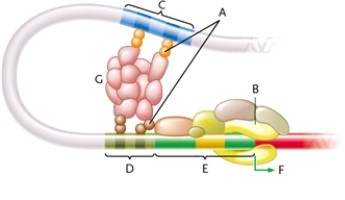 -RNA polymerase
 (Short Answer)
4.8/5 (90)
(90) Identify each labelled part on the illustration of the Lac operon. 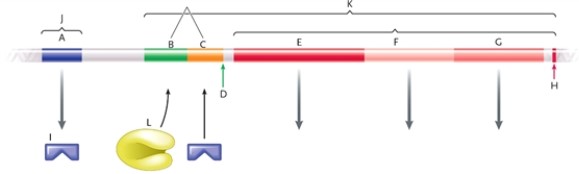 -promoter
 (Short Answer)
4.9/5 (80)
(80) Which of the following is a characteristic of normal cells relative to cancer cells?
(Multiple Choice)
4.8/5 (71)
(71) Suppose that you observe a mutant E. coli in which CAP is always inactive. In the presence of lactose and low levels of glucose, what would you expect the gene expression from this mutant's lac operon to be?
(Multiple Choice)
4.9/5 (81)
(81) Eukaryotic genes consist of protein-coding sequences and adjacent regulatory sequences.
(True/False)
4.9/5 (69)
(69) A direct correlation exists between the level of translation and the length of a poly(A) tail.
(True/False)
4.7/5 (86)
(86) Identify each labelled part of this illustration of eukaryotic DNA.
-coactivator multiprotein complex
-coactivator multiprotein complex (Short Answer)
4.8/5 (74)
(74) Identify each labelled part on the illustration of the Lac operon.
-lacZ
-lacZ (Short Answer)
4.7/5 (75)
(75) The DNA that encodes siRNA is NOT normally found in the nucleus.
(True/False)
4.7/5 (69)
(69) Identify each labelled part on the illustration of the Lac operon.
-transcription initiation site
-transcription initiation site (Short Answer)
4.7/5 (96)
(96) Why do prokaryotic organisms tend to undergo rapid and reversible alterations in their genes?
(Multiple Choice)
5.0/5 (69)
(69) Identify each labelled part on the illustration of the Lac operon.
-lacI
-lacI (Short Answer)
4.9/5 (85)
(85) Identify each labelled part on the illustration of the Lac operon.
-lacA
-lacA (Short Answer)
4.8/5 (84)
(84) Which of the following proteins binds to the operator in the operon model?
(Multiple Choice)
4.8/5 (79)
(79) 
Filters
- Essay(0)
- Multiple Choice(0)
- Short Answer(0)
- True False(0)
- Matching(0)