



 Chat with AI
Exam 5: Cellular Respiration

Exam 1: Light and Life109 Questions
Exam 2: The Cell: an Overview155 Questions
Exam 3: Energy and Enzymes66 Questions
Exam 4: Cell Membranes and Signaling81 Questions
Exam 5: Cellular Respiration61 Questions
Exam 6: Photosynthesis95 Questions
Exam 7: Cell Cycles93 Questions
Exam 8: Genetic Recombination88 Questions
Exam 9: The Chromosomal Basis of Mendelian Inheritance86 Questions
Exam 10: Genetic Linkage, Sex-Linkage, and Other Non-Mendelian Inheritance Mechanisms73 Questions
Exam 11: DNA Structure, Replication, and Repair57 Questions
Exam 12: Gene Structure Expression, and Mutation106 Questions
Exam 13: Regulation of Gene Expression91 Questions
Exam 14: Dna Technologies91 Questions
Exam 15: Genomes53 Questions
Exam 16: Evolution: the Development of the Theory66 Questions
Exam 17: Microevolution: Changes Within Populations83 Questions
Exam 18: Speciation and Macroevolution64 Questions
Exam 19: Systematics and Phylogenetics: Revealing the Tree of Life68 Questions
Exam 20: Humans and Evolution54 Questions
Exam 21: Defining Life and Its Origins55 Questions
Exam 22: Viruses, Viroids, and Prions: Infectious Biological Particles38 Questions
Exam 23: Bacteria and Archaea78 Questions
Exam 24: Protists98 Questions
Exam 25: Fungi81 Questions
Exam 26: Plants80 Questions
Exam 27: Animals171 Questions
Exam 28: Conservation of Biodiversity41 Questions
Exam 29: Population Ecology65 Questions
Exam 30: Species Interactions and Community Ecology70 Questions
Exam 31: Ecosystems68 Questions
Exam 32: Animal Behaviour120 Questions
Exam 33: Organization of the Plant Body69 Questions
Exam 34: Transport in Plants80 Questions
Exam 35: Reproduction and Development in Flowering Plants70 Questions
Exam 36: Plant Nutrition97 Questions
Exam 37: Plant Signals and Responses to the Environment93 Questions
Exam 38: Introduction to Animal Organization and Physiology65 Questions
Exam 39: Animal Nutrition98 Questions
Exam 40: Gas Exchange: the Respiratory System56 Questions
Exam 41: Internal Transport: the Circulatory System72 Questions
Exam 42: Regulation of the Internal Environment: Water, Solutes, and Temperature75 Questions
Exam 43: Control of Animal Processes: Endocrine Control80 Questions
Exam 44: Animal Reproduction168 Questions
Exam 45: Control of Animal Processes: Neural Control253 Questions
Exam 46: Muscles, Skeletons, and Body Movements71 Questions
Select questions type


Which of these analogies best illustrates the following: Sugars contain energy, but we have to break them apart to release the energy in order to make the high energy chemical called ATP.
(Multiple Choice)
4.7/5  (87)
(87) Which of these statements best explains the energetic status of cellular respiration?
(Multiple Choice)
4.8/5 (80)
(80) Which phrase best describes what occurs during chemiosmosis?
(Multiple Choice)
4.9/5 (84)
(84) Which of the following molecules is responsible for carrying the acetyl group from pyruvate into the citric acid cycle?
(Multiple Choice)
4.8/5 (73)
(73) Refer to the illustration of a mitochondrion. Match the labelled parts of the mitochondrion with the steps of cellular respiration. A labelled part may be used once, more than once, or not at all. 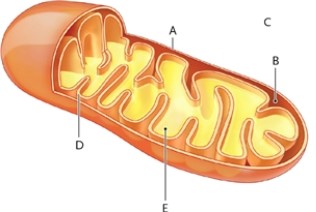 -pyruvate oxidation
A)outer mitochondrial membrane
B)intermembrane compartment
C)cytosol
D)inner mitochondrial membrane
E)matrix
-pyruvate oxidation
A)outer mitochondrial membrane
B)intermembrane compartment
C)cytosol
D)inner mitochondrial membrane
E)matrix (Short Answer)
4.7/5 (102)
(102) Which statement best describes the function of NADH and FADH2?
(Multiple Choice)
4.8/5 (77)
(77) Which phrase describes the mechanism that facilitates the passage of electrons between protein complexes in the mitochondrial inner membrane?
(Multiple Choice)
4.9/5 (79)
(79) Refer to the illustration of a mitochondrion. Match the labelled parts of the mitochondrion with the steps of cellular respiration. A labelled part may be used once, more than once, or not at all.
-glycolysis
A)outer mitochondrial membrane
B)intermembrane compartment
C)cytosol
D)inner mitochondrial membrane
E)matrix
-glycolysis
A)outer mitochondrial membrane
B)intermembrane compartment
C)cytosol
D)inner mitochondrial membrane
E)matrix (Short Answer)
4.9/5 (77)
(77) Consider the contribution of NADH and FADH2. How many of the 32 total ATP molecules produced in cellular respiration come from oxidative phosphorylation?
(Multiple Choice)
5.0/5 (89)
(89) If, during a chemical reaction, a molecule loses hydrogens, it could be described as being oxidized.
(True/False)
4.8/5 (73)
(73) Which chemical characteristic makes phosphoenolpyruvate (PEP) unusual?
(Multiple Choice)
5.0/5 (70)
(70) Which phrase best describes the chemical conditions inside the mitochondrial matrix?
(Multiple Choice)
4.8/5 (74)
(74) In the process of aerobic metabolism, carbon-containing molecules are broken down. What is the energy from the electrons used for?
(Multiple Choice)
4.9/5 (96)
(96) Which part of the ATP synthase is responsible for catalyzing ATP formation?
(Multiple Choice)
4.8/5 (80)
(80) 
Filters
- Essay(0)
- Multiple Choice(0)
- Short Answer(0)
- True False(0)
- Matching(0)