



 Chat with AI
Exam 5: Cellular Respiration

Exam 1: Light and Life109 Questions
Exam 2: The Cell: an Overview155 Questions
Exam 3: Energy and Enzymes66 Questions
Exam 4: Cell Membranes and Signaling81 Questions
Exam 5: Cellular Respiration61 Questions
Exam 6: Photosynthesis95 Questions
Exam 7: Cell Cycles93 Questions
Exam 8: Genetic Recombination88 Questions
Exam 9: The Chromosomal Basis of Mendelian Inheritance86 Questions
Exam 10: Genetic Linkage, Sex-Linkage, and Other Non-Mendelian Inheritance Mechanisms73 Questions
Exam 11: DNA Structure, Replication, and Repair57 Questions
Exam 12: Gene Structure Expression, and Mutation106 Questions
Exam 13: Regulation of Gene Expression91 Questions
Exam 14: Dna Technologies91 Questions
Exam 15: Genomes53 Questions
Exam 16: Evolution: the Development of the Theory66 Questions
Exam 17: Microevolution: Changes Within Populations83 Questions
Exam 18: Speciation and Macroevolution64 Questions
Exam 19: Systematics and Phylogenetics: Revealing the Tree of Life68 Questions
Exam 20: Humans and Evolution54 Questions
Exam 21: Defining Life and Its Origins55 Questions
Exam 22: Viruses, Viroids, and Prions: Infectious Biological Particles38 Questions
Exam 23: Bacteria and Archaea78 Questions
Exam 24: Protists98 Questions
Exam 25: Fungi81 Questions
Exam 26: Plants80 Questions
Exam 27: Animals171 Questions
Exam 28: Conservation of Biodiversity41 Questions
Exam 29: Population Ecology65 Questions
Exam 30: Species Interactions and Community Ecology70 Questions
Exam 31: Ecosystems68 Questions
Exam 32: Animal Behaviour120 Questions
Exam 33: Organization of the Plant Body69 Questions
Exam 34: Transport in Plants80 Questions
Exam 35: Reproduction and Development in Flowering Plants70 Questions
Exam 36: Plant Nutrition97 Questions
Exam 37: Plant Signals and Responses to the Environment93 Questions
Exam 38: Introduction to Animal Organization and Physiology65 Questions
Exam 39: Animal Nutrition98 Questions
Exam 40: Gas Exchange: the Respiratory System56 Questions
Exam 41: Internal Transport: the Circulatory System72 Questions
Exam 42: Regulation of the Internal Environment: Water, Solutes, and Temperature75 Questions
Exam 43: Control of Animal Processes: Endocrine Control80 Questions
Exam 44: Animal Reproduction168 Questions
Exam 45: Control of Animal Processes: Neural Control253 Questions
Exam 46: Muscles, Skeletons, and Body Movements71 Questions
Select questions type


How efficient is cellular respiration in extracting the energy stored in the bonds of glucose?
(Multiple Choice)
4.9/5  (75)
(75) Refer to the illustration of a mitochondrion. Match the labelled parts of the mitochondrion with the steps of cellular respiration. A labelled part may be used once, more than once, or not at all. 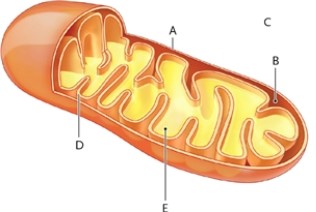 -oxidative phosphorylation
A)outer mitochondrial membrane
B)intermembrane compartment
C)cytosol
D)inner mitochondrial membrane
E)matrix
-oxidative phosphorylation
A)outer mitochondrial membrane
B)intermembrane compartment
C)cytosol
D)inner mitochondrial membrane
E)matrix (Short Answer)
4.7/5 (74)
(74) Glycolysis can take place in the absence of which of the following small molecules?
(Multiple Choice)
4.8/5 (74)
(74) Which of the following best illustrates the concept of supply and demand in cells?
(Multiple Choice)
4.9/5 (83)
(83) Refer to the illustration of a mitochondrion. Match the labelled parts of the mitochondrion with the steps of cellular respiration. A labelled part may be used once, more than once, or not at all.
-ATP synthesis
A)outer mitochondrial membrane
B)intermembrane compartment
C)cytosol
D)inner mitochondrial membrane
E)matrix
-ATP synthesis
A)outer mitochondrial membrane
B)intermembrane compartment
C)cytosol
D)inner mitochondrial membrane
E)matrix (Short Answer)
4.8/5 (82)
(82) During glycolysis, ATP is produced by oxidative phosphorylation.
(True/False)
4.9/5 (78)
(78) During which stage of cellular respiration is CO2 released?
(Multiple Choice)
4.9/5 (75)
(75) It has been thought that many human diseases are now associated with malfunctioning mitochondria. Why are the mitochondria so important to all cells?
(Multiple Choice)
4.7/5 (88)
(88) Which molecules are responsible for delivering the high-energy electrons from the citric acid cycle to the electron transfer system?
(Multiple Choice)
4.8/5 (85)
(85) Which cellular respiration process is absolutely dependent upon a supply of NADH?
(Multiple Choice)
4.9/5 (86)
(86) What molecule is a product of each of glycolysis, pyruvate oxidation, and the citric acid cycle?
(Multiple Choice)
4.8/5 (82)
(82) The main purpose of fermentation is to regenerate NADH and FADH2.
(True/False)
4.8/5 (77)
(77) Which of these processes actually produces a significant quantity of ATP during cellular respiration?
(Multiple Choice)
4.9/5 (86)
(86) Which of the following is the best line of evidence for glycolysis being an ancient pathway?
(Multiple Choice)
4.8/5 (74)
(74) Ultimately, the carbon molecules in pyruvate become integrated into which of the following molecules?
(Multiple Choice)
4.9/5 (77)
(77) Suppose that the proton gradient was destroyed and ATP was no longer produced by oxidative phosphorylation. Which statement describes what happens to these protons as they re-enter the mitochondrial matrix?
(Multiple Choice)
4.9/5 (73)
(73) Oxygen acts as a final electron acceptor in respiration. Which molecule is it ultimately converted into?
(Multiple Choice)
4.8/5 (71)
(71) 
Filters
- Essay(0)
- Multiple Choice(0)
- Short Answer(0)
- True False(0)
- Matching(0)