



 Chat with AI
Exam 14: Monopolistic Competition

Exam 1: What Is Economics483 Questions
Exam 2: The Economic Problem440 Questions
Exam 3: Demand and Supply515 Questions
Exam 4: Elasticity530 Questions
Exam 5: Efficiency and Equity450 Questions
Exam 6: Government Actions in Markets412 Questions
Exam 7: Global Markets in Action205 Questions
Exam 8: Utility and Demand366 Questions
Exam 10: Organizing Production385 Questions
Exam 11: Output and Costs493 Questions
Exam 12: Perfect Competition487 Questions
Exam 13: Monopoly599 Questions
Exam 14: Monopolistic Competition318 Questions
Exam 15: Oligopoly276 Questions
Exam 16: Public Choices, Public Goods, and Healthcare205 Questions
Exam 17: Externalities437 Questions
Exam 18: Markets for Factors of Production382 Questions
Exam 19: Economic Inequality351 Questions
Exam 20: Uncertainty and Information233 Questions
Select questions type


If the market demand in a monopolistically competitive industry increases, a likely result in the long run will be
(Multiple Choice)
4.8/5  (82)
(82) One important difference between monopoly and monopolistic competition is the
(Multiple Choice)
4.9/5 (94)
(94) Which of the following is TRUE regarding the long run for a firm in monopolistic competition?
(Multiple Choice)
4.9/5 (78)
(78) The Karaoke Channel Online streams professional-grade karaoke for $9.95 a month. Suppose Karaoke Channel Online has a constant marginal cost of $1 per customer and total fixed cost is $20,000. The profit maximizing number of customers is 10,000. Several competitors start to advertise online. Karaoke Channel Online now spends $5,000 a month on advertising and the profit maximizing number of customers increases to 12,000. What is Karaoke Channel Online's average total cost after the advertising begins?
(Multiple Choice)
4.8/5 (81)
(81) Dole Co. operates in a monopolistically competitive market. Which of the following characterizes Dole Co.'s market?
(Multiple Choice)
4.7/5 (77)
(77) In monopolistic competition, each firm has a demand curve with a ________ and there ________ barriers to entry into the market.
(Multiple Choice)
4.9/5 (74)
(74) 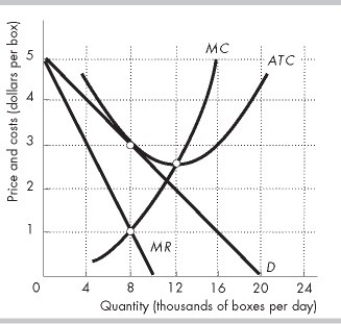 -Fresh Taste, Inc. produces organic breakfast cereals. The market for breakfast cereals is monopolistically competitive. The figure above shows the demand curve that Fresh Taste faces (D), the company's marginal revenue curve (MR), its marginal cost curve (MC), and its average total cost curve (ATC). Fresh Taste produces ________ thousand boxes of cereals per day and sets a price of ________ a box.
 (Multiple Choice)
4.8/5 (80)
(80) Which of the following is NOT true of firms in monopolistic competition?
(Multiple Choice)
4.8/5 (85)
(85) A textbook publisher is in monopolistic competition. If the firm spends nothing on advertising, it can sell no books at $100 a book, but for each $10 cut in price, the quantity of books it can sell increases by 20 books a day. The firm's total fixed cost is $2,400 a day. Its average variable cost and marginal cost is a constant $20 per book. If the firm spends $1,200 a day on advertising, it can increase the quantity of books sold at each price by 50 percent. The firm will
(Multiple Choice)
5.0/5 (87)
(87) A product that is a close substitute but not a perfect substitute for the products of the other firms is called
(Multiple Choice)
4.8/5 (90)
(90) 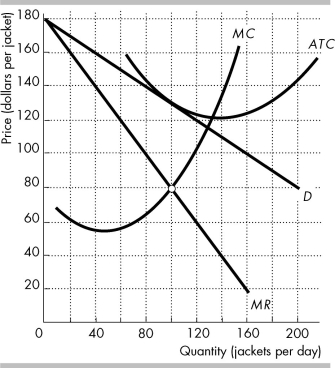 The figure shows the demand curve for Gap jackets (D), and Gap's marginal revenue curve (MR), marginal cost curve (MC), and average total cost curve (ATC).
-In the figure above, if the market for jackets were perfectly competitive, in long-run equilibrium, each firm would sell ________ jackets per day at ________ per jacket.
The figure shows the demand curve for Gap jackets (D), and Gap's marginal revenue curve (MR), marginal cost curve (MC), and average total cost curve (ATC).
-In the figure above, if the market for jackets were perfectly competitive, in long-run equilibrium, each firm would sell ________ jackets per day at ________ per jacket. (Multiple Choice)
4.8/5 (77)
(77) What type of profit can a firm in monopolistic competition make in the long run? Explain your answer.
(Essay)
4.7/5 (77)
(77) 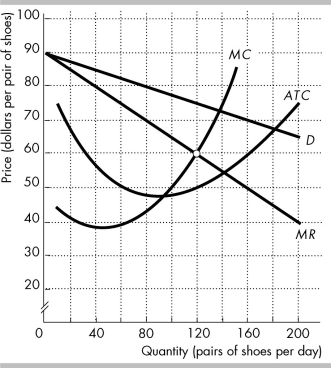 The figure shows the demand curve for Nike shoes (D), and Nike's marginal revenue curve (MR), marginal cost curve (MC), and average total cost curve (ATC).
-In the figure above, Nike maximizes its profit if it sells ________ pairs of shoes per day.
The figure shows the demand curve for Nike shoes (D), and Nike's marginal revenue curve (MR), marginal cost curve (MC), and average total cost curve (ATC).
-In the figure above, Nike maximizes its profit if it sells ________ pairs of shoes per day. (Multiple Choice)
4.9/5 (82)
(82) In the long run, monopolistically competitive firms make zero economic profit because of
(Multiple Choice)
4.9/5 (69)
(69) A textbook publisher is in monopolistic competition. If the firm spends nothing on advertising, it can sell no books at $100 a book, but for each $10 cut in price, the quantity of books it can sell increases by 20 books a day. The firm's total fixed cost is $2,400 a day. Its average variable cost and marginal cost is a constant $20 per book. If the firm spends $1,200 a day on advertising, it can increase the quantity of books sold at each price by 50 percent. Compared to the situation if it does not advertise, if the firm advertises, the profit-maximizing price
(Multiple Choice)
4.9/5 (87)
(87) At a monopolistically competitive firm's current level of product development, marginal revenue of product development is greater than its marginal cost. The firm will
(Multiple Choice)
4.9/5 (74)
(74) What do demand and marginal revenue curves look like in monopolistic competition? How do they compare to the demand and marginal revenue curves in perfect competition and monopoly?
(Essay)
4.8/5 (84)
(84) 
Filters
- Essay(0)
- Multiple Choice(0)
- Short Answer(0)
- True False(0)
- Matching(0)