



 Chat with AI
Exam 15: Oligopoly

Exam 1: What Is Economics483 Questions
Exam 2: The Economic Problem440 Questions
Exam 3: Demand and Supply515 Questions
Exam 4: Elasticity530 Questions
Exam 5: Efficiency and Equity450 Questions
Exam 6: Government Actions in Markets412 Questions
Exam 7: Global Markets in Action205 Questions
Exam 8: Utility and Demand366 Questions
Exam 10: Organizing Production385 Questions
Exam 11: Output and Costs493 Questions
Exam 12: Perfect Competition487 Questions
Exam 13: Monopoly599 Questions
Exam 14: Monopolistic Competition318 Questions
Exam 15: Oligopoly276 Questions
Exam 16: Public Choices, Public Goods, and Healthcare205 Questions
Exam 17: Externalities437 Questions
Exam 18: Markets for Factors of Production382 Questions
Exam 19: Economic Inequality351 Questions
Exam 20: Uncertainty and Information233 Questions
Select questions type


 -The payoff matrix of economic profits above displays the possible outcomes for Bob and Jane who are involved in game of whether or not to advertise. After each player chooses his or her best strategy and sees the result
 (Multiple Choice)
4.8/5  (67)
(67) The Clayton Act of 1914 was passed to prohibit, in part, price discrimination if the effect is to substantially lessen competition or create monopoly.
(True/False)
5.0/5 (87)
(87) In a prisoner's dilemma, the Nash equilibrium occurs where
(Multiple Choice)
4.9/5 (86)
(86) Game theory is a tool for studying competitive behavior between firms in monopolistic competition because of the mutual interdependence among the firms.
(True/False)
4.8/5 (88)
(88) If firms in an industry make output decisions that are partially based on the price and output decisions of their competitors, then these firms are in ________ market have ________ with the other firms in the market.
(Multiple Choice)
4.8/5 (85)
(85) Nimbus, Inc., and Cleansweep, Inc., are the only producers of flying brooms. Each firm has two strategies: Spend 30,000 galleons a year on research and development (R&D) or spend nothing on R&D. If neither firm spends on R&D, Nimbus' economic profit is 80, 000 galleons and Cleansweep's economic profit is 40,000 galleons. If each firm conducts R&D, market shares are maintained, but each firm's profit is lower by the amount spent on R&D. If Nimbus conducts R&D and Cleansweep does not, Nimbus makes an economic profit of 120,000 galleons, while Cleansweep incurs an economic loss of 20,000 galleons. If Cleansweep conducts R&D and Nimbus does not, Cleansweep makes a profit of 60,000 galleons while Nimbus loses 10,000 galleons.
a) Construct a payoff matrix for the game that Nimbus and Cleansweep must play.
b) Find the Nash equilibrium. In the Nash equilibrium, what is each firm's equilibrium profit?
c) What is the cooperative outcome? Would the firms make more economic profit if they collude to achieve the cooperative outcome?
(Essay)
4.9/5 (86)
(86) Which of the following is illegal under the Sherman Act? I. A competitor agrees with another competitor on the price at which the product will be sold.
II) A manufacturer refuses to supply a retailer who does not accept the manufacturer's guidance on the price.
(Multiple Choice)
4.8/5 (79)
(79) In the United States, why are cartels among firms usually kept secret?
(Essay)
4.9/5 (97)
(97) Explain what a cartel is and the difficulties faced in maintaining a cartel.
(Essay)
4.7/5 (76)
(76) Two duopoly firms that sell an identical good form a cartel. They decide to collude and fix the price of their good. In this prisoners' dilemma type situation, the likely outcome is
(Multiple Choice)
4.8/5 (70)
(70) Game theory is applicable to oligopoly behavior because oligopolists
(Multiple Choice)
4.8/5 (74)
(74) 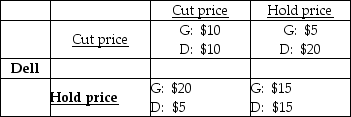 -Dell and Gateway must decide whether to lower their prices, based on the potential economic profits shown in the payoff matrix above. (The profits are in millions of dollars.) In the Nash equilibrium, Dell's profit is ________ million and Gateway's profit is ________ million.
 (Multiple Choice)
4.8/5 (75)
(75) 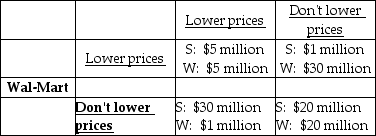 -Sears and Wal-Mart must decide whether to lower their prices, based on the economic profits shown in the table above. Which of the following is TRUE?
 (Multiple Choice)
4.9/5 (77)
(77) Which of the following business practices, if proven to exist, is always illegal under U.S. antitrust law?
(Multiple Choice)
4.7/5 (60)
(60) 
Filters
- Essay(0)
- Multiple Choice(0)
- Short Answer(0)
- True False(0)
- Matching(0)