



 Chat with AI
Exam 18: Markets for Factors of Production

Exam 1: What Is Economics483 Questions
Exam 2: The Economic Problem440 Questions
Exam 3: Demand and Supply515 Questions
Exam 4: Elasticity530 Questions
Exam 5: Efficiency and Equity450 Questions
Exam 6: Government Actions in Markets412 Questions
Exam 7: Global Markets in Action205 Questions
Exam 8: Utility and Demand366 Questions
Exam 10: Organizing Production385 Questions
Exam 11: Output and Costs493 Questions
Exam 12: Perfect Competition487 Questions
Exam 13: Monopoly599 Questions
Exam 14: Monopolistic Competition318 Questions
Exam 15: Oligopoly276 Questions
Exam 16: Public Choices, Public Goods, and Healthcare205 Questions
Exam 17: Externalities437 Questions
Exam 18: Markets for Factors of Production382 Questions
Exam 19: Economic Inequality351 Questions
Exam 20: Uncertainty and Information233 Questions
Select questions type


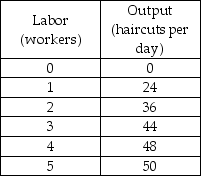 -The above table has the total product schedule for Joe's Barber Shop. Joe charges $6 per haircut. If the wage rate falls from $24 per worker to $12 per worker, the quantity of labor hired ________ and the new number of workers employed is ________.
 (Multiple Choice)
4.8/5  (81)
(81) Which of the following decreases the supply of labor that competes with union labor?
(Multiple Choice)
4.8/5 (82)
(82) Because a monopsony is the only buyer in a particular market, the
(Multiple Choice)
4.9/5 (85)
(85) If a union successfully restricts the supply of labor to the firm but the union has no effect on the demand for labor, then the
(Multiple Choice)
4.8/5 (79)
(79) 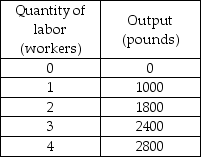 -The preceding table gives monthly production information for Peter's Peanuts, a firm in a perfectly competitive industry. An increase in the wage rate for labor leads to
 (Multiple Choice)
5.0/5 (73)
(73) 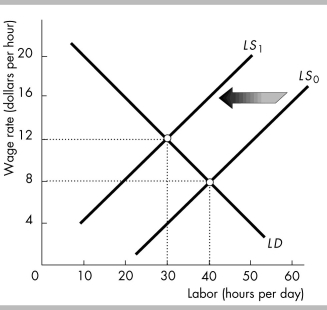 -The figure above shows the labor demand and labor supply curves for workers in local fast-food restaurants. The fast-food restaurant industry is competitive. A decrease in the supply of labor shifts the labor supply curve from LS0 to LS1. The wages of fast-food workers
 (Multiple Choice)
4.9/5 (78)
(78) The demand for labor increases (that is, the demand for labor curve shifts rightward) if the
(Multiple Choice)
5.0/5 (82)
(82) For a monopsony, the marginal cost of labor is ________ the wage rate.
(Multiple Choice)
4.9/5 (87)
(87) A company finds that for the next worker hired, the worker's VMP is less than the cost of the worker. In this case, to maximize its profit the company should
(Multiple Choice)
4.8/5 (89)
(89) The interest rate is 5 percent. How does $500 to be received a year from today compare in value to $500 right now?
(Essay)
4.8/5 (94)
(94) If a nonrenewable natural resource's price is expected to increase at a rate faster than the interest rate, then the supply today will
(Multiple Choice)
4.8/5 (75)
(75) Intel hired a consultant who found that the value of marginal product of Intel's workers decreased as more workers were hired. Suppose Intel is a monopolistically competitive firm. Then the value of marginal product decreases because the I. workers' marginal product of labor decreased as more workers were hired.
II) marginal revenue of Intel's chips decreased as more chips were sold.
(Multiple Choice)
4.8/5 (81)
(81) If the interest rate is 20 percent, $100 to be received four years from today has a present value of approximately
(Multiple Choice)
4.9/5 (75)
(75) The demand for labor depends on I. technology.
II) the prices of other factors of production.
III) the price of the product.
(Multiple Choice)
4.9/5 (87)
(87) Joe manages a company that produces lawn mowers. Joe knows that the value of marginal product
(Multiple Choice)
4.9/5 (72)
(72) In comparison to an employer in a competitive labor market, a monopsony employer hires ________ workers and produces ________ output.
(Multiple Choice)
4.9/5 (68)
(68) S & S Backhoe Service in Ozark, Arkansas rents backhoes and other heavy equipment to local construction companies. What determines the demand for backhoes in Arkansas?
(Multiple Choice)
4.8/5 (84)
(84) 
Filters
- Essay(0)
- Multiple Choice(0)
- Short Answer(0)
- True False(0)
- Matching(0)