



 Chat with AI
Exam 6: Economic Growth

Exam 1: What Is Economics483 Questions
Exam 2: The Economic Problem443 Questions
Exam 3: Demand and Supply515 Questions
Exam 4: Measuring Gdp and Economic Growth395 Questions
Exam 5: Monitoring Jobs and Inflation409 Questions
Exam 6: Economic Growth352 Questions
Exam 7: Finance, Saving, and Investment227 Questions
Exam 8: Money, the Price Level, and Inflation578 Questions
Exam 9: The Exchange Rate and the Balance of Payments489 Questions
Exam 10: Aggregate Supply and Aggregate Demand426 Questions
Exam 11: Expenditure Multipliers469 Questions
Exam 12: The Business Cycle, Inflation, and Deflation409 Questions
Exam 13: Fiscal Policy263 Questions
Exam 14: Monetary Policy229 Questions
Exam 15: International Trade Policy208 Questions
Select questions type


If the price level rises by 5 percent and workers' money wage rates remain constant, firms'
(Multiple Choice)
4.8/5  (80)
(80) If the price level rises by 3 percent and workers' money wage rates increase by 2 percent, then the
(Multiple Choice)
4.8/5 (89)
(89) New growth theory holds that choices, and the discoveries that result from them, result in growth that is temporary in nature.
(True/False)
4.8/5 (72)
(72) An increase in saving that leads to more capital accumulation ________ labor productivity.
(Multiple Choice)
4.9/5 (89)
(89) Since 1980, which of the following had the lowest level of real GDP per person?
(Multiple Choice)
4.8/5 (82)
(82) Which of the following is NOT associated with the new growth theory?
(Multiple Choice)
4.8/5 (69)
(69) 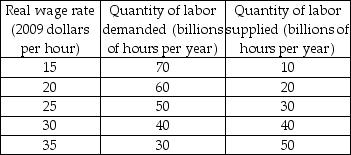
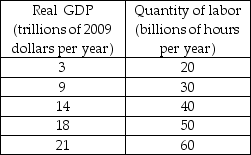 -The tables above show the labor market and the production function schedule for the country of Pickett. Potential GDP is
 (Multiple Choice)
4.8/5 (73)
(73) We are interested in long-term growth primarily because it brings
(Multiple Choice)
4.9/5 (81)
(81) All of the following would increase the growth rate of the economy EXCEPT
(Multiple Choice)
4.8/5 (69)
(69) Which of the following contributes to an increase in labor productivity?
(Multiple Choice)
4.8/5 (88)
(88) The U.S. employment-to-population ratio peaked in 2000 and by 2016 it had fallen to 60 percent, a level not seen since the early 1980s. This fall in the employment-to-population ratio ________ the equilibrium quantity of labor and ________ potential GDP.
(Multiple Choice)
4.9/5 (84)
(84) Real GDP grows when
I. the quantities of the factors of production grow.
II. persistent advances in technology make factors of production increasingly productive.
III. human capital grows.
(Multiple Choice)
4.8/5 (85)
(85) Which of the following is TRUE regarding the labor market?
I. The labor supply curve slopes upward because firms maximize profits as they hire more workers.
II. If the real wage rate falls, the quantity of labor firms demand increases.
III. The demand for labor curve slopes downward because as the real wage rate falls, workers demand to work fewer hours.
(Multiple Choice)
4.8/5 (92)
(92) 
Filters
- Essay(0)
- Multiple Choice(0)
- Short Answer(0)
- True False(0)
- Matching(0)