



 Chat with AI
Exam 6: Economic Growth

Exam 1: What Is Economics483 Questions
Exam 2: The Economic Problem443 Questions
Exam 3: Demand and Supply515 Questions
Exam 4: Measuring Gdp and Economic Growth395 Questions
Exam 5: Monitoring Jobs and Inflation409 Questions
Exam 6: Economic Growth352 Questions
Exam 7: Finance, Saving, and Investment227 Questions
Exam 8: Money, the Price Level, and Inflation578 Questions
Exam 9: The Exchange Rate and the Balance of Payments489 Questions
Exam 10: Aggregate Supply and Aggregate Demand426 Questions
Exam 11: Expenditure Multipliers469 Questions
Exam 12: The Business Cycle, Inflation, and Deflation409 Questions
Exam 13: Fiscal Policy263 Questions
Exam 14: Monetary Policy229 Questions
Exam 15: International Trade Policy208 Questions
Select questions type


Within neoclassical growth theory, technological change ________ saving and ________ investment.
(Multiple Choice)
4.8/5  (76)
(76) The classical model of Malthus predicted that economies would
(Multiple Choice)
4.8/5 (67)
(67) Use the table below to answer this question. The data show national savings rates as a percentage of GDP; the growth rate of real GDP per person; and birth rates in 2006. 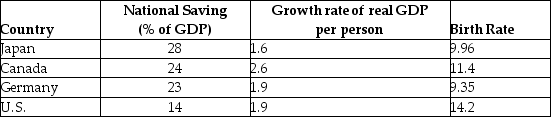 www.econstats.com; www.os-connect.com
If the data support the neoclassical growth theory, we would expect to see
www.econstats.com; www.os-connect.com
If the data support the neoclassical growth theory, we would expect to see (Multiple Choice)
4.8/5 (85)
(85) If the real wage rate is such that the quantity of labor supplied equals the quantity of labor demanded
(Multiple Choice)
4.9/5 (93)
(93) Which theory emphasizes the significance of new discoveries that can be used by many people at the same time?
(Multiple Choice)
4.9/5 (87)
(87) According to the Economic Times (09/2012), Standard & Poor's forecast for India's GDP growth rate was cut by 1 percentage point to 5.5 percent as the entire Asia Pacific region feels the pressure of ongoing economic uncertainty. India has averaged 7 percent growth in GDP since 1997. Which of the following is TRUE?
(Multiple Choice)
4.8/5 (71)
(71) The aggregate production function describes the relationship between
(Multiple Choice)
4.9/5 (89)
(89) If the price level rises by 4 percent and workers' money wage rates increase by 2 percent, then the
(Multiple Choice)
4.9/5 (74)
(74) A movement along the aggregate production function is the result of a change in
(Multiple Choice)
4.9/5 (93)
(93) If the saving rate increases, a country's growth rate of real GDP per hour of labor ________ and capital per hour of labor ________.
(Multiple Choice)
4.8/5 (87)
(87) If both the supply of labor and the demand for labor increase, then
(Multiple Choice)
4.8/5 (75)
(75) To achieve faster growth, economies can increase income tax rates in order to increase saving rates.
(True/False)
5.0/5 (83)
(83) The classical growth theory's view of the economy and its ability to achieve growth can be compared to a perpetual motion machine.
(True/False)
4.8/5 (75)
(75) When labor productivity increases, the demand for labor curve ________ and the supply of labor curve ________.
(Multiple Choice)
4.9/5 (78)
(78) If capital per hour of labor decreases, real GDP per hour of labor
(Multiple Choice)
5.0/5 (86)
(86) 
Filters
- Essay(0)
- Multiple Choice(0)
- Short Answer(0)
- True False(0)
- Matching(0)