



 Chat with AI
Exam 10: Matter, Light, and Glass Examination

Exam 1: Introduction109 Questions
Exam 2: The Crime Scene136 Questions
Exam 3: Physical Evidence80 Questions
Exam 4: Crime Scene Reconstruction: Blood Stain Pattern Analysis96 Questions
Exam 5: Death Investigation118 Questions
Exam 6: Fingerprints115 Questions
Exam 7: Forensic Biometrics92 Questions
Exam 8: The Microscope101 Questions
Exam 9: Firearms, Tool Marks, and Other Impressions95 Questions
Exam 10: Matter, Light, and Glass Examination110 Questions
Exam 11: Hairs and Fibers120 Questions
Exam 12: Drugs141 Questions
Exam 13: Forensic Toxicology104 Questions
Exam 14: Metals, Paint, and Soil91 Questions
Exam 15: Forensic Serology91 Questions
Exam 16: DNA: The Indispensable Forensic Science Tool105 Questions
Exam 17: Forensic Aspects of Fire and Explosion Investigation142 Questions
Exam 18: Document Examination67 Questions
Exam 19: Computer Forensics109 Questions
Exam 20: Mobile Device Forensics77 Questions
Select questions type


When a substance undergoes a change of state from liquid to gas, the attractive forces between the molecules increase in strength.
(True/False)
4.8/5  (86)
(86) If glass cannot be physically pieced together, then the control and question glass are best compared by their refractive index and ________.
(Essay)
4.8/5 (75)
(75) Crystalline solids, with the exception of ________ crystals, exhibit ________, or the property of refracting a beam of light into two different ray components.
(Multiple Choice)
4.8/5 (74)
(74) Match the word in Column 1 to its definition in Column 2. Each answer can only be used once.
A)The separation of light into its component wavelengths
B)A constant property of matter that reflects the amount of material present
C)The behavior of a substance without alteration of the substance's composition through a chemical reaction
D)A difference in the two indices of a refraction exhibited by most crystalline materials
E)The bending of a light wave as it passes from one medium to another
F)A property of matter that depends on both the mass of a substance and the effects of gravity on the mass
G)A physical property of matter that is equivalent to the mass per unit volume of a substance
H)Glass that is strengthened by introducing stress through rapid heating and cooling of the glass surfaces
I)A crack in a glass that forms a rough circle around the point of impact
J)A crack in a glass that extends outward like the spoke of a wheel from the point at which the glass was struck
K)The behavior of a substance when it reacts or combines with another substance
L)A property that is not dependent on the size of the object
M)A bright halo that is observed near the border of a particle immersed in a liquid of a different refractive index
N)Two sheets of ordinary glass bonded together with a plastic film
-Dispersion
(Essay)
4.9/5 (67)
(67) The two most important physical properties of glass for forensic comparisons are refractive index and density.
(True/False)
4.8/5 (84)
(84) Match the word in Column 1 to its definition in Column 2. Each answer can only be used once.
A)The separation of light into its component wavelengths
B)A constant property of matter that reflects the amount of material present
C)The behavior of a substance without alteration of the substance's composition through a chemical reaction
D)A difference in the two indices of a refraction exhibited by most crystalline materials
E)The bending of a light wave as it passes from one medium to another
F)A property of matter that depends on both the mass of a substance and the effects of gravity on the mass
G)A physical property of matter that is equivalent to the mass per unit volume of a substance
H)Glass that is strengthened by introducing stress through rapid heating and cooling of the glass surfaces
I)A crack in a glass that forms a rough circle around the point of impact
J)A crack in a glass that extends outward like the spoke of a wheel from the point at which the glass was struck
K)The behavior of a substance when it reacts or combines with another substance
L)A property that is not dependent on the size of the object
M)A bright halo that is observed near the border of a particle immersed in a liquid of a different refractive index
N)Two sheets of ordinary glass bonded together with a plastic film
-Laminated glass
(Essay)
4.9/5 (76)
(76) If glass cannot be physically pieced together, then the control and question glass are best compared by their:
(Multiple Choice)
4.7/5 (65)
(65) X-rays have higher frequencies and higher energy values in the electromagnetic spectrum.
(True/False)
4.7/5 (77)
(77) The smallest particle of an element that can exist and still retain its identity as that element is the:
(Multiple Choice)
4.8/5 (82)
(82) The atoms in a crystalline solid have a regular arrangement while the atoms in an amorphous solid have no regular order.
(True/False)
4.8/5 (70)
(70) Stress marks on the edge of a radial crack near the point of impact are ________ to the side on which the force was applied.
(Essay)
4.7/5 (90)
(90) The photons of which source have the LEAST amount of energy?
(Multiple Choice)
4.9/5 (92)
(92) The color of an opaque object is determined by which component color(s)of light it ________.
(Essay)
4.9/5 (68)
(68) 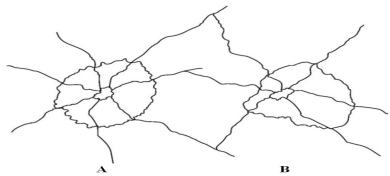 In reference to the diagram above, what is the correct sequence of impacts?
 (Multiple Choice)
4.8/5 (68)
(68) Match the word in Column 1 to its definition in Column 2. Each answer can only be used once.
A)The separation of light into its component wavelengths
B)A constant property of matter that reflects the amount of material present
C)The behavior of a substance without alteration of the substance's composition through a chemical reaction
D)A difference in the two indices of a refraction exhibited by most crystalline materials
E)The bending of a light wave as it passes from one medium to another
F)A property of matter that depends on both the mass of a substance and the effects of gravity on the mass
G)A physical property of matter that is equivalent to the mass per unit volume of a substance
H)Glass that is strengthened by introducing stress through rapid heating and cooling of the glass surfaces
I)A crack in a glass that forms a rough circle around the point of impact
J)A crack in a glass that extends outward like the spoke of a wheel from the point at which the glass was struck
K)The behavior of a substance when it reacts or combines with another substance
L)A property that is not dependent on the size of the object
M)A bright halo that is observed near the border of a particle immersed in a liquid of a different refractive index
N)Two sheets of ordinary glass bonded together with a plastic film
-Chemical property
(Essay)
4.7/5 (74)
(74) The attraction between the molecules of a gas is ________ the attraction between the molecules of a liquid.
(Multiple Choice)
5.0/5 (91)
(91) 
Filters
- Essay(0)
- Multiple Choice(0)
- Short Answer(0)
- True False(0)
- Matching(0)