



 Chat with AI
Exam 6: Fingerprints

Exam 1: Introduction109 Questions
Exam 2: The Crime Scene136 Questions
Exam 3: Physical Evidence80 Questions
Exam 4: Crime Scene Reconstruction: Blood Stain Pattern Analysis96 Questions
Exam 5: Death Investigation118 Questions
Exam 6: Fingerprints115 Questions
Exam 7: Forensic Biometrics92 Questions
Exam 8: The Microscope101 Questions
Exam 9: Firearms, Tool Marks, and Other Impressions95 Questions
Exam 10: Matter, Light, and Glass Examination110 Questions
Exam 11: Hairs and Fibers120 Questions
Exam 12: Drugs141 Questions
Exam 13: Forensic Toxicology104 Questions
Exam 14: Metals, Paint, and Soil91 Questions
Exam 15: Forensic Serology91 Questions
Exam 16: DNA: The Indispensable Forensic Science Tool105 Questions
Exam 17: Forensic Aspects of Fire and Explosion Investigation142 Questions
Exam 18: Document Examination67 Questions
Exam 19: Computer Forensics109 Questions
Exam 20: Mobile Device Forensics77 Questions
Select questions type


The identity, number, and relative location of ridge characteristics impart ________ to a fingerprint.
(Essay)
4.8/5  (71)
(71) Using the description given below of the types of fingerprint patterns on each finger of a suspect, give the primary classification of the individual.
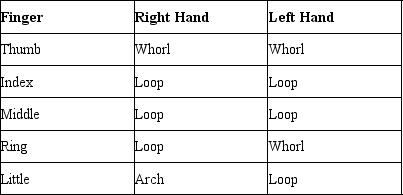
(Essay)
4.9/5 (81)
(81) Match the word in Column 1 to its definition in Column 2. Each answer can only be used once.
A)A class of fingerprints characterized by ridge lines that enter the print from one side and flow out the other side
B)An inkless device that captures digital images of fingerprints and palm prints and electronically transmits them to an AFIS
C)A square electronic dot that is used to compose a digital image
D)A fingerprint impressed in a soft surface
E)A class of fingerprints characterized by ridge lines that enter from one side of the pattern and curve around to exit from the same side of the pattern
F)A system of identification of individuals by measurement of parts of the body, developed by Alphonse Bertillon
G)A process through which a picture is converted into pixels
H)A technique for visualizing latent fingerprints by exposing them to iodine vapors
I)Ridge endings, bifurcations, enclosures, and other ridge details which must match in two fingerprints to establish their common origin
J)A chemical reagent used to develop latent fingerprints on porous materials by reacting with amino acids in perspiration
K)A class of fingerprints that includes ridge patterns that are generally rounded or circular and have two deltas
L)A physical change from the solid directly into the gaseous state
M)A fingerprint made by the deposit of oils and/or perspiration; it is invisible to the naked eye
N)A silver nitrate-based reagent formulated to develop latent fingerprints on porous surfaces
O)To emit visible light when exposed to light of a shorter wavelength
P)A technique for visualizing latent fingerprints on nonporous surfaces by exposing them to cyanoacrylate vapors
Q)A fingerprint made when the finger deposits a visible material such as ink, dirt, or blood onto a surface
R)A verbal description of a perpetrator's physical characteristics and dress provided by an eyewitness
-Physical developer
(Essay)
4.7/5 (71)
(71) Give three reasons why alternate light sources have replaced lasers for visualizing latent prints.
(Essay)
4.9/5 (80)
(80) Digital imaging is still effective in enhancing latent fingerprints even if details of the print do not exist on the original images.
(True/False)
4.8/5 (83)
(83) The three types of fingerprint patterns are loops, whorls, and ________.
(Essay)
4.9/5 (65)
(65) Match the word in Column 1 to its definition in Column 2. Each answer can only be used once.
A)A class of fingerprints characterized by ridge lines that enter the print from one side and flow out the other side
B)An inkless device that captures digital images of fingerprints and palm prints and electronically transmits them to an AFIS
C)A square electronic dot that is used to compose a digital image
D)A fingerprint impressed in a soft surface
E)A class of fingerprints characterized by ridge lines that enter from one side of the pattern and curve around to exit from the same side of the pattern
F)A system of identification of individuals by measurement of parts of the body, developed by Alphonse Bertillon
G)A process through which a picture is converted into pixels
H)A technique for visualizing latent fingerprints by exposing them to iodine vapors
I)Ridge endings, bifurcations, enclosures, and other ridge details which must match in two fingerprints to establish their common origin
J)A chemical reagent used to develop latent fingerprints on porous materials by reacting with amino acids in perspiration
K)A class of fingerprints that includes ridge patterns that are generally rounded or circular and have two deltas
L)A physical change from the solid directly into the gaseous state
M)A fingerprint made by the deposit of oils and/or perspiration; it is invisible to the naked eye
N)A silver nitrate-based reagent formulated to develop latent fingerprints on porous surfaces
O)To emit visible light when exposed to light of a shorter wavelength
P)A technique for visualizing latent fingerprints on nonporous surfaces by exposing them to cyanoacrylate vapors
Q)A fingerprint made when the finger deposits a visible material such as ink, dirt, or blood onto a surface
R)A verbal description of a perpetrator's physical characteristics and dress provided by an eyewitness
-Loop
(Essay)
4.9/5 (80)
(80) The three kinds of crime scene fingerprints are visible prints, invisible prints, and latent prints.
(True/False)
4.7/5 (88)
(88) Match the word in Column 1 to its definition in Column 2. Each answer can only be used once.
A)A class of fingerprints characterized by ridge lines that enter the print from one side and flow out the other side
B)An inkless device that captures digital images of fingerprints and palm prints and electronically transmits them to an AFIS
C)A square electronic dot that is used to compose a digital image
D)A fingerprint impressed in a soft surface
E)A class of fingerprints characterized by ridge lines that enter from one side of the pattern and curve around to exit from the same side of the pattern
F)A system of identification of individuals by measurement of parts of the body, developed by Alphonse Bertillon
G)A process through which a picture is converted into pixels
H)A technique for visualizing latent fingerprints by exposing them to iodine vapors
I)Ridge endings, bifurcations, enclosures, and other ridge details which must match in two fingerprints to establish their common origin
J)A chemical reagent used to develop latent fingerprints on porous materials by reacting with amino acids in perspiration
K)A class of fingerprints that includes ridge patterns that are generally rounded or circular and have two deltas
L)A physical change from the solid directly into the gaseous state
M)A fingerprint made by the deposit of oils and/or perspiration; it is invisible to the naked eye
N)A silver nitrate-based reagent formulated to develop latent fingerprints on porous surfaces
O)To emit visible light when exposed to light of a shorter wavelength
P)A technique for visualizing latent fingerprints on nonporous surfaces by exposing them to cyanoacrylate vapors
Q)A fingerprint made when the finger deposits a visible material such as ink, dirt, or blood onto a surface
R)A verbal description of a perpetrator's physical characteristics and dress provided by an eyewitness
-Latent fingerprint
(Essay)
5.0/5 (80)
(80) In the Primary Classification System, a finger is assigned numerical value if its pattern is a(n):
(Multiple Choice)
4.7/5 (83)
(83) Match the word in Column 1 to its definition in Column 2. Each answer can only be used once.
A)A class of fingerprints characterized by ridge lines that enter the print from one side and flow out the other side
B)An inkless device that captures digital images of fingerprints and palm prints and electronically transmits them to an AFIS
C)A square electronic dot that is used to compose a digital image
D)A fingerprint impressed in a soft surface
E)A class of fingerprints characterized by ridge lines that enter from one side of the pattern and curve around to exit from the same side of the pattern
F)A system of identification of individuals by measurement of parts of the body, developed by Alphonse Bertillon
G)A process through which a picture is converted into pixels
H)A technique for visualizing latent fingerprints by exposing them to iodine vapors
I)Ridge endings, bifurcations, enclosures, and other ridge details which must match in two fingerprints to establish their common origin
J)A chemical reagent used to develop latent fingerprints on porous materials by reacting with amino acids in perspiration
K)A class of fingerprints that includes ridge patterns that are generally rounded or circular and have two deltas
L)A physical change from the solid directly into the gaseous state
M)A fingerprint made by the deposit of oils and/or perspiration; it is invisible to the naked eye
N)A silver nitrate-based reagent formulated to develop latent fingerprints on porous surfaces
O)To emit visible light when exposed to light of a shorter wavelength
P)A technique for visualizing latent fingerprints on nonporous surfaces by exposing them to cyanoacrylate vapors
Q)A fingerprint made when the finger deposits a visible material such as ink, dirt, or blood onto a surface
R)A verbal description of a perpetrator's physical characteristics and dress provided by an eyewitness
-Ridge characteristics
(Essay)
4.8/5 (76)
(76) A chemical method used for developing prints on nonporous surfaces is:
(Multiple Choice)
4.9/5 (70)
(70) Chemical methods for developing latent fingerprints must be used in the following sequence:
(Multiple Choice)
4.8/5 (95)
(95) A final conclusion made using the ACE-V process is either the individualization or elimination of a print.
(True/False)
4.9/5 (67)
(67) If an imaginary line drawn between the two deltas of a whorl pattern touches any of the spiral ridges, the pattern is classified as a(n):
(Multiple Choice)
4.8/5 (71)
(71) Fingerprints are a reproduction of ________ skin ridges found on the palm side of the fingers and thumbs.
(Essay)
4.8/5 (74)
(74) Level ________ of the comparison step in the ACE-V process can individualize a print.
(Essay)
4.9/5 (94)
(94) 
Filters
- Essay(0)
- Multiple Choice(0)
- Short Answer(0)
- True False(0)
- Matching(0)