



 Chat with AI
Exam 27: Bringing in the Supply Side: Unemployment and Inflation?

Exam 1: What Is Economics?227 Questions
Exam 2: The Economy: Myth and Reality150 Questions
Exam 3: The Fundamental Economic Problem: Scarcity and Choice250 Questions
Exam 4: Supply and Demand: An Initial Look308 Questions
Exam 5: Consumer Choice: Individual and Market Demand202 Questions
Exam 6: Demand and Elasticity209 Questions
Exam 7: Production, Inputs, and Cost: Building Blocks for Supply Analysis216 Questions
Exam 8: Output, Price, and Profit: The Importance of Marginal Analysis189 Questions
Exam 9: Securities: Business Finance, and the Economy: The Tail that Wags the Dog?198 Questions
Exam 10: The Firm and the Industry under Perfect Competition208 Questions
Exam 11: Monopoly203 Questions
Exam 12: Between Competition and Monopoly225 Questions
Exam 13: Limiting Market Power: Regulation and Antitrust152 Questions
Exam 14: The Case for Free Markets I: The Price System220 Questions
Exam 15: The Shortcomings of Free Markets212 Questions
Exam 16: The Market's Prime Achievement: Innovation and Growth110 Questions
Exam 17: Externalities, the Environment, and Natural Resources217 Questions
Exam 18: Taxation and Resource Allocation219 Questions
Exam 19: Pricing the Factors of Production228 Questions
Exam 20: Labor and Entrepreneurship: The Human Inputs223 Questions
Exam 21: Poverty, Inequality, and Discrimination167 Questions
Exam 22: An Introduction to Macroeconomics211 Questions
Exam 23: The Goals of Macroeconomic Policy207 Questions
Exam 24: Economic Growth: Theory and Policy223 Questions
Exam 25: Aggregate Demand and the Powerful Consumer214 Questions
Exam 26: Demand-Side Equilibrium: Unemployment or Inflation?210 Questions
Exam 27: Bringing in the Supply Side: Unemployment and Inflation?223 Questions
Exam 28: Managing Aggregate Demand: Fiscal Policy205 Questions
Exam 29: Money and the Banking System219 Questions
Exam 30: Monetary Policy: Conventional and Unconventional205 Questions
Exam 31: The Financial Crisis and the Great Recession61 Questions
Exam 32: The Debate over Monetary and Fiscal Policy214 Questions
Exam 33: Budget Deficits in the Short and Long Run210 Questions
Exam 34: The Trade-Off between Inflation and Unemployment214 Questions
Exam 35: International Trade and Comparative Advantage226 Questions
Exam 36: The International Monetary System: Order or Disorder?213 Questions
Exam 37: Exchange Rates and the Macroeconomy214 Questions
Select questions type


An economic boom that creates an inflationary gap is usually followed later by
(Multiple Choice)
4.8/5  (88)
(88) The recessionary gap of the 1990s in Japan led to decreases in the price level.
(True/False)
4.8/5 (81)
(81) Supply-side economics concerns itself with the interaction between demand and supply, the price level, and real GDP.
(True/False)
4.9/5 (93)
(93) When the expenditure schedule is too high, the result is a(n)
(Multiple Choice)
4.9/5 (77)
(77) Economists do not agree on why wages are more rigid now than they were before World War II.
(True/False)
4.9/5 (99)
(99) The self-correcting mechanism would be expected to be very rapid in an economy with
(Multiple Choice)
5.0/5 (74)
(74) A vertical aggregate supply curve increases the size of the multiplier effect.
(True/False)
4.9/5 (76)
(76) A period of stagflation can be considered as part of the normal aftermath of a
(Multiple Choice)
4.9/5 (79)
(79) The only factor that can cause movement along the aggregate supply curve is the
(Multiple Choice)
4.9/5 (83)
(83) The price of imported oil decreased in 2001.How did this affect the aggregate supply curve?
(Multiple Choice)
4.8/5 (70)
(70) In the period from 1996-2000, the United States economy experienced the unusual combination of
(Multiple Choice)
4.8/5 (76)
(76) 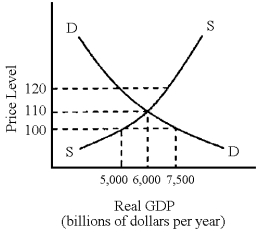 -If the price level in Figure 10-1 were 110,
In 1973, the U.S.experienced a decline in output and high inflation.
(True/False)
5.0/5 (79)
(79) College graduates looking for jobs were less fortunate in 2007 than graduates in 2009.
(True/False)
4.9/5 (73)
(73) The existence of an inflationary gap would tend to benefit most
(Multiple Choice)
4.9/5 (84)
(84) How is it possible for the economy to have an inflationary gap?
(Multiple Choice)
4.8/5 (75)
(75) One complication in the process of reducing inflation by creating recessions is that the price level
(Multiple Choice)
4.7/5 (70)
(70) A company succumbs to a wage increase demand without any changes in the productivity of labor, price of the product, and the total output sold.Which of the following would happen?
(Multiple Choice)
4.8/5 (79)
(79) The diminished employment prospects for the graduates of 2002 is most likely due to the existence of a(n)
(Multiple Choice)
4.9/5 (84)
(84) 
Filters
- Essay(0)
- Multiple Choice(0)
- Short Answer(0)
- True False(0)
- Matching(0)