



 Chat with AI
Exam 20: Labor and Entrepreneurship: The Human Inputs

Exam 1: What Is Economics?227 Questions
Exam 2: The Economy: Myth and Reality150 Questions
Exam 3: The Fundamental Economic Problem: Scarcity and Choice250 Questions
Exam 4: Supply and Demand: An Initial Look308 Questions
Exam 5: Consumer Choice: Individual and Market Demand202 Questions
Exam 6: Demand and Elasticity209 Questions
Exam 7: Production, Inputs, and Cost: Building Blocks for Supply Analysis216 Questions
Exam 8: Output, Price, and Profit: The Importance of Marginal Analysis189 Questions
Exam 9: Securities: Business Finance, and the Economy: The Tail that Wags the Dog?198 Questions
Exam 10: The Firm and the Industry under Perfect Competition208 Questions
Exam 11: Monopoly203 Questions
Exam 12: Between Competition and Monopoly225 Questions
Exam 13: Limiting Market Power: Regulation and Antitrust152 Questions
Exam 14: The Case for Free Markets I: The Price System220 Questions
Exam 15: The Shortcomings of Free Markets212 Questions
Exam 16: The Market's Prime Achievement: Innovation and Growth110 Questions
Exam 17: Externalities, the Environment, and Natural Resources217 Questions
Exam 18: Taxation and Resource Allocation219 Questions
Exam 19: Pricing the Factors of Production228 Questions
Exam 20: Labor and Entrepreneurship: The Human Inputs223 Questions
Exam 21: Poverty, Inequality, and Discrimination167 Questions
Exam 22: An Introduction to Macroeconomics211 Questions
Exam 23: The Goals of Macroeconomic Policy207 Questions
Exam 24: Economic Growth: Theory and Policy223 Questions
Exam 25: Aggregate Demand and the Powerful Consumer214 Questions
Exam 26: Demand-Side Equilibrium: Unemployment or Inflation?210 Questions
Exam 27: Bringing in the Supply Side: Unemployment and Inflation?223 Questions
Exam 28: Managing Aggregate Demand: Fiscal Policy205 Questions
Exam 29: Money and the Banking System219 Questions
Exam 30: Monetary Policy: Conventional and Unconventional205 Questions
Exam 31: The Financial Crisis and the Great Recession61 Questions
Exam 32: The Debate over Monetary and Fiscal Policy214 Questions
Exam 33: Budget Deficits in the Short and Long Run210 Questions
Exam 34: The Trade-Off between Inflation and Unemployment214 Questions
Exam 35: International Trade and Comparative Advantage226 Questions
Exam 36: The International Monetary System: Order or Disorder?213 Questions
Exam 37: Exchange Rates and the Macroeconomy214 Questions
Select questions type


The United States suffers more from strikes than Japan but fewer strikes than Canada.
(True/False)
5.0/5  (82)
(82) A person's decision to supply a certain amount of labor in a week is simultaneously a decision to consume a certain amount of leisure per week.
(True/False)
4.8/5 (91)
(91) Agriculture is a sector of the economy where increased productivity has been accompanied by a significant decrease in employment.
(True/False)
4.9/5 (74)
(74) American unions came under increasing pressure in the 1950s because of stronger competition both at home and abroad.
(True/False)
4.8/5 (85)
(85) The supply curve of truck drivers is upward sloping and demand curve is downward sloping.A reduction in the price of hauling freight by truck relative to the price of hauling freight by rail will ____ the equilibrium wage of truck drivers and ____ the number of drivers employed.
(Multiple Choice)
4.8/5 (85)
(85) Explain the expression "time is more valuable than money." Explain in words and use a diagram to illustrate the implications of this for a person's labor supply curve.
(Essay)
4.9/5 (78)
(78) The concept of economic rent would be more applicable to the earnings of
(Multiple Choice)
4.8/5 (63)
(63) The fact that invention is based largely on fixed costs and is a public good means that which of the following is not relevant to the process?
(Multiple Choice)
4.8/5 (76)
(76) Explain why on average the profit levels for invention and entrepreneurship are generally so low.
(Essay)
4.9/5 (76)
(76) The United Automobile Workers union can select the most favorable point on the demand curve for labor and the auto manufacturing companies can do nothing in response.
(True/False)
4.8/5 (80)
(80) Figure 20-3
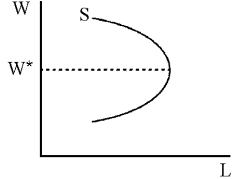 -Figure 20-3 shows a worker's backward-bending supply curve of labor.Which of the following statements is correct?
 (Multiple Choice)
4.7/5 (89)
(89) All other things being equal, an increase in the supply of labor will lead to a fall in the wage.
(True/False)
4.9/5 (92)
(92) A minimum wage law might increase wages without reducing employment if the hiring firm is
(Multiple Choice)
4.7/5 (83)
(83) According to the process of creative destruction, at first the entrepreneur will be able to sell her product for
(Multiple Choice)
4.9/5 (87)
(87) Figure 20-4
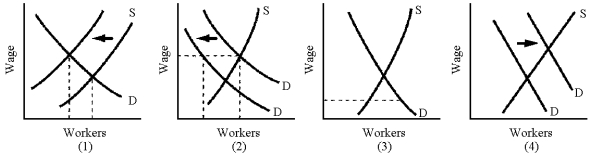 -In Figure 20-4, which panel depicts a union suffering unemployment during a recession rather than allowing the wage to fall?
 (Multiple Choice)
4.7/5 (79)
(79) 
Filters
- Essay(0)
- Multiple Choice(0)
- Short Answer(0)
- True False(0)
- Matching(0)