



 Chat with AI
Exam 20: Labor and Entrepreneurship: The Human Inputs

Exam 1: What Is Economics?227 Questions
Exam 2: The Economy: Myth and Reality150 Questions
Exam 3: The Fundamental Economic Problem: Scarcity and Choice250 Questions
Exam 4: Supply and Demand: An Initial Look308 Questions
Exam 5: Consumer Choice: Individual and Market Demand202 Questions
Exam 6: Demand and Elasticity209 Questions
Exam 7: Production, Inputs, and Cost: Building Blocks for Supply Analysis216 Questions
Exam 8: Output, Price, and Profit: The Importance of Marginal Analysis189 Questions
Exam 9: Securities: Business Finance, and the Economy: The Tail that Wags the Dog?198 Questions
Exam 10: The Firm and the Industry under Perfect Competition208 Questions
Exam 11: Monopoly203 Questions
Exam 12: Between Competition and Monopoly225 Questions
Exam 13: Limiting Market Power: Regulation and Antitrust152 Questions
Exam 14: The Case for Free Markets I: The Price System220 Questions
Exam 15: The Shortcomings of Free Markets212 Questions
Exam 16: The Market's Prime Achievement: Innovation and Growth110 Questions
Exam 17: Externalities, the Environment, and Natural Resources217 Questions
Exam 18: Taxation and Resource Allocation219 Questions
Exam 19: Pricing the Factors of Production228 Questions
Exam 20: Labor and Entrepreneurship: The Human Inputs223 Questions
Exam 21: Poverty, Inequality, and Discrimination167 Questions
Exam 22: An Introduction to Macroeconomics211 Questions
Exam 23: The Goals of Macroeconomic Policy207 Questions
Exam 24: Economic Growth: Theory and Policy223 Questions
Exam 25: Aggregate Demand and the Powerful Consumer214 Questions
Exam 26: Demand-Side Equilibrium: Unemployment or Inflation?210 Questions
Exam 27: Bringing in the Supply Side: Unemployment and Inflation?223 Questions
Exam 28: Managing Aggregate Demand: Fiscal Policy205 Questions
Exam 29: Money and the Banking System219 Questions
Exam 30: Monetary Policy: Conventional and Unconventional205 Questions
Exam 31: The Financial Crisis and the Great Recession61 Questions
Exam 32: The Debate over Monetary and Fiscal Policy214 Questions
Exam 33: Budget Deficits in the Short and Long Run210 Questions
Exam 34: The Trade-Off between Inflation and Unemployment214 Questions
Exam 35: International Trade and Comparative Advantage226 Questions
Exam 36: The International Monetary System: Order or Disorder?213 Questions
Exam 37: Exchange Rates and the Macroeconomy214 Questions
Select questions type


Figure 20-4
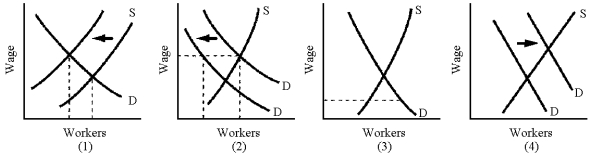 -In Figure 20-4, which panel shows the impact of union efforts to have goods produced in Asia excluded from the U.S.market?
 (Multiple Choice)
4.9/5  (92)
(92) The monetary return on a college education is considered economic rent.
(True/False)
4.7/5 (81)
(81) Define the following terms and explain their importance to the study of economics.
a.minimum wage law
b.income and substitution effects
c.backward-bending labor supply curve
d.human capital theory
e.dual labor markets
(Essay)
4.9/5 (79)
(79) The percentage of work time lost due to strikes is greater than the percentage of work time lost due to coffee breaks.
(True/False)
4.7/5 (77)
(77) Evidence indicates that the average economic profits of invention are
(Multiple Choice)
4.8/5 (82)
(82) The government enacted minimum wage legislation to protect skilled workers.
(True/False)
4.9/5 (71)
(71) The initial stage of the procedure in which a union and an employer negotiate over a contract is known as
(Multiple Choice)
4.9/5 (77)
(77) The argument that the minimum wage law has significantly increased teenage unemployment is not supported by recent statistical analysis.
(True/False)
4.9/5 (84)
(84) Earnings of some highly skilled or highly specialized persons can be classified as economic rents.
(True/False)
4.8/5 (64)
(64) If an individual possesses an ability that others cannot acquire, payment to that individual is
(Multiple Choice)
4.8/5 (82)
(82) Recent studies suggest that a rise in the minimum wage results in a substantial cut in the demand for teen labor.
(True/False)
4.8/5 (71)
(71) Which of the following is most likely to affect the supply of labor in any particular industry?
(Multiple Choice)
4.9/5 (67)
(67) A worker's marginal revenue product depends upon his average product.
(True/False)
4.8/5 (90)
(90) Give some explanations for the decline in union membership in the United States.
(Essay)
4.8/5 (87)
(87) When unions and management fail to reach agreement and the public interest is compromised, the government may require the union and management to undertake mediation.
(True/False)
4.8/5 (72)
(72) 
Filters
- Essay(0)
- Multiple Choice(0)
- Short Answer(0)
- True False(0)
- Matching(0)