



 Chat with AI
Exam 14: The Case for Free Markets I: The Price System

Exam 1: What Is Economics?227 Questions
Exam 2: The Economy: Myth and Reality150 Questions
Exam 3: The Fundamental Economic Problem: Scarcity and Choice250 Questions
Exam 4: Supply and Demand: An Initial Look308 Questions
Exam 5: Consumer Choice: Individual and Market Demand202 Questions
Exam 6: Demand and Elasticity209 Questions
Exam 7: Production, Inputs, and Cost: Building Blocks for Supply Analysis216 Questions
Exam 8: Output, Price, and Profit: The Importance of Marginal Analysis189 Questions
Exam 9: Securities: Business Finance, and the Economy: The Tail that Wags the Dog?198 Questions
Exam 10: The Firm and the Industry under Perfect Competition208 Questions
Exam 11: Monopoly203 Questions
Exam 12: Between Competition and Monopoly225 Questions
Exam 13: Limiting Market Power: Regulation and Antitrust152 Questions
Exam 14: The Case for Free Markets I: The Price System220 Questions
Exam 15: The Shortcomings of Free Markets212 Questions
Exam 16: The Market's Prime Achievement: Innovation and Growth110 Questions
Exam 17: Externalities, the Environment, and Natural Resources217 Questions
Exam 18: Taxation and Resource Allocation219 Questions
Exam 19: Pricing the Factors of Production228 Questions
Exam 20: Labor and Entrepreneurship: The Human Inputs223 Questions
Exam 21: Poverty, Inequality, and Discrimination167 Questions
Exam 22: An Introduction to Macroeconomics211 Questions
Exam 23: The Goals of Macroeconomic Policy207 Questions
Exam 24: Economic Growth: Theory and Policy223 Questions
Exam 25: Aggregate Demand and the Powerful Consumer214 Questions
Exam 26: Demand-Side Equilibrium: Unemployment or Inflation?210 Questions
Exam 27: Bringing in the Supply Side: Unemployment and Inflation?223 Questions
Exam 28: Managing Aggregate Demand: Fiscal Policy205 Questions
Exam 29: Money and the Banking System219 Questions
Exam 30: Monetary Policy: Conventional and Unconventional205 Questions
Exam 31: The Financial Crisis and the Great Recession61 Questions
Exam 32: The Debate over Monetary and Fiscal Policy214 Questions
Exam 33: Budget Deficits in the Short and Long Run210 Questions
Exam 34: The Trade-Off between Inflation and Unemployment214 Questions
Exam 35: International Trade and Comparative Advantage226 Questions
Exam 36: The International Monetary System: Order or Disorder?213 Questions
Exam 37: Exchange Rates and the Macroeconomy214 Questions
Select questions type


When box lunches are handed out at an elementary school, Jimmy (who loves chocolate and hates raisins) gets a raisin cookie and Johnny (who hates chocolate and loves raisins) gets a chocolate chip cookie.This is an example of inefficiency in
(Multiple Choice)
4.9/5  (86)
(86) In order for a central planner to achieve the invisible-hand type efficiency of a free market, the planner would
(Multiple Choice)
4.9/5 (81)
(81) In a competitive economy, the questions of what, how, and for whom to produce tend to be regulated by
(Multiple Choice)
4.9/5 (76)
(76) Which of the following is concerned with the distribution part of resource allocation?
(Multiple Choice)
4.9/5 (78)
(78) Which central coordination task has claimed the most attention of central planners?
(Multiple Choice)
4.8/5 (74)
(74) Explain why movie theaters charge more for evening performances than for matinees.
(Essay)
4.9/5 (82)
(82) Economists believe having higher prices for scarcer resources promotes efficiency.
(True/False)
4.7/5 (90)
(90) Figure 14-4
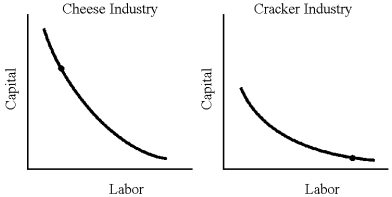 -In Figure 14-4, if the cheese industry and the cracker industry have the indicated quantities of capital and labor and are on the indicated production indifference curves, is there the possibility of mutually beneficial trade in inputs? Explain.
 (Essay)
5.0/5 (81)
(81) When an economy is operating with maximum efficiency, the production of more of commodity A will entail the production of less of commodity B because
(Multiple Choice)
4.9/5 (80)
(80) An economy consists of two goods: beef and lamb.Of all the points on this economy's production possibilities frontier, which one is best in terms of efficiency?
(Essay)
4.9/5 (87)
(87) The graphical device that illustrates the concept of scarce resources being efficiently utilized in the economy is a(n)
(Multiple Choice)
4.9/5 (79)
(79) Figure 14-5
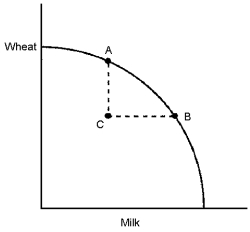 -Figure 14-5 contains a production possibilities frontier for wheat and milk production.Explain why Point C is not a point where resources are being used efficiently.
 (Essay)
4.9/5 (80)
(80) The price of a ride on the Washington, D.C.metro depends on the time of day you ride.This is an example of
(Multiple Choice)
4.9/5 (78)
(78) The slope of a typical production possibilities frontier reflects the fact that
(Multiple Choice)
4.9/5 (77)
(77) Under laissez faire, society's decisions about how much of every product to produce depend on
(Multiple Choice)
4.8/5 (84)
(84) Marxists and leaders of communist economies actually often admire the market mechanism for its
(Multiple Choice)
4.8/5 (91)
(91) For any combination or outputs, there is an efficient allocation of income.
(True/False)
4.9/5 (71)
(71) 
Filters
- Essay(0)
- Multiple Choice(0)
- Short Answer(0)
- True False(0)
- Matching(0)