



 Chat with AI
Exam 14: The Case for Free Markets I: The Price System

Exam 1: What Is Economics?227 Questions
Exam 2: The Economy: Myth and Reality150 Questions
Exam 3: The Fundamental Economic Problem: Scarcity and Choice250 Questions
Exam 4: Supply and Demand: An Initial Look308 Questions
Exam 5: Consumer Choice: Individual and Market Demand202 Questions
Exam 6: Demand and Elasticity209 Questions
Exam 7: Production, Inputs, and Cost: Building Blocks for Supply Analysis216 Questions
Exam 8: Output, Price, and Profit: The Importance of Marginal Analysis189 Questions
Exam 9: Securities: Business Finance, and the Economy: The Tail that Wags the Dog?198 Questions
Exam 10: The Firm and the Industry under Perfect Competition208 Questions
Exam 11: Monopoly203 Questions
Exam 12: Between Competition and Monopoly225 Questions
Exam 13: Limiting Market Power: Regulation and Antitrust152 Questions
Exam 14: The Case for Free Markets I: The Price System220 Questions
Exam 15: The Shortcomings of Free Markets212 Questions
Exam 16: The Market's Prime Achievement: Innovation and Growth110 Questions
Exam 17: Externalities, the Environment, and Natural Resources217 Questions
Exam 18: Taxation and Resource Allocation219 Questions
Exam 19: Pricing the Factors of Production228 Questions
Exam 20: Labor and Entrepreneurship: The Human Inputs223 Questions
Exam 21: Poverty, Inequality, and Discrimination167 Questions
Exam 22: An Introduction to Macroeconomics211 Questions
Exam 23: The Goals of Macroeconomic Policy207 Questions
Exam 24: Economic Growth: Theory and Policy223 Questions
Exam 25: Aggregate Demand and the Powerful Consumer214 Questions
Exam 26: Demand-Side Equilibrium: Unemployment or Inflation?210 Questions
Exam 27: Bringing in the Supply Side: Unemployment and Inflation?223 Questions
Exam 28: Managing Aggregate Demand: Fiscal Policy205 Questions
Exam 29: Money and the Banking System219 Questions
Exam 30: Monetary Policy: Conventional and Unconventional205 Questions
Exam 31: The Financial Crisis and the Great Recession61 Questions
Exam 32: The Debate over Monetary and Fiscal Policy214 Questions
Exam 33: Budget Deficits in the Short and Long Run210 Questions
Exam 34: The Trade-Off between Inflation and Unemployment214 Questions
Exam 35: International Trade and Comparative Advantage226 Questions
Exam 36: The International Monetary System: Order or Disorder?213 Questions
Exam 37: Exchange Rates and the Macroeconomy214 Questions
Select questions type


Scarcity is illustrated graphically by a production possibilities frontier.
(True/False)
4.7/5  (79)
(79) In an effort to prepare for war, the Defense Department is required by Congress to stockpile helium, once used to provide lift for blimps (phased out in the 1960s).About 100 years of total U.S.usage of helium is in storage.The Pentagon agrees to buy helium from producers at a price above what would otherwise prevail in the marketplace.Is this likely to result in efficiency? Explain.
(Essay)
4.9/5 (92)
(92) The nation listed below whose economy currently comes closest to a free market is
(Multiple Choice)
4.9/5 (66)
(66) Production planning without the market mechanism is very efficiently handled by central planners.
(True/False)
4.7/5 (72)
(72) Laissez faire refers to a program of minimal interference in the market system.
(True/False)
4.8/5 (80)
(80) Figure 14-1
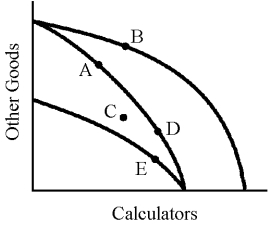 -In Figure 14-1, a cost-reducing technological breakthrough in calculator production would cause which movement?
 (Multiple Choice)
4.8/5 (74)
(74) Differentiate between consumer's surplus and producer's surplus.For a rational consumer, consumer's surplus will never be a negative number.Why?
(Essay)
4.8/5 (80)
(80) If a technological breakthrough reduces input quantities needed to produce some item,
(Multiple Choice)
4.8/5 (76)
(76) In a laissez-faire economy, the price system plays a key role in
(Multiple Choice)
4.8/5 (80)
(80) The coordination task of dividing products among consumers is a problem of
(Multiple Choice)
5.0/5 (88)
(88) Free markets produce allocatively efficient outcomes and have no flaws.
(True/False)
4.8/5 (81)
(81) Laissez-faire refers to a situation in which there is ____ with the workings of the market system.
(Multiple Choice)
5.0/5 (75)
(75) If MU = MC = P, an economist can judge with certainty that the distribution of output is
(Multiple Choice)
4.9/5 (82)
(82) To equalize traffic on transportation routes, a pricing arrangement called "peak, off-peak pricing" would most likely be proposed by
(Multiple Choice)
4.8/5 (96)
(96) The price system takes into account consumer preferences in the distribution of goods and services.
(True/False)
4.8/5 (72)
(72) In a market system, the primary instruments used to coordinate economic activity are
(Multiple Choice)
4.8/5 (85)
(85) In a free-market system, producers will react to an increase in demand when
(Multiple Choice)
4.7/5 (73)
(73) 
Filters
- Essay(0)
- Multiple Choice(0)
- Short Answer(0)
- True False(0)
- Matching(0)