



 Chat with AI
Exam 12: Between Competition and Monopoly

Exam 1: What Is Economics?227 Questions
Exam 2: The Economy: Myth and Reality150 Questions
Exam 3: The Fundamental Economic Problem: Scarcity and Choice250 Questions
Exam 4: Supply and Demand: An Initial Look308 Questions
Exam 5: Consumer Choice: Individual and Market Demand202 Questions
Exam 6: Demand and Elasticity209 Questions
Exam 7: Production, Inputs, and Cost: Building Blocks for Supply Analysis216 Questions
Exam 8: Output, Price, and Profit: The Importance of Marginal Analysis189 Questions
Exam 9: Securities: Business Finance, and the Economy: The Tail that Wags the Dog?198 Questions
Exam 10: The Firm and the Industry under Perfect Competition208 Questions
Exam 11: Monopoly203 Questions
Exam 12: Between Competition and Monopoly225 Questions
Exam 13: Limiting Market Power: Regulation and Antitrust152 Questions
Exam 14: The Case for Free Markets I: The Price System220 Questions
Exam 15: The Shortcomings of Free Markets212 Questions
Exam 16: The Market's Prime Achievement: Innovation and Growth110 Questions
Exam 17: Externalities, the Environment, and Natural Resources217 Questions
Exam 18: Taxation and Resource Allocation219 Questions
Exam 19: Pricing the Factors of Production228 Questions
Exam 20: Labor and Entrepreneurship: The Human Inputs223 Questions
Exam 21: Poverty, Inequality, and Discrimination167 Questions
Exam 22: An Introduction to Macroeconomics211 Questions
Exam 23: The Goals of Macroeconomic Policy207 Questions
Exam 24: Economic Growth: Theory and Policy223 Questions
Exam 25: Aggregate Demand and the Powerful Consumer214 Questions
Exam 26: Demand-Side Equilibrium: Unemployment or Inflation?210 Questions
Exam 27: Bringing in the Supply Side: Unemployment and Inflation?223 Questions
Exam 28: Managing Aggregate Demand: Fiscal Policy205 Questions
Exam 29: Money and the Banking System219 Questions
Exam 30: Monetary Policy: Conventional and Unconventional205 Questions
Exam 31: The Financial Crisis and the Great Recession61 Questions
Exam 32: The Debate over Monetary and Fiscal Policy214 Questions
Exam 33: Budget Deficits in the Short and Long Run210 Questions
Exam 34: The Trade-Off between Inflation and Unemployment214 Questions
Exam 35: International Trade and Comparative Advantage226 Questions
Exam 36: The International Monetary System: Order or Disorder?213 Questions
Exam 37: Exchange Rates and the Macroeconomy214 Questions
Select questions type


In the past, the Department of Transportation allowed airline mergers that gave the merged airlines market shares of 79 and 82 percent, respectively, in their hub cities.The concept the DOT used to allow mergers where there was obvious concentration was most likely
(Multiple Choice)
4.8/5  (79)
(79) Price leadership is an example of explicit collusion by oligopolies.
(True/False)
5.0/5 (77)
(77) What is the long-run effect on the demand curve of a monopolistically competitive firm when more firms enter the market?
(Multiple Choice)
4.9/5 (71)
(71) Oligopolists seldom change prices, because they don't like change.
(True/False)
4.8/5 (72)
(72) Oligopolistic firms that practice sales revenue maximization will produce
(Multiple Choice)
4.8/5 (76)
(76) Figure 12-4
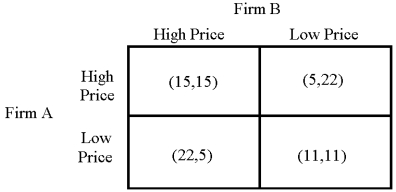 -The above matrix (Figure 12-4) displays the possible profit results of two firms, A and B, from following two different possible strategies: charging a high price and charging a low price.In each cell, the first number is the profit of firm A, and the second number is the profit of firm B.
a.
Assume that collusion is not possible.Determine the optimal strategy for each firm.Explain why it is the best strategy to follow.
a., explain why firms collude.What are the pitfalls of collusion?
b.
Based on your answer to
-The above matrix (Figure 12-4) displays the possible profit results of two firms, A and B, from following two different possible strategies: charging a high price and charging a low price.In each cell, the first number is the profit of firm A, and the second number is the profit of firm B.
a.
Assume that collusion is not possible.Determine the optimal strategy for each firm.Explain why it is the best strategy to follow.
a., explain why firms collude.What are the pitfalls of collusion?
b.
Based on your answer to (Essay)
4.9/5 (62)
(62) What are the four types of industry structures? Compare and contrast them with the number of firms in the industry, whether firms produce homogeneous or heterogeneous products, whether there are economic profits in long-run equilibrium, and how frequently the model appears in the real world.
(Essay)
4.8/5 (69)
(69) What are the advantages and disadvantages of resource allocation under monopolistic competition compared to perfect competition?
(Essay)
4.8/5 (78)
(78) Economists place cartels among the least-desirable forms of market organization.
(True/False)
4.8/5 (78)
(78) To maximize sales revenue, an oligopoly will expand output until the price is zero.
(True/False)
4.8/5 (82)
(82) Monopolistic competition has at least one similarity to perfect competition: firms are free to enter and leave the industry.
(True/False)
4.9/5 (66)
(66) The cost-revenue diagrams for a monopolist and a monopolistic competitor are similar except that the demand curve for the monopolistic competitor is flatter.
(True/False)
4.9/5 (90)
(90) The demand curve for a monopolistic competitor is likely to be steeper than that of a monopolist.
(True/False)
4.9/5 (92)
(92) The entry of new firms into a monopolistically competitive industry will cause the long-run equilibrium price to rise.
(True/False)
4.9/5 (80)
(80) 
Filters
- Essay(0)
- Multiple Choice(0)
- Short Answer(0)
- True False(0)
- Matching(0)