



 Chat with AI
Exam 12: Between Competition and Monopoly

Exam 1: What Is Economics?227 Questions
Exam 2: The Economy: Myth and Reality150 Questions
Exam 3: The Fundamental Economic Problem: Scarcity and Choice250 Questions
Exam 4: Supply and Demand: An Initial Look308 Questions
Exam 5: Consumer Choice: Individual and Market Demand202 Questions
Exam 6: Demand and Elasticity209 Questions
Exam 7: Production, Inputs, and Cost: Building Blocks for Supply Analysis216 Questions
Exam 8: Output, Price, and Profit: The Importance of Marginal Analysis189 Questions
Exam 9: Securities: Business Finance, and the Economy: The Tail that Wags the Dog?198 Questions
Exam 10: The Firm and the Industry under Perfect Competition208 Questions
Exam 11: Monopoly203 Questions
Exam 12: Between Competition and Monopoly225 Questions
Exam 13: Limiting Market Power: Regulation and Antitrust152 Questions
Exam 14: The Case for Free Markets I: The Price System220 Questions
Exam 15: The Shortcomings of Free Markets212 Questions
Exam 16: The Market's Prime Achievement: Innovation and Growth110 Questions
Exam 17: Externalities, the Environment, and Natural Resources217 Questions
Exam 18: Taxation and Resource Allocation219 Questions
Exam 19: Pricing the Factors of Production228 Questions
Exam 20: Labor and Entrepreneurship: The Human Inputs223 Questions
Exam 21: Poverty, Inequality, and Discrimination167 Questions
Exam 22: An Introduction to Macroeconomics211 Questions
Exam 23: The Goals of Macroeconomic Policy207 Questions
Exam 24: Economic Growth: Theory and Policy223 Questions
Exam 25: Aggregate Demand and the Powerful Consumer214 Questions
Exam 26: Demand-Side Equilibrium: Unemployment or Inflation?210 Questions
Exam 27: Bringing in the Supply Side: Unemployment and Inflation?223 Questions
Exam 28: Managing Aggregate Demand: Fiscal Policy205 Questions
Exam 29: Money and the Banking System219 Questions
Exam 30: Monetary Policy: Conventional and Unconventional205 Questions
Exam 31: The Financial Crisis and the Great Recession61 Questions
Exam 32: The Debate over Monetary and Fiscal Policy214 Questions
Exam 33: Budget Deficits in the Short and Long Run210 Questions
Exam 34: The Trade-Off between Inflation and Unemployment214 Questions
Exam 35: International Trade and Comparative Advantage226 Questions
Exam 36: The International Monetary System: Order or Disorder?213 Questions
Exam 37: Exchange Rates and the Macroeconomy214 Questions
Select questions type


Define the following terms and explain their importance to the study of economics.
a.monopolistic competition
b.oligopoly
c.cartel
d.oligopolistic interdependence
(Essay)
4.8/5  (77)
(77) In the long run, zero economic profit exists in monopolistic competition and perfect competition.
(True/False)
4.9/5 (75)
(75) In a perfectly contestable market in the long run, each firm
(Multiple Choice)
4.7/5 (76)
(76) Which of the following attitudes will be held by a typical firm in a typical cartel?
(Multiple Choice)
4.8/5 (68)
(68) Why is oligopoly more difficult to model than competition or monopoly?
(Essay)
4.8/5 (82)
(82) An oligopoly will always use game theory to maximize sales rather than profits.
(True/False)
4.9/5 (91)
(91) The short-run equilibrium of the firm under monopolistic competition has excess capacity.
(True/False)
4.9/5 (63)
(63) The game theory approach to the analysis of oligopoly assumes that oligopolists
(Multiple Choice)
4.8/5 (87)
(87) Unlike a perfectly competitive firm, a monopolistically competitive firm
(Multiple Choice)
4.9/5 (85)
(85) Oligopolies are difficult to analyze because of the interdependent nature of management decisions.
(True/False)
4.9/5 (72)
(72) Figure 12-3
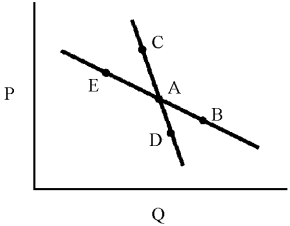 -In Figure 12-3, demand curve CAD represents a market in which oligopolists will match the price changes of rivals and demand curve EAB represents a market in which oligopolists will ignore the price changes of rivals.According to the kinked demand model, the relevant demand curve will be
 (Multiple Choice)
4.9/5 (87)
(87) In ____, each competing firm is determined to sell at a price that is lower than the prices of its rivals, often regardless of whether that price covers the pertinent cost.
(Multiple Choice)
4.7/5 (81)
(81) Economic theory of market forms between pure monopoly and perfect competition was largely nonexistent until the work of
(Multiple Choice)
4.7/5 (75)
(75) In the long run, a monopolistically competitive firm produces at minimum average cost.
(True/False)
4.8/5 (68)
(68) The demand curve for a monopolistic competitor is likely to be flatter than that of a monopolist.
(True/False)
4.9/5 (79)
(79) A dominant strategy is one that is best for one player regardless of the strategy chosen by the other player.
(True/False)
4.8/5 (77)
(77) 
Filters
- Essay(0)
- Multiple Choice(0)
- Short Answer(0)
- True False(0)
- Matching(0)