



 Chat with AI
Exam 21: Introduction to Statistical Analysis

Exam 1: Discovering the World of Nursing Research16 Questions
Exam 2: Evolution of Research in Building Evidence-Based Nursing Practice26 Questions
Exam 3: Introduction to Quantitative Research25 Questions
Exam 4: Introduction to Qualitative Research13 Questions
Exam 5: Research Problem and Purpose20 Questions
Exam 6: Objectives, Questions, Hypotheses, and Study Variables28 Questions
Exam 7: Review of Relevant Literature17 Questions
Exam 8: Frameworks27 Questions
Exam 9: Ethics in Research37 Questions
Exam 10: Quantitative Methodology: Noninterventional Designs and Methods22 Questions
Exam 11: Quantitative Methodology: Interventional Designs and Methods40 Questions
Exam 12: Qualitative Research Methods14 Questions
Exam 13: Outcomes Research19 Questions
Exam 14: Mixed Methods Research10 Questions
Exam 15: Sampling47 Questions
Exam 16: Quantitative Measurement Concepts25 Questions
Exam 17: Measurement Methods Used in Developing Evidence-Based Practice24 Questions
Exam 18: Critical Appraisal of Nursing Studies13 Questions
Exam 19: Evidence Synthesis and Strategies for Implementing Evidence-Based Practice13 Questions
Exam 20: Collecting and Managing Data12 Questions
Exam 21: Introduction to Statistical Analysis31 Questions
Exam 22: Using Statistics to Describe Variables12 Questions
Exam 23: Using Statistics to Examine Relationships14 Questions
Exam 24: Using Statistics to Predict12 Questions
Exam 25: Using Statistics to Determine Differences14 Questions
Exam 26: Interpreting Research Outcomes18 Questions
Exam 27: Disseminating Research Findings23 Questions
Exam 28: Writing Research Proposals9 Questions
Exam 29: Seeking Funding for Research10 Questions
Select questions type


In this illustration of a negatively skewed curve, identify which line represents the mode. 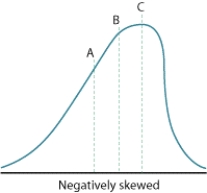

Free
(Multiple Choice)
4.7/5  (85)
(85) Correct Answer: Verified
C
Why can Type I error and Type II error not be both present for one given hypothesis?
Free
(Multiple Choice)
5.0/5 (75)
(75) Correct Answer:Verified
VerifiedB, C
A researcher conducts a statistical test that reveals that the four groups analyzed differed. The researcher wants to discover which one or ones of the four differed from the others. The researcher must then perform a post hoc analysis. What will this involve?
Free
(Multiple Choice)
4.9/5 (84)
(84) Correct Answer:Verified
VerifiedD
If beta, , is the probability of making a Type II error, what is 1 minus ?
(Multiple Choice)
4.9/5 (89)
(89) In statistical hypothesis testing, which of the following occur before the data are collected?
(Multiple Choice)
4.9/5 (85)
(85) Findings can be statistically significant but clinically not significant. Which of the following studies with statistically significant findings exemplify this?
(Multiple Choice)
4.8/5 (98)
(98) A measured value is within two standard deviations of the mean but not within one standard deviation, and it is greater than the mean. The distribution is very close to a normal distribution. What does this signify?
(Multiple Choice)
4.8/5 (85)
(85) A researcher who has conducted experimental research finds that in the researcher's 145-person hospital study, the patients who are ambulated on the evening of abdominal surgery are less likely than the control group to develop postoperative pneumonia. What does the researcher infer?
(Multiple Choice)
4.8/5 (79)
(79) A researcher is concerned about the power of a study. The researcher's planned interventional study examines the effect upon depression of instituting twice-yearly trips with the Road Scholar travel program for widows and widowers who have, 1 to 2 years before, lost a spouse to a long illness. What strategies could make Type II error less likely?
(Multiple Choice)
4.8/5 (82)
(82) A teacher administers an examination. The examination seemed relatively easy for the students, and the majority of the scores are at the high end of the scale, although several students received low scores. In statistical terms this represents what?
(Multiple Choice)
4.9/5 (82)
(82) A null hypothesis is stated. The null hypothesis is, "There is no difference between 10 mcg and 20 mcg of vitamin D3, in prevention of osteoporosis." What are the implications of this statement, concerning the null hypothesis and Type I error?
(Multiple Choice)
5.0/5 (77)
(77) Why might nonparametric statistical methods be used for analysis?
(Multiple Choice)
4.9/5 (69)
(69) A researcher reports that the heights of men aged 53 living in Rapid City, South Dakota, is between 5'7" and 6'0" and that the confidence interval is calculated at the p < 0.05 level. What does this mean?
(Multiple Choice)
4.9/5 (92)
(92) A data set shows that the mean, median, and mode are the same. This means which of the following?
(Multiple Choice)
4.8/5 (76)
(76) Where would one find approximately 95% of the scores in the following example if scores are normally distributed? "Scores ranged from 30 to 68, M = 45, SD = 7."
(Multiple Choice)
4.9/5 (72)
(72) A researcher designs a study to measure the effect on patient satisfaction of the nurse stating to the patient at least once a day, "You're a good person." The researcher sets the alpha (Type I error) for the study at p < 0.10 because the intervention costs nothing, it needs very little time to enact, and it is harmless. If the alpha is set at 0.10, what is the effect on the beta [ ], and on Type II error?
(Multiple Choice)
4.9/5 (76)
(76) There are four data sets:
A: 1, 1, 1, 1, 1, 10, 10, 10, 10
B: 2, 2, 2, 2, 4, 8, 8, 8, 9
C: 3, 4, 4, 5, 5, 5, 6, 6, 7
D: 1, 2, 3, 4, 5, 6, 7, 8, 9
What is the mean of the four individual data sets?
(Multiple Choice)
4.8/5 (88)
(88) There are four data sets:
A: 1, 1, 1, 1, 1, 10, 10, 10, 10
B: 2, 2, 2, 2, 4, 8, 8, 8, 9
C: 3, 4, 4, 5, 5, 5, 6, 6, 7
D: 1, 2, 3, 4, 5, 6, 7, 8, 9
What is the median of the four individual data sets?
(Multiple Choice)
4.8/5 (88)
(88) In the illustration, what is this particular distribution called? 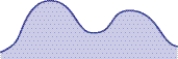
(Multiple Choice)
4.8/5 (75)
(75) 
Filters
- Essay(0)
- Multiple Choice(0)
- Short Answer(0)
- True False(0)
- Matching(0)