



 Chat with AI
Exam 2: Solar Energy to Earth and the Seasons

Exam 1: Essentials of Geography205 Questions
Exam 2: Solar Energy to Earth and the Seasons142 Questions
Exam 3: Earth's Modern Atmosphere152 Questions
Exam 4: Atmosphere and Surface Energy Balances100 Questions
Exam 5: Global Temperatures113 Questions
Exam 6: Atmospheric and Oceanic Circulations144 Questions
Exam 7: Water and Atmospheric Moisture164 Questions
Exam 8: Weather129 Questions
Exam 9: Water Resources127 Questions
Exam 10: Climate Systems and Climate Change135 Questions
Exam 11: The Dynamic Planet176 Questions
Exam 12: Tectonics, Earthquakes, and Volcanism138 Questions
Exam 13: Weathering, Karst Landscapes, and Mass Movement114 Questions
Exam 14: River Systems and Landforms136 Questions
Exam 15: Eolian Processes and Arid Landscapes127 Questions
Exam 16: The Oceans, Coastal Processes, and Landforms123 Questions
Exam 17: Glacial and Periglacial Processes and Landforms159 Questions
Exam 18: The Geography of Soils134 Questions
Exam 19: Ecosystem Essentials143 Questions
Exam 20: Terrestrial Biomes131 Questions
Exam 21: Earth and the Human Denominator34 Questions
Select questions type


Which of the following is true of the Sun's electromagnetic spectrum?
(Multiple Choice)
4.8/5  (87)
(87) Which of the following is true of Earth's orbit about the Sun?
(Multiple Choice)
4.8/5 (84)
(84) The two main portions of the solar spectrum which enter the atmosphere are
(Multiple Choice)
4.9/5 (72)
(72) Which of the following is true of the number of hours of daylight?
(Multiple Choice)
4.8/5 (80)
(80) The magnetosphere deflects the solar wind toward Earth's two poles.
(True/False)
4.8/5 (78)
(78) To answer the following questions,refer to the figure below.Assume that it shows the orbit of a hypothetical planet in another part of the galaxy and that this planet has an axial tilt of 20°.(Note the direction of the axial tilt and the direction of the orbit. )
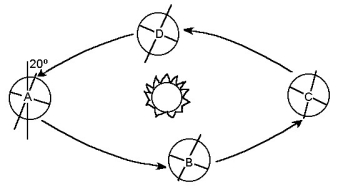 -In Figure MC2,what position corresponds to the winter solstice for observers in the northern hemisphere? (Assume north is toward the top of the page. )
 (Multiple Choice)
4.8/5 (88)
(88) Rotation is Earth's motion on its axis revolution is its motion about the Sun.
(True/False)
4.8/5 (80)
(80) The Sun emits streams of charged particles that are collectively referred to as the electromagnetic spectrum.
(True/False)
4.9/5 (86)
(86) If we can see galaxies 12 billion light years away,that means that the universe must be at least 12 billion years old because that is how long it took the light from these galaxies to reach us.
(True/False)
4.8/5 (83)
(83) For where you live,how do daylength and the Sun's altitude vary throughout the year?
(Not Answered)
This question doesn't have any answer yet
The Sun is directly overhead north of 23.5° north latitude twice a year.
(True/False)
4.8/5 (88)
(88) Energy is liberated within the Sun's interior through a process known as nuclear fusion.
(True/False)
4.8/5 (83)
(83) There is no evidence for a correlation between sunspot activity and weather conditions on Earth.
(True/False)
4.8/5 (77)
(77) Astronauts deployed a solar wind measuring experiment on the Moon because
(Multiple Choice)
4.8/5 (68)
(68) Which of the following is correct relative to insolation at the thermopause?
(Multiple Choice)
4.8/5 (76)
(76) What is the name of the location on the surface of Earth that receives insolation when the Sun is directly overhead? (When this occurs,the Sun's rays are perpendicular to this surface. )
(Multiple Choice)
4.8/5 (84)
(84) The planetesimal hypothesis pertains to the formation of the
(Multiple Choice)
4.8/5 (79)
(79) To answer the following questions,refer to the figure below.Assume that it shows the orbit of a hypothetical planet in another part of the galaxy and that this planet has an axial tilt of 20°.(Note the direction of the axial tilt and the direction of the orbit. )
-According to Figure MC2,given the tilt of the axis (20°),the Tropic of Capricorn would be located at
-According to Figure MC2,given the tilt of the axis (20°),the Tropic of Capricorn would be located at (Multiple Choice)
4.9/5 (78)
(78) 
Filters
- Essay(0)
- Multiple Choice(0)
- Short Answer(0)
- True False(0)
- Matching(0)