



 Chat with AI
Exam 2: Solar Energy to Earth and the Seasons

Exam 1: Essentials of Geography205 Questions
Exam 2: Solar Energy to Earth and the Seasons142 Questions
Exam 3: Earth's Modern Atmosphere152 Questions
Exam 4: Atmosphere and Surface Energy Balances100 Questions
Exam 5: Global Temperatures113 Questions
Exam 6: Atmospheric and Oceanic Circulations144 Questions
Exam 7: Water and Atmospheric Moisture164 Questions
Exam 8: Weather129 Questions
Exam 9: Water Resources127 Questions
Exam 10: Climate Systems and Climate Change135 Questions
Exam 11: The Dynamic Planet176 Questions
Exam 12: Tectonics, Earthquakes, and Volcanism138 Questions
Exam 13: Weathering, Karst Landscapes, and Mass Movement114 Questions
Exam 14: River Systems and Landforms136 Questions
Exam 15: Eolian Processes and Arid Landscapes127 Questions
Exam 16: The Oceans, Coastal Processes, and Landforms123 Questions
Exam 17: Glacial and Periglacial Processes and Landforms159 Questions
Exam 18: The Geography of Soils134 Questions
Exam 19: Ecosystem Essentials143 Questions
Exam 20: Terrestrial Biomes131 Questions
Exam 21: Earth and the Human Denominator34 Questions
Select questions type


Which of the following accurately describes Earth's distance from the Sun?
(Multiple Choice)
4.8/5  (86)
(86) Large magnetic disturbances on the Sun's surface are called sunspots and produce increased amounts of solar wind.
(True/False)
4.9/5 (82)
(82) To answer the following questions,refer to the figure below.Assume that it shows the orbit of a hypothetical planet in another part of the galaxy and that this planet has an axial tilt of 20°.(Note the direction of the axial tilt and the direction of the orbit. )
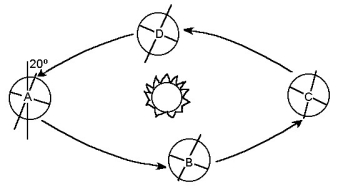 -On Earth,the Sun passes directly overhead at 25° north latitude ________ times a year.
 (Multiple Choice)
4.8/5 (74)
(74) The uneven distribution of insolation by latitude is primarily a result of
(Multiple Choice)
4.9/5 (75)
(75) Sunspots vary in a cycle from 7 to 17 years,averaging 11 years from a maximum to maximum peak.
(True/False)
4.9/5 (82)
(82) Which of the following have been correlated with sunspot cycles?
(Multiple Choice)
4.8/5 (82)
(82) The Solar System,Sun,and Earth formed about 4.6 to 5 billion years ago.
(True/False)
4.8/5 (68)
(68) On June 21,the Sun never sets at Finn's location.Based on this,it can be concluded that Finn lives
(Multiple Choice)
4.9/5 (80)
(80) Draw and label a diagram of the Earth-Sun relationship for the four seasons.Include the average distance from Earth to the Sun,the location of the subsolar point for each seasonal event,and the name and date for each of the solstices and equinoxes.
(Not Answered)
This question doesn't have any answer yet
Do high latitudes receive less energy than the equatorial regions? Why?
(Multiple Choice)
4.9/5 (69)
(69) To answer the following questions,refer to the figure below.Assume that it shows the orbit of a hypothetical planet in another part of the galaxy and that this planet has an axial tilt of 20°.(Note the direction of the axial tilt and the direction of the orbit. )
-According to Figure MC2,at what position would daylight last for 24 hours for observers located north of the Arctic Circle?
-According to Figure MC2,at what position would daylight last for 24 hours for observers located north of the Arctic Circle? (Multiple Choice)
4.8/5 (78)
(78) On the northern hemisphere's summer solstice,the north polar region receives more total daily energy than the equator.
(True/False)
4.8/5 (72)
(72) While standing at the Tropic of Cancer,Emma's shadow points north at noon (Sun time).Based on this,which of the following can be definitely concluded?
(Multiple Choice)
4.8/5 (75)
(75) All places on Earth receive the same period of day and night on March 21.
(True/False)
4.9/5 (78)
(78) Auroras in the upper atmosphere are stimulated by streams of charged (ionized)particles emitted by the Sun.
(True/False)
4.9/5 (79)
(79) 
Filters
- Essay(0)
- Multiple Choice(0)
- Short Answer(0)
- True False(0)
- Matching(0)