



 Chat with AI
Exam 2: Solar Energy to Earth and the Seasons

Exam 1: Essentials of Geography205 Questions
Exam 2: Solar Energy to Earth and the Seasons142 Questions
Exam 3: Earth's Modern Atmosphere152 Questions
Exam 4: Atmosphere and Surface Energy Balances100 Questions
Exam 5: Global Temperatures113 Questions
Exam 6: Atmospheric and Oceanic Circulations144 Questions
Exam 7: Water and Atmospheric Moisture164 Questions
Exam 8: Weather129 Questions
Exam 9: Water Resources127 Questions
Exam 10: Climate Systems and Climate Change135 Questions
Exam 11: The Dynamic Planet176 Questions
Exam 12: Tectonics, Earthquakes, and Volcanism138 Questions
Exam 13: Weathering, Karst Landscapes, and Mass Movement114 Questions
Exam 14: River Systems and Landforms136 Questions
Exam 15: Eolian Processes and Arid Landscapes127 Questions
Exam 16: The Oceans, Coastal Processes, and Landforms123 Questions
Exam 17: Glacial and Periglacial Processes and Landforms159 Questions
Exam 18: The Geography of Soils134 Questions
Exam 19: Ecosystem Essentials143 Questions
Exam 20: Terrestrial Biomes131 Questions
Exam 21: Earth and the Human Denominator34 Questions
Select questions type


Changes in daylength and the Sun's altitude above the horizon over the course of the year
(Multiple Choice)
4.9/5  (77)
(77) To answer the following questions,refer to the figure below.Assume that it shows the orbit of a hypothetical planet in another part of the galaxy and that this planet has an axial tilt of 20°.(Note the direction of the axial tilt and the direction of the orbit. )
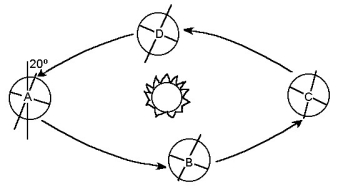 -According to Figure MC2,if the hypothetical planet requires 20 months to complete one orbit around the star,how many months after the Summer Solstice would the Sun cross the equator moving north?
 (Multiple Choice)
4.7/5 (69)
(69) Earth's axis is tilted 23.5° from a perpendicular to the plane of the ecliptic.
(True/False)
4.8/5 (75)
(75) The amount of energy received above the South Pole during the southern hemisphere's summer solstice is ________ than that received above the North Pole during the northern hemisphere's summer solstice because ________.
(Multiple Choice)
4.8/5 (69)
(69) Insolation occurs primarily in the ultraviolet portion of the spectrum.
(True/False)
4.8/5 (77)
(77) The 28-ton stones assembled at Stonehenge in England were evidently used by ancients to mark seasonal changes.In other words,Stonehenge is an ancient calendar.
(True/False)
4.9/5 (67)
(67) The correct order for wavelengths of electromagnetic radiation,from shortest to longest is: X-rays,infrared,radio waves,visible light,and ultraviolet.
(True/False)
4.8/5 (76)
(76) During the process by which energy is produced inside of stars,
(Multiple Choice)
4.7/5 (87)
(87) To answer the following questions,refer to the figure below.Assume that it shows the orbit of a hypothetical planet in another part of the galaxy and that this planet has an axial tilt of 20°.(Note the direction of the axial tilt and the direction of the orbit. )
-According to Figure MC2,given the tilt of the axis (20°),the Arctic Circle would be located at
-According to Figure MC2,given the tilt of the axis (20°),the Arctic Circle would be located at (Multiple Choice)
4.8/5 (70)
(70) Earth's spherical shape is not a factor with regards to seasonality.
(True/False)
4.7/5 (68)
(68) The amount of the solar energy received by a given location is not really constant-it varies depending upon the season and Earth's distance from the Sun.
(True/False)
4.9/5 (86)
(86) The planets in the solar system are believed to have formed as a result of a process known as ________ which is caused by ________.
(Multiple Choice)
4.9/5 (82)
(82) 
Filters
- Essay(0)
- Multiple Choice(0)
- Short Answer(0)
- True False(0)
- Matching(0)