



 Chat with AI
Exam 8: Corporate Formation, Reorganization, and Liquidation

Exam 1: Business Income, Deductions, and Accounting Methods105 Questions
Exam 2: Property Acquisition and Cost Recovery86 Questions
Exam 3: Property Dispositions111 Questions
Exam 4: Business Entities Overview81 Questions
Exam 5: Corporate Operations114 Questions
Exam 6: Accounting for Income Taxes106 Questions
Exam 7: Corporate Taxation: Non-Liquidating Distributions101 Questions
Exam 8: Corporate Formation, Reorganization, and Liquidation108 Questions
Exam 9: Forming and Operating Partnerships114 Questions
Exam 10: Dispositions of Partnership Interests and Partnership Distributions94 Questions
Exam 11: S Corporations132 Questions
Exam 12: State and Local Taxes114 Questions
Exam 13: The Us Taxation of Multinational Transactions88 Questions
Exam 14: Transfer Taxes and Wealth Planning114 Questions
Select questions type


Celeste transferred 100 percent of her stock in Supply Chain Company to Marketing Corporation in a Type A merger. In exchange, she received stock in Marketing with a fair market value of $500,000 plus $500,000 in cash. Celeste's tax basis in the Supply Chain stock was $1,200,000. What amount of loss does Celeste recognize in the exchange and what is her basis in the Marketing stock she receives?
(Multiple Choice)
5.0/5  (84)
(84) Which of the following statements does not describe a motivation by the buyer or seller in the acquisition or sale of a company?
(Multiple Choice)
4.9/5 (73)
(73) Packard Corporation transferred its 100 percent interest to State Company as part of a complete liquidation of the company. In the exchange, Packard received land with a fair market value of $300,000. Packard's basis in the State stock was $600,000. The land had a basis to State Company of $500,000. What amount of loss does State recognize in the exchange and what is Packard's basis in the land it receives?
(Multiple Choice)
4.8/5 (77)
(77) Amy transfers property with a tax basis of $1,590 and a fair market value of $1,080 to a corporation in exchange for stock with a fair market value of $605 in a transaction that qualifies for deferral under section 351. The corporation assumed a liability of $475 on the property transferred. What is Amy's tax basis in the stock received in the exchange?
(Multiple Choice)
4.8/5 (81)
(81) Which of the following statements does not describe a tax consequence to shareholders in a complete liquidation?
(Multiple Choice)
4.7/5 (71)
(71) Robin transferred her 60 percent interest to Cardinal Company as part of a complete liquidation of the company. In the exchange, she received land with a fair market value of $965,000. Robin's basis in the Cardinal stock was $987,500. The land had a basis to Cardinal Company of $1,245,000. What amount of loss does Cardinal recognize in the exchange and what is Robin's basis in the land she receives? The distribution was non-pro rata to Robin, a related person.
(Multiple Choice)
4.8/5 (81)
(81) Camille transfers property with a tax basis of $800 and a fair market value of $1,200 to a corporation in exchange for stock with a fair market value of $850 and $350 in cash in a transaction that qualifies for deferral under section 351. Camille also incurred selling expenses of $100. What is the amount realized by Camille in the exchange?
(Multiple Choice)
4.7/5 (59)
(59) Ken and Jim agree to go into business together selling old comic books and records. According to the agreement, Ken will contribute inventory valued at $200,000 in return for 80 percent of the stock in the corporation. Ken's tax basis in the inventory is $100,000. Jim will receive 20 percent of the stock in return for providing accounting services to the corporation (these qualify as organizational expenditures). The accounting services are valued at $50,000.
Please answer the following questions about the tax consequences of the transaction to Jim.
a. What amount of income gain or loss does Jim realize on the formation of the corporation?
b. What amount of gain or loss, if any, does he recognize?
c. What is Jim's tax basis in the stock he receives in return for his contribution of services to the corporation?
(Essay)
4.8/5 (80)
(80) Generally, before gain or loss is realized for tax purposes, the taxpayer must engage in a transaction.
(True/False)
4.9/5 (86)
(86) Tristan transfers property with a tax basis of $900 and a fair market value of $1,200 to a corporation in exchange for stock with a fair market value of $900 and $200 in cash in a transaction that qualifies for deferral under section 351. The corporation assumed a liability of $100 on the property transferred. What is the corporation's tax basis in the property received in the exchange?
(Multiple Choice)
4.8/5 (83)
(83) Gary and Laura decided to liquidate their jointly owned corporation, Amelia, Incorporated. After liquidating its remaining inventory and paying off its remaining liabilities, Amelia had the following tax accounting balance sheet.
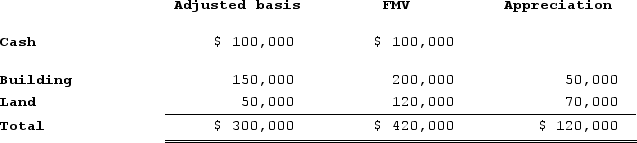 Under the terms of the agreement, Gary will receive the $100,000 cash in exchange for his interest in Amelia. Gary's tax basis in his Amelia stock is $30,000. Laura will receive the building and land in exchange for her interest in Amelia. Laura's tax basis in her Amelia stock is $60,000.
What amount of gain or loss does Amelia recognize in the complete liquidation?
Under the terms of the agreement, Gary will receive the $100,000 cash in exchange for his interest in Amelia. Gary's tax basis in his Amelia stock is $30,000. Laura will receive the building and land in exchange for her interest in Amelia. Laura's tax basis in her Amelia stock is $60,000.
What amount of gain or loss does Amelia recognize in the complete liquidation? (Essay)
4.8/5 (82)
(82) Han transferred land to his solely owned corporation in a §351 transaction. Han had held the land for two years prior to the transfer and recognized no gain on the transfer. The corporation will tack Han's holding period for the land.
(True/False)
4.8/5 (77)
(77) Sybil transfers property with a tax basis of $5,000 and a fair market value of $6,000 to a corporation in exchange for stock with a fair market value of $3,000 and $2,000 in cash in a transaction that qualifies for deferral under §351. The corporation assumed a liability of $1,000 on the property transferred. What is Sybil's tax basis in the stock received in the exchange?
(Multiple Choice)
4.9/5 (78)
(78) A §338 transaction is a stock acquisition elected to be treated as an asset acquisition.
(True/False)
4.8/5 (75)
(75) Mike and Michelle decided to liquidate their jointly owned corporation, Pennsylvania Corporation. After liquidating its remaining inventory and paying off its remaining liabilities, Pennsylvania had the following tax accounting balance sheet.
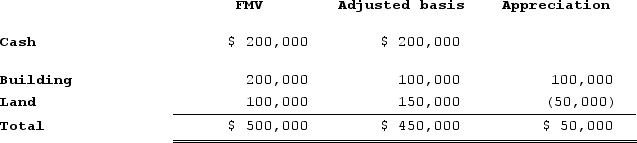 Under the terms of the agreement, Mike will receive the $200,000 cash in exchange for his 40 percent interest in Pennsylvania. Mike's tax basis in his Pennsylvania stock is $50,000. Michelle will receive the building and land in exchange for her 60 percent interest in Pennsylvania. Her tax basis in the Pennsylvania stock is $100,000.
What amount of gain or loss does Michelle recognize in the complete liquidation, and what is her tax basis in the building and land after the complete liquidation?
Under the terms of the agreement, Mike will receive the $200,000 cash in exchange for his 40 percent interest in Pennsylvania. Mike's tax basis in his Pennsylvania stock is $50,000. Michelle will receive the building and land in exchange for her 60 percent interest in Pennsylvania. Her tax basis in the Pennsylvania stock is $100,000.
What amount of gain or loss does Michelle recognize in the complete liquidation, and what is her tax basis in the building and land after the complete liquidation? (Essay)
4.8/5 (74)
(74) Don and Marie formed Paper Lilies Corporation on January 2. Don contributed cash of $400,000 in return for 50 percent of the corporation's stock. Marie contributed a building and land with the following fair market values and tax-adjusted bases in return for 50 percent of the corporation's stock.
 To equalize the exchange, Paper Lilies Corporation paid Marie $50,000 in addition to her stock.
a. What amount of gain or loss does Marie realize on the formation of the corporation?
b. What amount of gain or loss, if any, does she recognize?
c. What is Marie's tax basis in the stock she receives in return for her contribution of property to the corporation?
d. What adjusted basis does Paper Lilies Corporation take in the land and building received from Marie?
To equalize the exchange, Paper Lilies Corporation paid Marie $50,000 in addition to her stock.
a. What amount of gain or loss does Marie realize on the formation of the corporation?
b. What amount of gain or loss, if any, does she recognize?
c. What is Marie's tax basis in the stock she receives in return for her contribution of property to the corporation?
d. What adjusted basis does Paper Lilies Corporation take in the land and building received from Marie? (Essay)
5.0/5 (72)
(72) Jasmine transferred 100 percent of her stock in Woodward Company to Jefferson Corporation in a Type A merger. In exchange, she received stock in Jefferson with a fair market value of $600,000 plus $400,000 in cash. Jasmine's tax basis in the Woodward stock was $1,500,000. What amount of loss does Jasmine recognize in the exchange and what is her basis in the Jefferson stock she receives?
(Multiple Choice)
4.8/5 (78)
(78) Jalen transferred his 10 percent interest to Wolverine Company as part of a complete liquidation of the company. In the exchange, he received land with a fair market value of $100,000. Jalen's basis in the Wolverine stock was $50,000. The land had a basis to Wolverine Company of $80,000. What amount of gain does Jalen recognize in the exchange and what is his basis in the land he receives?
(Multiple Choice)
4.9/5 (76)
(76) The tax basis of property received by a non-corporate shareholder in a complete liquidation will be the property's fair market value.
(True/False)
4.7/5 (78)
(78) Inez transfers property with a tax basis of $200 and a fair market value of $300 to a corporation in exchange for stock with a fair market value of $250 in a transaction that qualifies for deferral under §351. The corporation assumed a liability of $50 on the property transferred. What is the corporation's tax basis in the property received in the exchange?
(Multiple Choice)
4.9/5 (81)
(81) 
Filters
- Essay(0)
- Multiple Choice(0)
- Short Answer(0)
- True False(0)
- Matching(0)