



 Chat with AI
Exam 8: Corporate Formation, Reorganization, and Liquidation

Exam 1: Business Income, Deductions, and Accounting Methods105 Questions
Exam 2: Property Acquisition and Cost Recovery86 Questions
Exam 3: Property Dispositions111 Questions
Exam 4: Business Entities Overview81 Questions
Exam 5: Corporate Operations114 Questions
Exam 6: Accounting for Income Taxes106 Questions
Exam 7: Corporate Taxation: Non-Liquidating Distributions101 Questions
Exam 8: Corporate Formation, Reorganization, and Liquidation108 Questions
Exam 9: Forming and Operating Partnerships114 Questions
Exam 10: Dispositions of Partnership Interests and Partnership Distributions94 Questions
Exam 11: S Corporations132 Questions
Exam 12: State and Local Taxes114 Questions
Exam 13: The Us Taxation of Multinational Transactions88 Questions
Exam 14: Transfer Taxes and Wealth Planning114 Questions
Select questions type


The shareholders in the target corporation always receive a tax basis in the stock received from the acquirer equal to the stock's fair market value.
(True/False)
4.8/5  (86)
(86) Which of the following amounts is not included in the computation of a property's adjusted basis in an exchange?
(Multiple Choice)
4.9/5 (89)
(89) Roberta transfers property with a tax basis of $435 and a fair market value of $559 to a corporation in exchange for stock with a fair market value of $372 in a transaction that qualifies for deferral under section 351. The corporation assumed a liability of $187 on the property transferred. What is the amount realized by Roberta in the exchange?
(Multiple Choice)
4.9/5 (79)
(79) Mandel transferred property to his new corporation in a §351 transaction. Among the several properties transferred by Mandel was land with a fair market value of $200,000 and a tax basis of $250,000. In all cases, the corporation will always take a tax basis in the land of $200,000 to prevent the "built-in loss" from being transferred from Mandel to the corporation.
(True/False)
4.9/5 (79)
(79) Casey transfers property with a tax basis of $2,000 and a fair market value of $5,000 to a corporation in exchange for stock with a fair market value of $4,000 and $400 in cash in a transaction that qualifies for deferral under section 351. The corporation assumed a liability of $600 on the property transferred. Casey also incurred selling expenses of $300. What is the amount realized by Casey in the exchange?
(Multiple Choice)
4.7/5 (71)
(71) Which of the following statements best describes the application of the continuity of enterprise principle to a Type A tax-deferred reorganization?
(Multiple Choice)
4.8/5 (76)
(76) Simone transferred 100 percent of her stock in Purple Company to Plum Corporation in a Type A merger. In exchange, she received stock in Plum with a fair market value of $532,500 plus $532,500 in cash. Simone's tax basis in the Purple stock was $287,000. What amount of gain does Simone recognize in the exchange and what is her basis in the Plum stock she receives?
(Multiple Choice)
4.8/5 (76)
(76) Which of the following statements does not describe a requirement that must be met in a tax-deferred reverse triangular merger?
(Multiple Choice)
4.9/5 (93)
(93) Which of the following statements does not describe a requirement that must be met in a tax-deferred forward triangular merger?
(Multiple Choice)
4.8/5 (85)
(85) Which of the following statements about §351 transactions is false?
(Multiple Choice)
4.9/5 (70)
(70) Packard Corporation transferred its 100 percent interest to State Company as part of a complete liquidation of the company. In the exchange, Packard received land with a fair market value of $427,500. Packard's basis in the State stock was $625,000. The land had a basis to State Company of $535,000. What amount of loss does State recognize in the exchange and what is Packard's basis in the land it receives?
(Multiple Choice)
4.9/5 (92)
(92) Juan transferred 100 percent of his stock in Rosa Company to Azul Corporation in a Type B stock-for-stock exchange. In exchange, he received stock in Azul with a fair market value of $1,000,000. Juan's tax basis in the Rosa stock was $400,000. What amount of gain does Juan recognize in the exchange and what is his basis in the Azul stock he receives?
(Multiple Choice)
4.8/5 (68)
(68) Which of the following statements best describes the concept of control as it applies to a §351 transaction?
(Multiple Choice)
4.8/5 (78)
(78) Boston, Incorporated made a capital contribution of investment property to its 100 percent-owned subsidiary, Hartford Company. The investment property had a fair market value of $1,000,000 and a tax basis to Boston of $250,000. What are the tax consequences to Boston, Incorporated on the contribution of the investment property to Hartford Company and what is the tax basis of the investment property to Hartford Company after the contribution to capital?
(Essay)
4.9/5 (79)
(79) A liquidation of a corporation always is a taxable event for thenon-corporate shareholder(s) of the liquidated corporation.
(True/False)
4.9/5 (68)
(68) Which of the following classes of stock is not allowed to be used in a §351 transaction?
(Multiple Choice)
4.8/5 (83)
(83) Paladin Corporation transferred its 90 percent interest to Furman Company as part of a complete liquidation of the company. In the exchange, Paladin received land with a fair market value of $1,000,000. The corporation's basis in the Furman Company stock was $400,000. The land had a basis to Furman Company of $200,000. What amount of gain does Paladin recognize in the exchange and what is its basis in the land it receives?
(Multiple Choice)
4.8/5 (79)
(79) Carlos transfers property with a tax basis of $500 and a fair market value of $800 to a corporation in exchange for stock with a fair market value of $650 and $50 in cash in a transaction that qualifies for deferral under section 351. The corporation assumed a liability of $100 on the property transferred. What is the corporation's tax basis in the property received in the exchange?
(Multiple Choice)
4.7/5 (92)
(92) Jamie transferred 100 percent of her stock in Fox Company to Otter Corporation in a Type A merger. In exchange, she received stock in Otter with a fair market value of $400,000 plus $600,000 in cash. Jamie's tax basis in the Fox stock was $600,000. What amount of gain does Jamie recognize in the exchange and what is her basis in the Otter stock she receives?
(Multiple Choice)
4.7/5 (73)
(73) Oriole,Incorporated decided to liquidate its wholly owned subsidiary, Tiger Corporation. Tiger had the following tax accounting balance sheet.
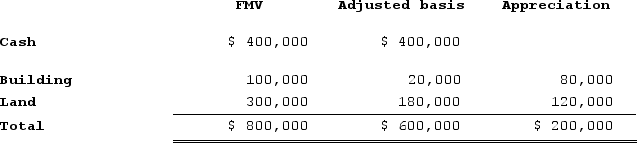 a. What amount of gain or loss does Tiger recognize in the complete liquidation?
b. What amount of gain or loss does Oriole recognize in the complete liquidation?
c. What is Oriole's tax basis in the building and land after the complete liquidation?
a. What amount of gain or loss does Tiger recognize in the complete liquidation?
b. What amount of gain or loss does Oriole recognize in the complete liquidation?
c. What is Oriole's tax basis in the building and land after the complete liquidation? (Essay)
4.9/5 (100)
(100) 
Filters
- Essay(0)
- Multiple Choice(0)
- Short Answer(0)
- True False(0)
- Matching(0)